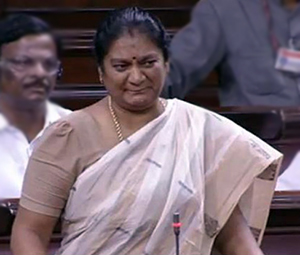
RS MP Sasikala Pushpa expelled from AIADMK

August 1, 2016

pushpaChennai, Aug 1: Days after she reportedly got into a scuffle with a DMK MP at Delhi airport, Rajya Sabha MP M Sasikala Pushpa was today expelled from the AIADMK by party supremo Jayalalithaa for "bringing disrepute to the party".

In a brief statement, Jayalalithaa said that Pushpa was being expelled from all party posts, including primary membership, as she had acted in violation of the party principles and ethics.

"Her behaviour has brought great disrepute to the party," she said.
Jayalalithaa asked party supporters not to have any truck henceforth with the Thoothukudi based Rajya Sabha MP.

Last week, Pushpa had reportedly got into a scuffle with her Rajya Sabha colleague from DMK Tiruchi Siva at Delhi airport.

Comments

Ahmed Bava
 - 
Monday, 1 Aug 2016

Dear PM Modi and his BJP Learn something from Jayalalitha.

Add new comment

  • Coastaldigest.com reserves the right to delete or block any comments.
  • Coastaldigset.com is not responsible for its readers’ comments.
  • Comments that are abusive, incendiary or irrelevant are strictly prohibited.
  • Please use a genuine email ID and provide your name to avoid reject.
News Network
April 23,2020

Washington, Apr 23: Air pollution over northern India has plummeted to a 20-year-low for this time of the year, according to satellite data published by US space agency National Aeronautics and Space Administration (NASA).
The US space agency's satellite sensors observed aerosol levels at a 20-year low post the countrywide lockdown, implemented to slow the spread of the novel coronavirus.

"We knew we would see changes in atmospheric composition in many places during the lockdown," said Pawan Gupta, a Universities Space Research Association (USRA) scientist at NASA''s Marshall Space Flight Center. "But I have never seen aerosol values so low in the Indo-Gangetic Plain at this time of year," added Mr Gupta.

Acting Assistant Secretary of State for South and Central Asia Alice G Wells tweeted, "These images from NASA were taken each spring starting in 2016 and show a 20-year low in airborne particle levels over India. When India and the world are ready to work and travel again, let's not forget that collaborative action can result in cleaner air."

The data published with maps show aerosol optical depth (AOD) in 2020 compared to the average for 2016-2019. Aerosol optical depth is a measure of how light is absorbed or reflected by airborne particles as it travels through the atmosphere.

If aerosols are concentrated near the surface, an optical depth of 1 or above indicates very hazy conditions. An optical depth, or thickness, of less than 0.1 over the entire atmospheric vertical column is considered "clean." The data were retrieved by the Moderate Resolution Imaging Spectroradiometer (MODIS) on NASA's Terra satellite.

In the first few days of the lockdown, it was difficult to observe a change in the pollution signature. "We saw an aerosol decrease in the first week of the shutdown, but that was due to a combination of rain and the lockdown," said Mr Gupta.

Around March 27, heavy rain poured over vast areas of northern India and helped clear the air of aerosols. Aerosol concentrations usually increase again after such heavy precipitation.

"After the rainfall, I was really impressed that aerosol levels did not go up and return to normal. We saw a gradual decrease and things have been staying at the level we might expect without anthropogenic emissions," Mr Gupta said.

On March 25, the Indian government placed its 1.3 billion citizens under a strict lockdown to reduce the spread of COVID-19. The countrywide mandate decreased activity at factories and severely reduced car, bus, truck and airplane traffic. Every year, aerosols from anthropogenic (human-made) sources contribute to unhealthy levels of air pollution in many Indian cities.

Aerosols are tiny solid and liquid particles suspended in the air that reduce visibility and can damage the human lungs and heart.

In southern India though, the story is a little hazier. Satellite data show aerosol levels have not yet decreased to the same extent. In fact, levels seem to be slightly higher than in the past four years. The reasons are unclear but could be related to recent weather patterns, agricultural fires, winds or other factors.

"This a model scientific experiment," Robert Levy, program leader for NASA's MODIS aerosol products, said about the lockdown and its effects on pollution.

"We have a unique opportunity to learn how the atmosphere reacts to sharp and sudden reductions in emissions from certain sectors. This can help us separate how natural and human sources of aerosols affect the atmosphere," Mr Levy added.

Comments

Add new comment

  • Coastaldigest.com reserves the right to delete or block any comments.
  • Coastaldigset.com is not responsible for its readers’ comments.
  • Comments that are abusive, incendiary or irrelevant are strictly prohibited.
  • Please use a genuine email ID and provide your name to avoid reject.
News Network
January 30,2020

New Delhi, Jan 30: Tension spiralled in Jamia Nagar on Thursday after a man fired a pistol at a group of anti-CAA protesters, injuring a Jamia Millia Islamia student before walking away while waving the firearm above his head and shouting "Yeh lo aazadi" amid heavy police presence in the area.

Massive protests erupted in the area after the incident with hundreds of agitated people gathering near the university, breaking barricades and clashing with police personnel.

The man, who identified himself as "Rambhakt Gopal", was subsequently overpowered by police and detained. He was taken into custody and was being interrogated, police said.

The entire drama, which triggered panic in the area, was captured by television cameras that showed the man in light coloured pants and a dark jacket, walking away on an empty road barricaded by police, turning around and shouting at the protesters in Hindi, "Here, take this freedom."

The gunman went live on Facebook before the brandishing the gun. Police said they were verifying whether it is his real name.

Before the attack, the man also put out messages on Facebook stating "Shaheen Bhag Khel Khatam" (Run Shaheen, the game is over). Another message stated, "Please wrap me in saffron in my last journey with slogans of Jai Shri Ram". His Facebook profile was deleted after screenshots of his posts were circulated widely on social media platforms.

Several students recapped how their peaceful march on Gandhi's death anniversary became violent.

"We were moving towards the Holy Family Hospital where the police had raised barricades. Suddenly, a gun-wielding man came out and opened fire. One bullet hit my friend's hand," Aamna Asif, a student of economics at the university, told PTI.

She said her friend, Shadab Farooq, a mass communication student, was trying to calm the attacker but he shot at him injuring his left hand.

Farooq, who belongs to Kashmir, was taken to the AIIMS Trauma Centre.

Ragibh Naushad, an LLB student at the university, said, "The Jamia Coordination Committee organised a march to pay homage to Gandhi ji on his death anniversary. It started at 12 noon from Gate number 7, but police denied the permission and stopped the march near the Holy Family hospital.

"A man named Gopal, came there and started brandishing a weapon and later shot a round. He was also chanting pro-CAA slogans."

The incident led to panic in the area.

Khalid Hassan, a JMI alumnus, said initially many were not sure whether it was a gunshot or a tyre burst.

There was heavy police and media presence when the incident took place.

The students were heading from Jamia to Mahatma Gandhi's memorial Rajghat. The march was stopped at the Holy Family Hospital near the university.

Chinmoy Biswal, DCP (southeast), said the students wanted to take out a march from Jamia to Rajghat but were denied permission.

"They were being repeatedly told that the protest should be carried out peacefully. We had barricaded the road just before the Holy Family hospital. Meanwhile, a person was seen in the crowd who waved something which appeared to be a weapon."

"We have detained him and are interrogating him. One person has also been injured," Biswal said.

Comments

Add new comment

  • Coastaldigest.com reserves the right to delete or block any comments.
  • Coastaldigset.com is not responsible for its readers’ comments.
  • Comments that are abusive, incendiary or irrelevant are strictly prohibited.
  • Please use a genuine email ID and provide your name to avoid reject.
Agencies
August 3,2020

The Drugs Controller General of India (DCGI) has given nod to the Serum Institute of India (SII) for conducting phase 2 and 3 human clinical trials of the Oxford University developed Covid-19 vaccine candidate in the country.

Government officials said that the approval for conducting phase 2 and 3 clinical trials by the SII was granted by DCGI Dr V G Somani late Sunday night after a thorough evaluation based on the recommendations of the Subject Expert Committee (SEC) on Covid-19.

"The firm has to submit safety data, evaluated by the Data Safety Monitoring Board (DSMB), to the CDSCO before proceeding to phase 3 clinical trials," a senior official said.

"As per the study design, each subject will be administered two doses four weeks apart (first dose on day one and second dose on day 29) following which the safety and immunogenicity will be assessed at predefined intervals," the official said.

As a rapid regulatory response, the expert panel at the Central Drugs Standard Control Organisation (CDSCO) on Friday, after a detailed deliberation and considering the data generated on the vaccine candidate in phase 1 and 2 of the Oxford University trial, had recommended granting permission for phase 2 and 3 clinical trials of the potential vaccine, 'Covishield', on healthy adults in India,  the officials said.

Currently, phase 2 and 3 clinical trials of the Oxford vaccine candidate is going on in the United Kingdom, phase 3 clinical trial in Brazil and phase 1 and 2 clinical trials in South Africa.

The officials said that the SII had submitted a revised proposal on Wednesday after the SEC on July 28, following deliberation over its application, had asked it to revise its protocol for the phase 2 and 3 clinical trials besides seeking some additional information.

The panel had also recommended that the clinical trial sites which have been proposed for the study be distributed across India.

According to the revised proposal by the SII, 1,600 people aged above 18 years will participate in the trials across 17 selected sites, including AIIMS-Delhi, B J Medical College in Pune, Rajendra Memorial Research Institute of Medical Sciences (RMRIMS) in Patna, Post Graduate Institute of Medical Education and Research in Chandigarh, AIIMS-Jodhpur, Nehru Hospital in Gorakhpur, Andhra Medical College in Visakhapatnam and JSS Academy of Higher Education and Research in Mysore.

"According to the application, it would conduct an observer-blind, randomised controlled study to determine the safety and immunogenicity of 'Covishield' on healthy Indian adults," the official said.

The SII, which has partnered with AstraZeneca, for manufacturing the Oxford vaccine candidate for Covid-19 had submitted its first application to the DCGI on July 25 seeking permission for conducting the phase 2 and 3 trials of the potential vaccine. 

Initial results of the first two-phases of trials of the vaccine conducted in five trial sites in the UK showed that it has an acceptable safety profile and homologous boosting increased antibody response, sources had said.

To introduce the vaccine, SII, the world's largest vaccine maker by number of doses produced and sold, has signed an agreement to manufacture the potential vaccine developed by the Jenner Institute (Oxford University) in collaboration with British-Swedish pharma company AstraZeneca. 

Comments

Add new comment

  • Coastaldigest.com reserves the right to delete or block any comments.
  • Coastaldigset.com is not responsible for its readers’ comments.
  • Comments that are abusive, incendiary or irrelevant are strictly prohibited.
  • Please use a genuine email ID and provide your name to avoid reject.