RSS triggers row by questioning legend behind Onam

September 11, 2016

Thiruvananthapuram, Sep 11: As Keralites gear up to celebrate Onam, RSS has triggered a controversy by questioning the legend behind the festival, arguing that it marks the celebration of birth of 'Vamana' (incarnation of Lord Vishnu) and not the homecoming of demon king Mahabali.onam-celebrations

An article published in the Onam special edition of RSS mouthpiece 'Kesari' claimed there was no reference in any mythological scriptures which supports the popular and widely circulated legend that Vamana' had sent Mahabali to the netherworld through deceit and the king visits the land annually to meet his subjects.

Countering the argument, senior CPI(M) leader and state Health Minister K K Shylaja said Onam was celebrated by all irrespective of caste, creed and religion and the attempt of the RSS was to bring back the bygone "upper class hegemony".

It was also a part of RSS's agenda to "hijack the festival", the minister alleged. According to the popular belief in the state, Mahabali's homecoming in the Malayalam month of Chingam to see his subjects is celebrated as 'Thiru Onam' annually, which falls on September 14 this year.

However, the article written by K Unnikrishnan Namboothiri in the RSS magazine argued that Onam was originally celebrated as the birthday of Vamana and not a festivity to mark the homecoming of the demon king.

"There is no such reference or explanation anywhere in mythology or epics to support the story that Mahabali was pushed to the netherworld by Vamana and he visits the land every year to meet his subjects. Then, how did such a false story become prevalent in Kerala?" the article stated.

The write-up claimed that Lord Vishnu had actually "blessed" the demon king and not "punished" him by pushing into 'pathala' (netherworld).

"There is no indication in spiritual texts like 'Bhagavatham' or 'Narayaneeyam' or such other authentic books that Bali was pushed to the netherworld. Instead, such texts say that the noble king had emerged victorious in the trial by Vamana and he was blessed by the God," it said.

The writer also criticised the general picturisation of Mahabali as a man with moustache, potbelly and wearing an 'olakkuda' (traditional palm leaf umbrella).

"It is an attempt by some vested interest to distort the mythical stories and paint in poor light the characters of Hindu Puranas," the writer said, adding that such attempts to destroy Hinduism should be checked.

According to mythology, Onam is connected with Asura' (demon) king Mahabali, under whose reign everyone lived in happiness and equality.

Envious by his popularity, Devas' (Gods) sought the help of Lord Vishnu to get him banished into the netherworld.

But before going down, Mahabali secured a boon from Lord Vishnu to visit his subjects every year on the 'Thiru Onam' day.

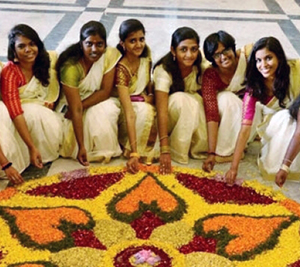
The demon king's annual visit is celebrated by Keralites, who lay by their front yards with floral carpets, wear new clothes and prepare a sumptuous feast.

Comments

ali
 - 
Tuesday, 13 Sep 2016

If hindu can follow valmiki (thief)script as holy book, they can trust anything. There is no surprise in onam.

Most of hindu gods looks like demon, what is wrong in worshiping demon king.

Satyameva jayate
 - 
Tuesday, 13 Sep 2016

Another few RSS workers may die soon....ha haa....that is kerala

True indian
 - 
Sunday, 11 Sep 2016

Correction. It's vishnus avatar. Too many gods. Thats why got confused.

True indian
 - 
Sunday, 11 Sep 2016

These rss donno that Fish is shivas avatar. Fish is more holier than cow.
But these people have problem with beef slaughtering which is zero pain in proper halal method.

And fish which die painfully when it comes out of the water.

Add new comment

  • Coastaldigest.com reserves the right to delete or block any comments.
  • Coastaldigset.com is not responsible for its readers’ comments.
  • Comments that are abusive, incendiary or irrelevant are strictly prohibited.
  • Please use a genuine email ID and provide your name to avoid reject.
News Network
April 19,2020

Bengaluru, Apr 19: Former Karnataka Chief Minister H D Kumaraswamy on Sunday thanked Chief Minister B S Yediyurappa for backing his family regarding his son Nikhil s wedding, which drew flak for allegedly violating lockdown norms.

Asserting that social distancing was maintained during the wedding, the JD(S) leader in a series of tweets hit out at those accusing his family of violating lockdown norms, by stating that they were doing it out of "political hate".

"Despite maintaining social distancing and following rules during Nikhil's marriage, there are discussion that norms were not followed.

Because of political hate, poisonous comments are being made about an auspicious event, but Chief Minister B S Yediyurappa by rejecting all this is standing by the truth," Kumaraswamy said in a tweet in Kannada.

He said, "heartfelt thanks to Yediyurappa for his statement that a big political family in the state has conducted the marriage ceremony in a simple way."

Nikhil, the grandson of former prime minister H D Deve Gowda, entered wedlock on Friday at a Bidadi farmhouse with Revathi, the grandniece of former Congress minister M Krishnappa.

On the day of the marriage several posts on social media, also media reports had criticised the Gowda family for violating locdown norms and social distancing during the event.

Coming to the defence of Gowda family, Yediyurappa in response to a question on Saturday told reporters "They (family) had all the permissions and the event was held in a simple fashion. There's no need to discuss this.

"Despite having many relatives, they stuck to the limitations. For this, I congratulate them," he had said.

Stating that lockdown rules were followed during Nikhil's marriage, Kumaraswamy said, "By looking for politics in Nikhil's marriage, certain faulty minds on social media are spewing venom that is in their mind."

Gowda family had scaled down Nikhil's wedding, which was earlier planned in a 95-acre land near Ramanagara with a lavish set, with lakhs of party workers and well-wishers in attendance, followed by a grand reception in Bengaluru.

Nikhil has acted in couple of Kannada films in the lead role.

He had contested the 2019 Lok Sabha polls from the party bastion of Mandya and had lost against multilingual actress Sumalatha Ambareesh, an independent candidate supported by BJP, in a bitterly contested polls.

Comments

Add new comment

  • Coastaldigest.com reserves the right to delete or block any comments.
  • Coastaldigset.com is not responsible for its readers’ comments.
  • Comments that are abusive, incendiary or irrelevant are strictly prohibited.
  • Please use a genuine email ID and provide your name to avoid reject.
News Network
January 15,2020

Bengaluru, Jan 15: Srishti Institute of Art, Design and Technology in Bengaluru has decided to remain shut for two days after a group of BJP workers wiped out graffiti on its outer walls claiming it as anti-Modi and allegedly warned them against any anti CAA agitation there.

According to sources, the group led by Yelahanka MLA S R Vishwanath allegedly even towed away some vehicles of students and faculty parked in front of the institute alleging that they were blocking the road and causing inconvenience to the local people.

Some students have alleged that they were threatened by BJP workers and also the institute's authorities regarding the graffiti and the blocking of the road using traffic police.

They even claimed that BJP workers warned them against organising any anti-NRC or CAA protests.

A few local residents are also said to have joined the BJP workers and raised complaints about the conduct of the institute's students.

According to local BJP workers, the MLA and a few party men had gone near the institute on receiving complaints from locals about vehicles parked there blocking the road, and when they came across the graffiti they painted it with saffron paint to avoid any controversy, and there was no altercation as being alleged.

However, there is no clarity on who drew the graffiti regarding Modi, which according to BJP workers allegedly depicted the PM in poor light.

The institute has declared holiday on Thursday and Friday to avoid any further escalation, keeping the interest and safety of students in mind, sources said.

Interestingly, on Tuesday graffiti had appeared overnight on the shutters of some shops and walls on the Church Street against Modi, CAA and NRC, following which the city police have launched an investigation.

Comments

Add new comment

  • Coastaldigest.com reserves the right to delete or block any comments.
  • Coastaldigset.com is not responsible for its readers’ comments.
  • Comments that are abusive, incendiary or irrelevant are strictly prohibited.
  • Please use a genuine email ID and provide your name to avoid reject.
Ram Puniyani
February 10,2020

Noam Chomsky is one of the leading peace workers in the world. In the wake of America’s attack on Vietnam, he brought out his classic formulation, ‘manufacturing consent’. The phrase explains the state manipulating public opinion to have the public approve of it policies—in this case, the attack of the American state on Vietnam, which was then struggling to free itself from French colonial rule.

In India, we are witness to manufactured hate against religious minorities. This hatred serves to enhance polarisation in society, which undermines India’s democracy and Constitution and promotes support for a Hindu nation. Hate is being manufactured through multiple mechanisms. For example, it manifests in violence against religious minorities. Some recent ghastly expressions of this manufactured hate was the massive communal violence witnessed in Mumbai (1992-93), Gujarat (2002), Kandhamal (2008) and Muzaffarnagar (2013). Its other manifestation was in the form of lynching of those accused of having killed a cow or consumed beef. A parallel phenomenon is the brutal flogging, often to death, of Dalits who deal with animal carcasses or leather.

Yet another form of this was seen when Shambhulal Regar, indoctrinated by the propaganda of Hindu nationalists, burned alive Afrazul Khan and shot the video of the heinous act. For his brutality, he was praised by many. Regar was incited into the act by the propaganda around love jihad. Lately, we have the same phenomenon of manufactured hate taking on even more dastardly proportions as youth related to Hindu nationalist organisations have been caught using pistols, while police authorities look on.

Anurag Thakur, a BJP minster in the central government recently incited a crowd in Delhi to complete his chant of what should happen to ‘traitors of the country...” with a “they should be shot”. Just two days later, a youth brought a pistol to the site of a protest at Jamia Millia Islamia university and shouted “take Azaadi!” and fired it. One bullet hit a student of Jamia. This happened on 30 January, the day Nathuram Godse had shot Mahatma Gandhi in 1948. A few days later, another youth fired near the site of protests against the CAA and NRC at Shaheen Bagh. Soon after, he said that in India, “only Hindus will rule”.

What is very obvious is that the shootings by those associated with Hindu nationalist organisations are the culmination of a long campaign of spreading hate against religious minorities in India in general and against Muslims in particular. The present phase is the outcome of a long and sustained hate campaign, the beginning of which lies in nationalism in the name of religion; Muslim nationalism and Hindu nationalism. This sectarian nationalism picked up the communal view of history and the communal historiography which the British introduced in order to pursue their ‘divide and rule’ policy.

In India what became part of “social common sense” was that Muslim kings had destroyed Hindu temples, that Islam was spread by force, and that it is a foreign religion, and so on. Campaigns, such as the one for a temple dedicated to the Hindu god Rama to be built at the site where the Babri masjid once stood, further deepened the idea of a Muslim as a “temple-destroyer”. Aurangzeb, Tipu Sultan and other Muslim kings were tarnished as the ones who spread Islam by force in the subcontinent. The tragic Partition, which was primarily due to British policies, and was well-supported by communal streams also, was entirely attributed to Muslims. The Kashmir conflict, which is the outcome of regional, ethnic and other historical issues, coupled with the American policy of supporting Pakistan’s ambitions of regional hegemony, (which also fostered the birth of Al-Qaeda), was also attributed to the Muslims.

With recurring incidents of communal violence, these falsehoods went on going deeper into the social thinking. Violence itself led to ghettoisation of Muslims and further broke inter-community social bonds. On the one hand, a ghettoised community is cut off from others and on the other hand the victims come to be presented as culprits. The percolation of this hate through word-of-mouth propaganda, media and re-writing of school curricula, had a strong impact on social attitudes towards the minorities.

In the last couple of decades, the process of manufacturing hate has been intensified by the social media platforms which are being cleverly used by the communal forces. Swati Chaturvedi’s book, I Am a Troll: Inside the Secret World of the BJP’s Digital Army, tells us how the BJP used social media to spread hate. Whatapp University became the source of understanding for large sections of society and hate for the ‘Other’, went up by leaps and bounds. To add on to this process, the phenomenon of fake news was shrewdly deployed to intensify divisiveness.

Currently, the Shaheen Bagh movement is a big uniting force for the country; but it is being demonised as a gathering of ‘anti-nationals’. Another BJP leader has said that these protesters will indulge in crimes like rape. This has intensified the prevalent hate.

While there is a general dominance of hate, the likes of Shambhulal Regar and the Jamia shooter do get taken in by the incitement and act out the violence that is constantly hinted at. The deeper issue involved is the prevalence of hate, misconceptions and biases, which have become the part of social thinking.

These misconceptions are undoing the amity between different religious communities which was built during the freedom movement. They are undoing the fraternity which emerged with the process of India as a nation in the making. The processes which brought these communities together broadly drew from Gandhi, Bhagat Singh and Ambedkar. It is these values which need to be rooted again in the society. The communal forces have resorted to false propaganda against the minorities, and that needs to be undone with sincerity.

Combating those foundational misconceptions which create hatred is a massive task which needs to be taken up by the social organisations and political parties which have faith in the Indian Constitution and values of freedom movement. It needs to be done right away as a priority issue in with a focus on cultivating Indian fraternity yet again.


Comments

Add new comment

  • Coastaldigest.com reserves the right to delete or block any comments.
  • Coastaldigset.com is not responsible for its readers’ comments.
  • Comments that are abusive, incendiary or irrelevant are strictly prohibited.
  • Please use a genuine email ID and provide your name to avoid reject.