Bengaluru, May 31: Karnataka government on Sunday issued guidelines, which will come into force from June 1 and continue till June 30.
According to the new guidelines, religious places and places of worship for the public, hotels, restaurants and other hospitality services, and shopping malls will be permitted to open from June 8.
Union Ministry of Home Affairs (MHA) on Saturday announced new guidelines for phased re-opening of "all activities outside containment zones for the next one month beginning June 1.
In an order, Karnataka government said that phased re-opening of areas outside the containment zones, all activities will be permitted, except the following, which will be allowed, with the stipulation of following Standard Operating Procedures (SOPs) to be prescribed by the Ministry of Health and Family Welfare (MoHFW).
PHASE I
The activities will be allowed with effect from June 8 at religious places/places of worship for public, hotels, restaurants, and other hospitality services, shopping malls.
PHASE II
For the opening of schools, colleges, educational/training/ coaching institutions, the State government will hold consultations at the institution level with parents and other stakeholders. Based on the feedback, a decision on the re-opening of these institutions will be taken in the month of July.
PHASE III
Based on the assessment of the situation, dates for re-starting activities will be decided -- international air travel of passengers, except as permitted by MHA, Metro Rail, cinema halls, gymnasiums, swimming pools, entertainment parks, theatres, bars and auditoriums, assembly halls and similar places, social/political/spoils/ entertainment/academic/cultural/religious functions and other large congregations.
The State government said that it will follow the MHA's national directives for the coronavirus management, including compulsory use of face masks and social distancing norms.
"Face coverings are compulsory in public places, workplaces and during transport. Individuals must maintain a minimum distance of 6 feet in public places. Shops will ensure physical distancing among customers and will not allow more than 5 persons at a time," read the directives issued by the MHA.
In the order, State government has said that night curfew will continue to remain in force on the movement of individuals for all non-essential activities outside containment zones till June 30.
Lockdown limited to Containment Zones
* Lockdown shall continue to remain in force in the Containment Zones till June 30.
* Containment Zones will be demarcated by the district authorities after taking into consideration the guidelines of Department of Health and Family Welfare, Government of Karnataka.
* In the Containment Zones, only essential activities shall be allowed. There shall be strict perimeter control to ensure that there is no movement of people in or out of these zones, except for medical emergencies and for maintaining a supply of essential goods and services.
* In the Containment Zones, there shall be intensive contact tracing, house-to-house surveillance, and other clinical interventions, as required. Guidelines of the Department of Health and Family Welfare, Government of Karnataka shall be taken into consideration for the above purpose.
* District authorities/BBMP authorities may also identify buffer zones outside the Containment Zones, where new cases are more likely to occur. Within the buffer zones, restrictions, as considered necessary, may be put in place by the District authorities.
Movement of persons, goods
* There shall be no restriction on inter-State and intra-State movement of persons and goods. No separate permission/approval/e-permit will be required for such movements.
* Based on reasons of public health and assessment of the prevalence of Covid-19 in various States separate orders will be issued by the Health and Family Welfare Department regarding the inter-state movement of persons to Karnataka.
* Movement by passenger trains and Shramik special trains; domestic passenger air travel; movement of Indian Nationals stranded outside the country and of specified persons to travel abroad; evacuation of foreign nationals; and sign-on and sign-off of Indian seafarers will continue to be regulated as per SOPs issued.
The State Government in its guidelines advised persons above 65 years of age, persons with co-morbidities, pregnant women, and children below the age of 10 years, to stay at home, except for essential and health purposes.
Guidelines for Aarogya Setu App
* Aarogya Setu enables early identification of potential risk of infection, and thus acts as a shield for individuals and the community.
* With a view to ensuring safety in offices and workplaces, employers on best effort basis should ensure that Aarogya Sew is installed by all employees having compatible mobile phones.
* District authorities and BBMP Authorities may advise individuals to install the Aarogya Setu application on compatible mobile phones and regularly update their health status on the app. This will facilitate timely provision of medical attention to those individuals who are at risk.
Union Ministry of Home Affairs (MHA) on Saturday said that lockdown will continue in containment zones till June 30 and only essential activities will be allowed in those areas.
"Lockdown shall continue to remain in force in the containment zones till 30 June. In the containment zones, only essential activities shall be allowed. There shall be strict perimeter control to ensure that there is no movement of people in or out of these zones, except for medical emergencies and for maintaining the supply of essential goods and services. In the containment zones, there shall be intensive contact tracing, house-to-house surveillance, and other clinical interventions, as required," MHA said in its guidelines for #Unlock1.
It also issued new guidelines for phased re-opening of "all activities outside containment zones for the next one month beginning June 1."



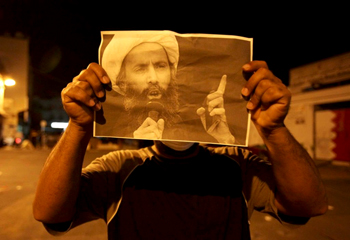 The killing of Sheikh Nimr al-Nimr may spark new unrest among Saudi Arabia's Shiite minority, largely concentrated in the kingdom's east, and in Bahrain, which has seen low-level violence since 2011 protests by its Shiite majority demanding greater rights from its Sunni monarchy.
Comments
Killing of Shaik Al-Nimr is the Biggest mistake by Saudi. This will change whole political scenario of the Gulf.
Another demonstration of the religion of Peace as practised by the people who invented it. Looked like pretty soon the KSA will be engulfed in terrorism. And innocent bystanders will be needlessly killed.
this incident was happened in 2011 it took 5 years to take final decision . if it is in India it would take more than 10 years, and one thing you have to remember is terrorist doesnt have a religion...
We should be thankful that we are in India and have a democratic set up,unlike most of the middle east kingdoms where at the behest of the ruling family any body can be executed fearing rebellion.
Add new comment