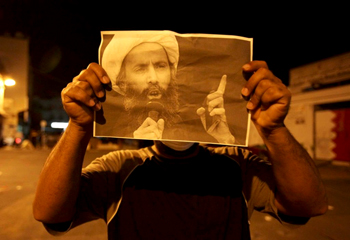
Saudi Arabia executes 47 terror convicts, including Shiite cleric

January 2, 2016

Riyadh, Jan 2: Saudi Arabia executed 47 prisoners convicted of terrorism charges today, including a Shiite cleric who was a central figure in 2011 Arab Spring-inspired protests in the kingdom.

terroristThe killing of Sheikh Nimr al-Nimr may spark new unrest among Saudi Arabia's Shiite minority, largely concentrated in the kingdom's east, and in Bahrain, which has seen low-level violence since 2011 protests by its Shiite majority demanding greater rights from its Sunni monarchy.

The cleric's name was on a list of the 47 carried by the state-run Saudi Press Agency. It cited the Interior Ministry for the information. Saudi state television also reported the executions.

Of those executed, Saudi Arabia said 45 were Saudi citizens, one was from Chad and another was from Egypt.

Saudi Arabia said a royal court order was issued to implement the sentences after all appeals had been exhausted. The executions were carried out today in the capital, Riyadh, and 12 other cities and towns, it said.

Al-Nimr had been a vocal critic of Bahrain's Sunni-led monarchy, which harshly suppressed the 2011 Shiite-led protests. Saudi Arabia sent troops to help Bahrain quash the uprising, fearing it would spread.

Amnesty International has called the verdict against the cleric, who was in his mid-50s, part of a campaign by Saudi authorities to "crush all dissent."

Before his arrest in 2012, al-Nimr had said the people do not want rulers who kill and carry out injustices against protesters. He was asked at his trial if he disapproves of the Al Saud ruling family.

"If injustice stops against Shiites in the east, then (at that point) I can have a different opinion," the cleric responded, according to his brother Mohammed, who attended court sessions and spoke to The Associated Press before the verdict.

Al-Nimr did not deny the political charges against him, but said he never carried weapons or called for violence.

In announcing the verdicts, Saudi state television showed mugshots of all those executed. Al-Nimr was No. 46, expressionless with a gray beard, his head covered with the red-and-white scarf traditionally worn by Saudi men.

After listing the names and images of those executed, Saudi state television showed black-and-white footage of previous terror attacks in the kingdom, one showing bodies in a mosque after an attack. Soft, traditional music played in the background.

Saudi Arabia carried out at least 157 executions in 2015, with beheadings reaching their highest level in the kingdom in two decades, according to several advocacy groups that monitor the death penalty worldwide.

Coinciding with the rise in executions is the number of people executed for non-lethal offenses that judges have wide discretion to rule on, particularly drug-related crimes.

Comments

CID
 - 
Monday, 4 Jan 2016

Killing of Shaik Al-Nimr is the Biggest mistake by Saudi. This will change whole political scenario of the Gulf.

Arvind
 - 
Monday, 4 Jan 2016

Another demonstration of the religion of Peace as practised by the people who invented it. Looked like pretty soon the KSA will be engulfed in terrorism. And innocent bystanders will be needlessly killed.

hamees
 - 
Monday, 4 Jan 2016

this incident was happened in 2011 it took 5 years to take final decision . if it is in India it would take more than 10 years, and one thing you have to remember is terrorist doesnt have a religion...

Rumi ahmed
 - 
Saturday, 2 Jan 2016

We should be thankful that we are in India and have a democratic set up,unlike most of the middle east kingdoms where at the behest of the ruling family any body can be executed fearing rebellion.

Add new comment

  • Coastaldigest.com reserves the right to delete or block any comments.
  • Coastaldigset.com is not responsible for its readers’ comments.
  • Comments that are abusive, incendiary or irrelevant are strictly prohibited.
  • Please use a genuine email ID and provide your name to avoid reject.
News Network
February 16,2020

Bengaluru, Feb 16: Deputy chief minister Laxman Savadi’s election to the lone vacant council seat, for which a bypoll has been called, is only a formality as the only other candidate in the contest, independent BR Anil Kumar, dropped out on Saturday.

Kumar conveyed his decision to council secretary and returning officer Vishalakshmi. He decided to withdraw from the February 17 bypoll after failing to get support from Congress and JD(S) legislators.

The bypoll was necessitated after sitting member Rizwan Arshad of Congress resigned as he moved to the legislative assembly as an MLA. Rizwan won the Shivajinagar bypoll in December last year.

“Since the notification on candidates in the fray, after the last date of withdrawal, has already been published, irrespective of any candidate’s retirement, the election has to be conducted,” an official said.

Savadi’s victory was always assured as BJP has 119 members in the House.

Still, Ramanagara BJP district president Rudresh and MP BY Raghavendra reportedly approached Kumar, urging him to withdraw. Kumar, however, denied that he was persuaded by BJP.

“I entered the fray thinking secular parties and likeminded MLAs will support me, but that didn’t happen, so I decided to retire,”he said.

A section of Congress and JD(S) politicians, led by former minister HD Revanna, had persuaded Kumar to enter the contest with the hope that disgruntlement among some BJP legislators over Savadi’s promotion as the deputy CM would result in an upset.

Former chief minister HD Kumaraswamy also offered to support Kumar. Siddaramaiah of Congress refused to do the same. Congress and JD(S) did not field any candidates of their own as they don’t have the requisite numbers in the House.

Savadi must get elected to the council before February 20, otherwise he will lose his cabinet role. According to rules, a person who is not a member of either House should get elected within six months after becoming a minister. Savadi took oath on August 20 last year.

Comments

Add new comment

  • Coastaldigest.com reserves the right to delete or block any comments.
  • Coastaldigset.com is not responsible for its readers’ comments.
  • Comments that are abusive, incendiary or irrelevant are strictly prohibited.
  • Please use a genuine email ID and provide your name to avoid reject.
Ram Puniyani
February 10,2020

Noam Chomsky is one of the leading peace workers in the world. In the wake of America’s attack on Vietnam, he brought out his classic formulation, ‘manufacturing consent’. The phrase explains the state manipulating public opinion to have the public approve of it policies—in this case, the attack of the American state on Vietnam, which was then struggling to free itself from French colonial rule.

In India, we are witness to manufactured hate against religious minorities. This hatred serves to enhance polarisation in society, which undermines India’s democracy and Constitution and promotes support for a Hindu nation. Hate is being manufactured through multiple mechanisms. For example, it manifests in violence against religious minorities. Some recent ghastly expressions of this manufactured hate was the massive communal violence witnessed in Mumbai (1992-93), Gujarat (2002), Kandhamal (2008) and Muzaffarnagar (2013). Its other manifestation was in the form of lynching of those accused of having killed a cow or consumed beef. A parallel phenomenon is the brutal flogging, often to death, of Dalits who deal with animal carcasses or leather.

Yet another form of this was seen when Shambhulal Regar, indoctrinated by the propaganda of Hindu nationalists, burned alive Afrazul Khan and shot the video of the heinous act. For his brutality, he was praised by many. Regar was incited into the act by the propaganda around love jihad. Lately, we have the same phenomenon of manufactured hate taking on even more dastardly proportions as youth related to Hindu nationalist organisations have been caught using pistols, while police authorities look on.

Anurag Thakur, a BJP minster in the central government recently incited a crowd in Delhi to complete his chant of what should happen to ‘traitors of the country...” with a “they should be shot”. Just two days later, a youth brought a pistol to the site of a protest at Jamia Millia Islamia university and shouted “take Azaadi!” and fired it. One bullet hit a student of Jamia. This happened on 30 January, the day Nathuram Godse had shot Mahatma Gandhi in 1948. A few days later, another youth fired near the site of protests against the CAA and NRC at Shaheen Bagh. Soon after, he said that in India, “only Hindus will rule”.

What is very obvious is that the shootings by those associated with Hindu nationalist organisations are the culmination of a long campaign of spreading hate against religious minorities in India in general and against Muslims in particular. The present phase is the outcome of a long and sustained hate campaign, the beginning of which lies in nationalism in the name of religion; Muslim nationalism and Hindu nationalism. This sectarian nationalism picked up the communal view of history and the communal historiography which the British introduced in order to pursue their ‘divide and rule’ policy.

In India what became part of “social common sense” was that Muslim kings had destroyed Hindu temples, that Islam was spread by force, and that it is a foreign religion, and so on. Campaigns, such as the one for a temple dedicated to the Hindu god Rama to be built at the site where the Babri masjid once stood, further deepened the idea of a Muslim as a “temple-destroyer”. Aurangzeb, Tipu Sultan and other Muslim kings were tarnished as the ones who spread Islam by force in the subcontinent. The tragic Partition, which was primarily due to British policies, and was well-supported by communal streams also, was entirely attributed to Muslims. The Kashmir conflict, which is the outcome of regional, ethnic and other historical issues, coupled with the American policy of supporting Pakistan’s ambitions of regional hegemony, (which also fostered the birth of Al-Qaeda), was also attributed to the Muslims.

With recurring incidents of communal violence, these falsehoods went on going deeper into the social thinking. Violence itself led to ghettoisation of Muslims and further broke inter-community social bonds. On the one hand, a ghettoised community is cut off from others and on the other hand the victims come to be presented as culprits. The percolation of this hate through word-of-mouth propaganda, media and re-writing of school curricula, had a strong impact on social attitudes towards the minorities.

In the last couple of decades, the process of manufacturing hate has been intensified by the social media platforms which are being cleverly used by the communal forces. Swati Chaturvedi’s book, I Am a Troll: Inside the Secret World of the BJP’s Digital Army, tells us how the BJP used social media to spread hate. Whatapp University became the source of understanding for large sections of society and hate for the ‘Other’, went up by leaps and bounds. To add on to this process, the phenomenon of fake news was shrewdly deployed to intensify divisiveness.

Currently, the Shaheen Bagh movement is a big uniting force for the country; but it is being demonised as a gathering of ‘anti-nationals’. Another BJP leader has said that these protesters will indulge in crimes like rape. This has intensified the prevalent hate.

While there is a general dominance of hate, the likes of Shambhulal Regar and the Jamia shooter do get taken in by the incitement and act out the violence that is constantly hinted at. The deeper issue involved is the prevalence of hate, misconceptions and biases, which have become the part of social thinking.

These misconceptions are undoing the amity between different religious communities which was built during the freedom movement. They are undoing the fraternity which emerged with the process of India as a nation in the making. The processes which brought these communities together broadly drew from Gandhi, Bhagat Singh and Ambedkar. It is these values which need to be rooted again in the society. The communal forces have resorted to false propaganda against the minorities, and that needs to be undone with sincerity.

Combating those foundational misconceptions which create hatred is a massive task which needs to be taken up by the social organisations and political parties which have faith in the Indian Constitution and values of freedom movement. It needs to be done right away as a priority issue in with a focus on cultivating Indian fraternity yet again.


Comments

Add new comment

  • Coastaldigest.com reserves the right to delete or block any comments.
  • Coastaldigset.com is not responsible for its readers’ comments.
  • Comments that are abusive, incendiary or irrelevant are strictly prohibited.
  • Please use a genuine email ID and provide your name to avoid reject.
News Network
April 18,2020

Bengaluru, Apr 18: Hours after announcing that two-wheelers will be allowed to ply and that IT/BT companies can resume operations with 33 per cent strength, Chief Minister B S Yediyurappa on Saturday took a u-turn and rolled them back, citing “public opinion” as the reason. 

Earlier in the day, Yediyurappa announced that, after April 20, there will not be any restriction on the movement of two-wheelers in areas that are not COVID-19 containment zones. Yediyurappa also said that a third of IT/BT employees will be allowed to go to the office after April 20. 

“In the backdrop of public opinion and after discussions with senior officials, it has been decided that the prohibition on two-wheelers will continue throughout the lockdown period,” a statement from the Chief Minister’s Office said. “And in the IT/BT sector, only essential services will be allowed and the work-from-home policy will continue.” 

According to sources, the u-turn came following opposition from Yediyurappa’s Cabinet colleagues. “If I was in the meeting, I’d not have allowed it,” a minister said. Only Home Minister Basavaraj Bommai and Revenue Minister R Ashoka were in the meeting Yediyurappa held earlier in the day. The Opposition also stemmed from the fact that there was no need to make decisions on the lockdown when the Cabinet was scheduled to meet on April 20, sources said. 

The incoordination was apparent on Friday when Deputy Chief Minister CN Ashwath Narayan, the IT/BT minister, said 50 per cent of employees in the sector will be permitted to work while Yediyurappa said this would depend on the number of cases reported in the coming days. 

Other announcements made by Yediyurappa remain unchanged.

“Places, where COVID-19 cases are reported, will be identified as containment zones. In such containment zones, an incident commander will be appointed and given magisterial power. Teams comprising the police and health department officials will oversee the lockdown,” Yediyurappa said. “Lockdown will be much more stringent in these areas and no one will be allowed to step out. Essential supplies will be delivered home.”

According to Bommai, there were 32 containment zones in Bengaluru and ‘hotspots’ have been identified in eight districts.

With an eye on restarting economic activities, the government will allow construction work and industries. “In urban areas, construction work will be allowed to start wherever construction workers have the facility to stay on site,” Yediyurappa said. “The manufacturing sector in rural areas and industrial units located in the special economic zones (SEZ) and townships in urban areas will be allowed to function,” he said.

Stating that inter-state travel will be prohibited, Yediyurappa said the districts of Bengaluru Urban, Bengaluru Rural and Ramnagara will be considered as one only for the movement of industrial workers.

Asked about liquor sale, Yediyurappa said a decision will be taken after May 3. The government has already prohibited liquor sale till April 20 midnight.

Comments

Add new comment

  • Coastaldigest.com reserves the right to delete or block any comments.
  • Coastaldigset.com is not responsible for its readers’ comments.
  • Comments that are abusive, incendiary or irrelevant are strictly prohibited.
  • Please use a genuine email ID and provide your name to avoid reject.