



Saudi King to take 506 tons of luggage including 2 Limos to Indonesia

March 1, 2017

Riyadh, Mar 1: Saudi Arabia's King Salman bin Abdul Aziz al-Saud is heading to Indonesia this week for a nine-day visit. It will be the first time in 46 years that a Saudi king has visited the world's largest Muslim nation, and it comes at a time of heightened attention on the economic links between the two nations.
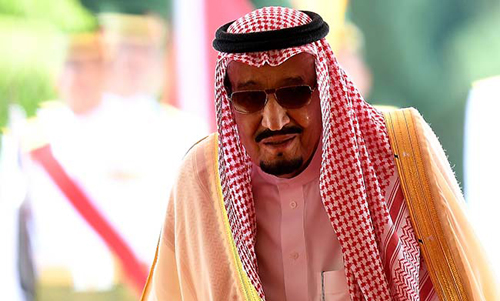
SaudiKing

But Salman has come prepared. According to reports in the Indonesian press, the Saudi royal is expected to bring 459 metric tonnes (506 U.S. tons) of cargo with him on his trip - including two Mercedes-Benz s600 limousines and two electric elevators.

Adji Gunawan of the airfreight company PT Jasa Angkasa Semesta (JAS) told the Antara news agency that his company had been appointed to handle the cargo, which had already arrived in the country. Adji said that his company was employing a total of 572 workers to deal with the Saudi King's luggage.

Saudi Royals are often known for traveling in grandiose style. Salman booked out the entire Four Seasons hotel in Georgetown when he visited Washington in 2015. The hotel, one of the most luxurious in the area, has 222 rooms.

That same year, the king was criticized by some locals after his 1,000-person entourage forced the closure of a beach on the French Riviera for three days due to privacy and security concerns. The local mayor also complained to the French president that the Saudi group had poured concrete directly onto the sand in an unauthorized attempt to install an elevator.

A similarly large entourage is expected this week in Indonesia. The Jakarta Post reports that the Saudi group will total about 1,500 people, including 10 ministers, 25 princes and at least 100 security personnel.

While the Saudi king's colossal cargo hold may seem large, it is not necessarily out of scale with other world leaders. When President Barack Obama visited sub-Saharan Africa in 2013, he was accompanied by 56 support vehicles, including 14 limousines, and hundreds of U.S. Secret Service agents tasked with helping secure locations in Senegal, South Africa and Tanzania.

Even when Obama traveled less exotic locales, there were reports of a similarly high level of organization: A 2014 visit to Brussels included a 900-person entourage and 45 vehicles, according to the Guardian. Though the White House later disputed that figure, it said it could not provide a more accurate one due to security concerns.

Comments

shaji
 - 
Thursday, 2 Mar 2017

If almighty God decides something to be happened none can stop or postpone it. May God protect all of us from Evil.

Add new comment

  • Coastaldigest.com reserves the right to delete or block any comments.
  • Coastaldigset.com is not responsible for its readers’ comments.
  • Comments that are abusive, incendiary or irrelevant are strictly prohibited.
  • Please use a genuine email ID and provide your name to avoid reject.
News Network
February 19,2020

Washington, Feb 19: US President Donald Trump has said he is "saving the big deal" with India for later and he "does not know" if it will be done before the presidential election in November, clearly indicating that a major bilateral trade deal during his visit to Delhi next week might not be on the cards.

"We can have a trade deal with India. But I'm really saving the big deal for later," he told reporters at Joint Base Andrews Tuesday afternoon (local time).

The US and India could sign a "trade package" during the visit, according to media reports.

Asked whether he expects a trade deal with India before the visit, Trump said, "We're doing a very big trade deal with India. We'll have it. I don't know if it'll be done before the election, but we'll have a very big deal with India."

US Trade Representative Robert Lighthizer, the point-person for trade negotiations with India, is likely to not accompany Trump to India, sources said. However, officials have not ruled it out altogether.

In an apparent dissatisfaction over US-India trade ties, Trump said, "We're not treated very well by India." But he praised Prime Minister Narendra Modi and said he is looking forward to his visit to India.

"I happen to like Prime Minister Modi a lot," Trump said.

"He told me we'll have seven million people between the airport and the event. And the stadium, I understand, is sort of semi under construction, but it's going to be the largest stadium in the world. So it's going to be very exciting... I hope you all enjoy it," he told reporters.

Meanwhile, the US-India Strategic and Partnership Forum (USISPF) in a report said the latest quarterly data depict continuation of overall positive bilateral trade trends. The third quarter data reflects some downslide in growth rates.

"It may be due to several reasons, including the unexpected economic slowdown in India's economic growth, impact of US-China trade war, GSP withdrawal from the US side and retaliatory tariffs on specific US goods from the Indian side," USISPF said.

According to the report, the data available for the first three quarters of 2019 (January-September) pulled the overall growth rate in cumulative bilateral trade down to 4.5 percent from 8.4 percent registered for the first two quarters.

Goods and services trade performance in third quarter was dismal at -2.3 percent, in contrast with the impressive 9.6 percent growth witnessed for the first two quarters of the year; while trade in services was up two percent goods trade dropped five percent, the report said.

The cumulative US-India trade in goods and services (USD 110.9 billion) for the first three quarters of 2019 increased 4.5 percent with US exports and imports growing at four percent and five percent respectively.

The US exported USD 45.3 billion worth of goods and services to India in the first three quarters 2019, up 4 percent from the corresponding period in the previous year; and the US imported USD 65.6 billion worth of goods and services from India, up five percent from the previous year's USD 62.5 billion level for the same period, it said.

The USISPF has projected that the total bilateral trade can touch USD 238 billion by 2025 if the current 7.5 percent average annual rate of growth sustains; however, higher growth rates can result in bilateral trade in the range of USD 283 billion and USD 327 billion.

The US remains the top trading partner for India in terms of trade in goods and services, followed by China. While the bilateral trade between US and India is approximately 62 percent in goods and 38 percent in services, the bilateral trade between India and China is dominated by goods.

China had a huge trade surplus of USD 58 billion with India, indicating Beijing's strength in the Indian market, especially in sectors, such as electronics, machinery, organic chemicals, plastics and medical devices.

The US goods exports to India, in comparison, were mainly concentrated in mineral fuels, precious stones, and aircraft. The US faces tough competition with China in the Indian market in areas such as electronics, machinery, organic chemicals and medical devices.

Comments

Add new comment

  • Coastaldigest.com reserves the right to delete or block any comments.
  • Coastaldigset.com is not responsible for its readers’ comments.
  • Comments that are abusive, incendiary or irrelevant are strictly prohibited.
  • Please use a genuine email ID and provide your name to avoid reject.
News Network
March 28,2020

Washington, Mar 28: The world is in the face of a devastating impact due to the coronavirus pandemic and has clearly entered a recession, the International Monetary Fund said on Friday, but projected a recovery next year.

"We have reassessed the prospects for growth for 2020 and 2021. It is now clear that we have entered a recession as bad or worse than in 2009. We do project recovery in 2021," IMF Managing Director Kristalina Georgieva told reporters at a news conference.

Georgieva was addressing the press after a meeting of governing body of the IMF, the International Monetary and Financial Committee. Representing 189 members, the body met virtually to discuss the unprecedented challenge posed to the world by COVID-19.

The key to recovery in 2021, she said, is only if the international community succeeds in containing the virus everywhere and prevent liquidity problems from becoming a solvency issue.

"The US is in recession, as is the rest of the advanced economies of the world. And in a big chunk of developed and emerging markets in developing economies. How severe? We are working now on our projections for 2020, Georgieva said in response to a question.

The new projections are expected in the next few weeks.

Stressing that while containment is the main reason for the economy to stand still and get into a recession, she said containment is very necessary to come out of this period and step in to recovery. "Until the virus is not contained, it would be very difficult to go to the lives we love."

"A key concern about a long-lasting impact of the sudden stop of the world economy is the risk of a wave of bankruptcies and layoffs that not only can undermine the recovery. But can erode the fabric of our societies," the IMF chief said.

To avoid this from happening, many countries have taken far-reaching measures to address the health crisis and to cushion its impact on the economy, both on the monetary and on the fiscal side, she said.

The IMF chief said 81 emergency financing requests, including 50 from lower-income countries, have been received. She said current estimate for the overall financial needs of emerging markets is 2.5 trillion dollars.

"We believe this is on the lower end. We do know that their own reserves and domestic resources will not be sufficient," she added.

The G-20, a day earlier, reported fiscal measures totalling some 5 trillion dollars or over 6 per cent of the global GDP.

Responding to another question, Georgieva said the IMF is projecting recession for 2020.

"We do expect it to be quite deep and we are very much urging countries to step up containment measures aggressively so we can shorten the duration of this period of time when the economy is in standstill," she said.

"And also to apply well-targeted measures, primarily focusing on the health system to absorb that enormous stress that comes from coronavirus. And on people, businesses and the financial system, I am very pleased to say that when we went through countries' responses, that sense of targeted fiscal measures is there and are also very impressive to see the size of these measures," she added.

"Countries are doing all they can on the fiscal and on the monetary front. We have heard from our members' very impressive decisions taken over the last days," the IMF chief said.

"We also want to caution that as we are responding now, we want to make the recession as possibly short and not too deep. We also want to think about what is going to follow the recovery and make sure that we are putting forward measures that can be supportive in this regard," she said.

Comments

Add new comment

  • Coastaldigest.com reserves the right to delete or block any comments.
  • Coastaldigset.com is not responsible for its readers’ comments.
  • Comments that are abusive, incendiary or irrelevant are strictly prohibited.
  • Please use a genuine email ID and provide your name to avoid reject.
Agencies
February 7,2020

Washington DC, Feb 7: United States on Thursday asked all countries to speak out against mistreatment of Muslims living in China especially in Xinjiang region by Chinese authorities.

Alice G. Wells, Principal Deputy Assistant Secretary for the Bureau of South and Central Asian Affairs, while talking to reporters appreciated the steps taken by Central Asian states to ensure that no ethnic Kazakh, Uighur, Kyrgyz is refouled to China and that the human rights of individuals who reach Central Asia are observed.

"As a matter of principle we urge all countries, not just Central Asian countries, to speak out against human rights abuses that are evident against Muslims in all of China but certainly in Xinjiang. And the countries of Central Asia, several of the countries of Central Asia have deep first-hand knowledge of those abuses given the direct impact it has on their own populations who have loved ones, family members, that are swept up in these detention centers," Wells said.

"We appreciate steps by Central Asian states to ensure that no ethnic Kazakh, Uighur, Kyrgyz is refouled to China, that the human rights of individuals who reach Central Asia are observed. And we also appreciate I think what countries like Kazakhstan can do to promote the free and safe travel of compatriots, ethnic compatriots across the border," she added.

China has been accused of oppressing the Uighurs by sending them to mass detention camps, interfering in their religious activities and sending the community to undergo some form of forceful re-education or indoctrination. However, Pakistan has stayed mum over this issue.

As many as 1 million people, or about 7 per cent of Xinjiang's Muslim population, have been incarcerated in a sprawling network of "political re-education" camps, according to US and UN studies.

In 2018, the New York-based Human Rights Watch released a report accusing Beijing of a "systematic campaign of human rights violations" against Uighur Muslims in Xinjiang.

Beijing says its camps in Xinjiang are "vocational training centres."

Last year, several documents leaked revealed details about Beijing's fears about religious extremism and its wholesale crackdown on Uighurs.

The US had called on the Chinese government to "immediately release all of those who are arbitrarily detained and to end its draconian policies that have terrorised its own citizens in Xinjiang."

Comments

Add new comment

  • Coastaldigest.com reserves the right to delete or block any comments.
  • Coastaldigset.com is not responsible for its readers’ comments.
  • Comments that are abusive, incendiary or irrelevant are strictly prohibited.
  • Please use a genuine email ID and provide your name to avoid reject.