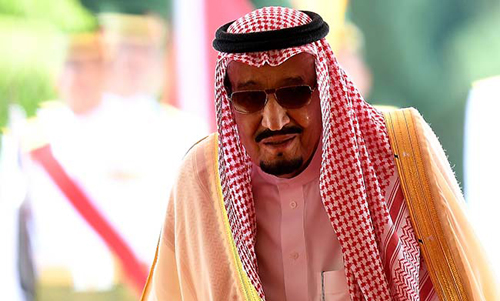
Saudi King to take 506 tons of luggage including 2 Limos to Indonesia

March 1, 2017

Riyadh, Mar 1: Saudi Arabia's King Salman bin Abdul Aziz al-Saud is heading to Indonesia this week for a nine-day visit. It will be the first time in 46 years that a Saudi king has visited the world's largest Muslim nation, and it comes at a time of heightened attention on the economic links between the two nations.

SaudiKing

But Salman has come prepared. According to reports in the Indonesian press, the Saudi royal is expected to bring 459 metric tonnes (506 U.S. tons) of cargo with him on his trip - including two Mercedes-Benz s600 limousines and two electric elevators.

Adji Gunawan of the airfreight company PT Jasa Angkasa Semesta (JAS) told the Antara news agency that his company had been appointed to handle the cargo, which had already arrived in the country. Adji said that his company was employing a total of 572 workers to deal with the Saudi King's luggage.

Saudi Royals are often known for traveling in grandiose style. Salman booked out the entire Four Seasons hotel in Georgetown when he visited Washington in 2015. The hotel, one of the most luxurious in the area, has 222 rooms.

That same year, the king was criticized by some locals after his 1,000-person entourage forced the closure of a beach on the French Riviera for three days due to privacy and security concerns. The local mayor also complained to the French president that the Saudi group had poured concrete directly onto the sand in an unauthorized attempt to install an elevator.

A similarly large entourage is expected this week in Indonesia. The Jakarta Post reports that the Saudi group will total about 1,500 people, including 10 ministers, 25 princes and at least 100 security personnel.

While the Saudi king's colossal cargo hold may seem large, it is not necessarily out of scale with other world leaders. When President Barack Obama visited sub-Saharan Africa in 2013, he was accompanied by 56 support vehicles, including 14 limousines, and hundreds of U.S. Secret Service agents tasked with helping secure locations in Senegal, South Africa and Tanzania.

Even when Obama traveled less exotic locales, there were reports of a similarly high level of organization: A 2014 visit to Brussels included a 900-person entourage and 45 vehicles, according to the Guardian. Though the White House later disputed that figure, it said it could not provide a more accurate one due to security concerns.

Comments

shaji
 - 
Thursday, 2 Mar 2017

If almighty God decides something to be happened none can stop or postpone it. May God protect all of us from Evil.

Add new comment

  • Coastaldigest.com reserves the right to delete or block any comments.
  • Coastaldigset.com is not responsible for its readers’ comments.
  • Comments that are abusive, incendiary or irrelevant are strictly prohibited.
  • Please use a genuine email ID and provide your name to avoid reject.
News Network
May 7,2020

United Nations, May 7: An average of 80,000 COVID-19 cases were reported each day in April to the World Health Organization, the top UN health agency has said, noting that South Asian nations like India and Bangladesh are seeing a spike in the infections while the numbers are declining in regions such as Western Europe.

WHO Director-General Tedros Adhanom Ghebreyesus said on Wednesday that countries must also be able to manage any risk of the disease being imported into their territories, and communities should be fully educated to adjust to what will be a "new norm".

He said as the countries press forward in the common fight against COVID-19, they should also lay the groundwork for resilient health systems globally.

"More than 3.5 million cases of COVID-19 and almost 250,000 deaths have now been reported to the WHO. Since the beginning of April, an average of around 80,000 new cases have been reported to the WHO every day," Ghebreyesus said in Geneva yesterday.

Asserting that the virus cases were not just numbers, he said: "every single case is a mother, a father, a son, a daughter, a brother, sister or friend".

He said while the numbers are declining in Western Europe, more cases are being reported every day from Eastern Europe, Africa, South-East Asia, the Eastern Mediterranean and the Americas. Even within regions and within countries, there are divergent trends, the agency added.

While some countries are reporting an increase in COVID-19 cases over time, many have seen caseloads rise because they have ramped up testing, the WHO official said.

"We've also seen in Europe and Western Europe a fundamental decrease in the number of cases, but we have seen an associated increase in the number of cases reported in places like the Russian Federation. Southeast, the Western Pacific areas are relatively on the downward trend like Korea and others, but then we do see in South Asia, in places like Bangladesh, in India, some trends towards increase.

"So it's very difficult to say that any particular region is improving or (not improving). There are individual countries within each region that are having difficulties getting on top of this disease and I am particularly concerned about those countries that have (an) ongoing humanitarian crisis," WHO's Executive Director Michael Ryan said.

The death toll due to COVID-19 in India rose to 1,783 while the number of cases climbed to 52,952 on Thursday, registering an increase of 89 deaths and 3,561 cases in the last 24 hours, the Union Health Ministry said.

The number of active COVID-19 cases stood at 35,902 while 15,266 people have recovered, it said.

Noting that while seeing an increase in the number of cases is not good in terms of transmission, WHO's Emerging Diseases and Zoonoses Unit head Maria Van Kerkhove said: "but I don't want to equate that with something (being) wrong".

"I want to equate that with countries are working very hard to increase their ability to find the virus, to find people with the virus, to have testing in place to identify who has COVID-19, and putting into place what they need to do to care for those patients," Kerkhove said.

With more countries considering easing restrictions implemented to curb the spread of the coronavirus, the WHO has again reminded the authorities of the need to maintain vigilance.

"The risk of returning to lockdown remains very real if countries do not manage the transition extremely carefully, and in a phased approach," Ghebreyesus said.

He urged countries to consider the UN agency's six criteria for lifting stay-at-home measures.

That advice includes ensuring surveillance is strong, cases are declining and transmission is controlled. Health systems also must be able to detect, isolate, test and treat cases, and to trace all contacts.

Additionally, the risk of outbreak in settings such as health facilities and nursing homes needs to be minimised, while schools, workplaces and other public locations should have preventive measures in place.

"The COVID-19 pandemic will eventually recede, but there can be no going back to business as usual. We cannot continue to rush to fund panic but let preparedness go by the wayside," he said.

He said the crisis has highlighted the importance of strong national health systems as the foundation of global health security: not only against pandemics but also against the multitude of health threats that people across the world face every day.

"If we learn anything from COVID-19, it must be that investing in health now will save lives later," Ghebreyesus said.

While the world currently spends around USD 7.5 trillion on health annually, the WHO believes the best investments are in promoting health and preventing disease.

"Prevention is not only better than cure, it's cheaper, and the smartest thing to do," he said.

The deadly coronavirus, which originated from the Chinese city of Wuhan in December last year, has infected over 3.7 million people and killed 263,831 people globally, according to a tally by Johns Hopkins University.


Comments

Add new comment

  • Coastaldigest.com reserves the right to delete or block any comments.
  • Coastaldigset.com is not responsible for its readers’ comments.
  • Comments that are abusive, incendiary or irrelevant are strictly prohibited.
  • Please use a genuine email ID and provide your name to avoid reject.
Agencies
July 24,2020

Chengdu, Jul 24: China on Friday asked the US to close down its Consulate in Chengdu in retaliation to Washington's decision to shut the Chinese Consulate in Houston.

A statement by the Chinese Foreign Ministry said China has informed the US Embassy of its decision to withdraw its consent for the establishment and operation of the US Consulate General in Chengdu.

This was in response to "unilateral" decision by the US to shut the Houston Consulate. China's decision is legitimate and necessary response to the unreasonable actions of the US, it said.

The US on Wednesday ordered the closure of the Chinese consulate in Houston, a move it said was aimed "to protect American intellectual property and private information."

Reacting strongly to the US move, Chinese Foreign Ministry spokesman Wang Wenbin termed it as an "unprecedented escalation and warned retaliatory measures.

China on Thursday said that "malicious slander" is behind an order by the US government to close its consulate in Houston, Texas, and maintained that its officials have never operated outside ordinary diplomatic norms.

Wang said the order to close the consulate violates international law and basic norms governing international relations, and seriously undermines China-US relations.

This is breaking down the bridge of friendship between the Chinese and American people, Wang said.

Comments

Add new comment

  • Coastaldigest.com reserves the right to delete or block any comments.
  • Coastaldigset.com is not responsible for its readers’ comments.
  • Comments that are abusive, incendiary or irrelevant are strictly prohibited.
  • Please use a genuine email ID and provide your name to avoid reject.
News Network
July 14,2020

Washington, Jul 14: Florida on Sunday reported a record 15,300 new coronavirus cases, the most by any state in a single day even as the coronavirus cases in the country have surged to 3,363,056.

The Washington Post reported that the huge number was result of both increased testing and widespread community transmission. The numbers shattered previous highs of 11,694 reported by California last week and 11,571 reported by New York on April 15.

Natalie E. Dean, an assistant professor of biostatistics at the University of Florida wrote that with Florida largely open for business, he doesn't expect this surge to slow.

Nationally, the conversation over reopening has become increasingly fraught amid the newly soaring case numbers, with much of the debate centering on whether schools should open their doors in the fall, reported the Post.

The Health workers in California and Texas too are facing an influx of COVID-19 patients where officials reported seven day averages for new cases - 8,664 and 9060 respectively.

According to the report, Florida has reported nearly 70,000 cases in last week alone, the most of any state.

Even though the COVID-19 cases are surging, Florida Gov. Ron DeSantis has stuck to an aggressive reopening plan with state officials recently ordering schools to reopen five days a week in the new academic year.

The state is also set to hold the Republican National Convention next month in Jacksonville's VyStar Veterans Memorial Arena, an indoor facility that seats about 15,000, reported Washington Post.

Seven-day averages for new cases -- considered a more reliable indicator of the virus's impact than single-day totals -- hit new highs in Alabama, Florida, Mississippi, Montana, North Carolina, Oklahoma and Puerto Rico.

Comments

Add new comment

  • Coastaldigest.com reserves the right to delete or block any comments.
  • Coastaldigset.com is not responsible for its readers’ comments.
  • Comments that are abusive, incendiary or irrelevant are strictly prohibited.
  • Please use a genuine email ID and provide your name to avoid reject.