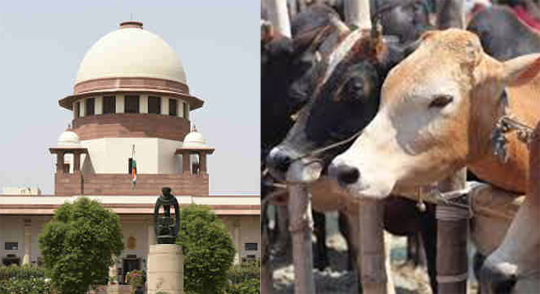
SC orders nationwide stay on Modi govt’s rules prohibiting cattle slaughter

Agencies
July 11, 2017

New Delhi, Jul 11: The Supreme Court on Tuesday ordered a nationwide stay on Central government’s new rules that had imposed a blanket prohibition on the slaughtering of cattle (cows, bulls, buffaloes, camels, heifers) brought from animal markets. Issued on May 23, the notification bans the sale of cattle for culling and also restrains sacrificing the animals for religious purposes.

Untitled-1

A bench led by Chief Justice of India J S Khehar said that the stay order by the Madras High Court will “extend to the whole of the country”.

Additional Solicitor General P S Narasimha had requested the court for not issuing any order since the government was re-examining the rules and that new changes were likely to be notified by the end of August.

But the bench responded: “Livelihood cannot be subjected to uncertainties.” It said that the government could go ahead and notify the new rules but the operation of the current rules will stay for the entire country.

The court also said that the government will have to give sufficient time for implementation of the new rules and also for enabling aggrieved people to approach the court again once the new rules are notified. It disposed of the current batch of petitions.

Comments

Abdullah
 - 
Thursday, 13 Jul 2017

Whatever they plan, Allah is the better planner. He only knows better.

Add new comment

  • Coastaldigest.com reserves the right to delete or block any comments.
  • Coastaldigset.com is not responsible for its readers’ comments.
  • Comments that are abusive, incendiary or irrelevant are strictly prohibited.
  • Please use a genuine email ID and provide your name to avoid reject.
News Network
March 12,2020

Bengaluru, Mar 12: The Karnataka government on Wednesday clarified that no coronavirus "emergency" has been declared in the state and that all the schools and offices will remain open.

Earlier, there were fake reports that Karnataka has declared "coronavirus as an epidemic" in the state.

In a statement, Karnataka health commissioner Pankaj Kumar Pandey refuted the reports doing rounds on social media which said Karnataka had declared COVID-19 as a "state epidemic".

Refuting the rumours, he added that all the schools, offices and other institutions will continue to function normally in the state.

The Karnataka government earlier today issued temporary regulation which asked all government and private hospitals to have flu corners for screening of suspected cases of COVID-19.

According to the regulation, no person/institution shall use print or electronic media to spread mis-information on COVID-19 without prior permission of the department of health & family welfare. If a person is found indulging in any such activity, they will be punished, it said.

The Karnataka government also started a campaign called 'Namaste over Handshake' that encourages people to greet in the traditional Indian style, to tackle the spread of the virus.

The state has reported four positive cases of coronavirus so far.

India, so far, has 60 confirmed cases of coronavirus, including 16 Italians tourists.

Comments

Add new comment

  • Coastaldigest.com reserves the right to delete or block any comments.
  • Coastaldigset.com is not responsible for its readers’ comments.
  • Comments that are abusive, incendiary or irrelevant are strictly prohibited.
  • Please use a genuine email ID and provide your name to avoid reject.
News Network
May 29,2020

Bengaluru, May 29: Seven out of ten (72 per cent) workers in Karnataka reported having lost their employment during the COVID-19-induced lockdown, according to findings of a survey by Azim Premji University, in collaboration with ten civil society organisations.

The university said in a statement it conducted "a detailed" phone survey of 5,000 workers across 12 states in the country, to gauge the impact of the COVID-19 lockdown on employment, livelihoods, and access to government relief schemes.

The survey covered self-employed, casual, and regular wage and salaried workers and it released the findings for Karnataka on Thursday.

Seventy-six per cent of urban workers and 66 per cent of rural workers lost their employment, the survey findings said.

For non-agricultural self-employed workers and wage workers, who were still employed, average weekly earnings fell by two-third.

More than four in ten salaried workers (44 per cent) saw either a reduction in their salary or received no salary during the lockdown.

Six out of ten households reported that they did not have enough money to buy even a weeks worth of essential items, according to the survey.

Eight out ten households reported a reduction in food intake, while less than three in ten vulnerable households (27 per cent) in urban Karnataka received any form of cash transfer from the government, it said.

In summary, the disruption in the Karnatakas economy and labour markets is enormous. Livelihoods have been devastated at unprecedented levels during the lockdown.

The recovery from this could be slow and very painful, the statement said.

As a response to the findings of this survey, the team which has conducted the survey suggested a universalisation of the PDS to expand its reach and implementation of expanded rations for at least the next six months.

It suggested cash transfers equal to at least Rs.7000 per month for two months, and proactive steps like expansion of MGNREGA, introduction of urban employment guarantee, and investment in universal basic services, among others.

Comments

Add new comment

  • Coastaldigest.com reserves the right to delete or block any comments.
  • Coastaldigset.com is not responsible for its readers’ comments.
  • Comments that are abusive, incendiary or irrelevant are strictly prohibited.
  • Please use a genuine email ID and provide your name to avoid reject.
News Network
June 26,2020

Bengaluru, Jun 26: The National Restaurant Association of India (NRAI) on Thursday came up with a Standard Operating Procedure (SOP) for restaurants whereby among other physical distancing norms, it has suggested a 2-metre gap between tables.

Formulated in partnership with Releski, a Bengaluru based skill-tech company, the SoP suggests that in case of back-to-back seating, people sitting with their backs towards each other will have their seats divided by 'Plexiglass' divider raised up to 2 meters from the ground.

"In a typical restaurant, the improvised seating plan should have a minimum distance of 2 metres between tables. The distance of 2 metres (6 feet) between tables should measure from one edge of the table to the other table's edge," it said.

In case of loose or free seating such as in banquet style or food court style seating, a minimum 2 meters of distance should be maintained between tables.

The guidelines noted that, to encourage physical distancing, restaurants have to sacrifice their seating capacity, to promote health and safety, and also to gain trust from their patrons.

"In order to perform this, divide your restaurants under different sectors. Pull out your restaurant's floor plan and colour code different sections red and yellow. Red sections are potential areas where maximum footfall or traffic is observed. Yellow sections are areas where the footfalls are average," it said.

All the red sections are encircled or bordered by placing barricades or Q manager and will open at specific points to access the yellow section and all the opening points will have hand sanitisers and sprays, and every guest who walks from red zones to yellow zones will sanitise himself/herself to reduce the chances of contamination.

For air conditioning, the guidelines of CPWD shall be followed which inter alia emphasises that the temperature setting of all air conditioning devices should be in the range of 24-30 degree Celsius, relative humidity should be in the range of 40- 65 per cent, intake of fresh air should be as much as possible and cross ventilation should be adequate, the guidelines suggested.

The industry body has also suggested appointment of a COVID-free Ambassador who would operate as the Chief Health Officer within the restaurant team, preferably from the management team in each shift.

The ambassador's would put the new daily work routines into practice, to monitor compliance with good practice and to lead the preventative measures, adapt to health & safety recommendations and requirements of the restaurant and oversee the implementation of the norms.

Anurag Katriar, President of NRAI and CEO & Executive Director of deGustibus Hospitality, said: "Every restaurant cutting across formats is facing the harsh reality of subdued to shut business volumes in the present and the uncertainty of business environment in the future. One thing is certain that hygiene and safety will be a key differentiator in the post-pandemic restaurant operations."


Comments

Add new comment

  • Coastaldigest.com reserves the right to delete or block any comments.
  • Coastaldigset.com is not responsible for its readers’ comments.
  • Comments that are abusive, incendiary or irrelevant are strictly prohibited.
  • Please use a genuine email ID and provide your name to avoid reject.