SC rejects Karnataka plea to stall draft Cauvery scheme

Agencies
May 16, 2018

New Delhi, May 16: The Supreme Court today rejected Karnataka's plea that finalisation of the draft Cauvery management scheme should be put on hold as the process of formation of a new government in the state is underway.

The apex court also asked the Centre to modify a provision in the draft Cauvery management scheme that authorises the Union government to issue directions "from time to time" on Cauvery water distribution between four southern riparian states, Tamil Nadu, Karnataka, Kerala and Puducherry.

A bench headed by Chief Justice Dipak Misra asked Attorney General K K Venugopal to modify the scheme and submit it for approval tomorrow.

The bench, also comprising Justices A M Khanwilkar and D Y Chandrachud, did not accept the vehement submission of senior advocate Shyam Divan, representing Karnataka, that the finalisation of the draft Cauvery scheme be put on hold till the first week of July as the process of government formation was on in the state.

"All the states concerned are making submissions to the draft scheme. I am requesting for adjournment till first week of July as I do not have the assistance and instruction from the council of ministers of Karnataka," Divan said.

"It was the Centre which has to set up the draft scheme," the court said while rejecting Karnataka's plea.

The bench has now fixed the matter for tomorrow to consider the modified draft scheme, which will ensure compliance of the February 16 apex court judgment relating to Cauvery water distribution among four states.

Comments

Add new comment

  • Coastaldigest.com reserves the right to delete or block any comments.
  • Coastaldigset.com is not responsible for its readers’ comments.
  • Comments that are abusive, incendiary or irrelevant are strictly prohibited.
  • Please use a genuine email ID and provide your name to avoid reject.
News Network
February 4,2020

New Delhi, Feb 4: Senior BJP leader and Defence Minister Rajnath Singh on Monday accused Delhi's ruling Aam Aadmi Party of not implementing the central government's schemes in the national capital.

Addressing an election rally in Moti Bagh, he also sought to allay fears over the Citizenship Amendment Act (CAA), assuring the gathering that the legislation will not take away anyone's citizenship.

Singh alleged that the Chief Minister Arvind Kejriwal-led Delhi government did not do anything in the last five years.

The AAP had promised to add 5,000 buses to the fleet of the Delhi Transport Corporation (DTC), but instead the number has come down by 1,000, he claimed.

The Union minister said the AAP dispensation did not implement central schemes in Delhi fearing that the popularity of the Prime Minister Narendra Modi-led government will grow among Delhiites.

Pension schemes and the Centre's flagship health insurance scheme, Ayushman Bharat Yojana, are some of those that the Kejriwal government did not allow to be implemented in Delhi.

On the anti-CAA protests, Singh said that the opposition parties have been spreading "lies" about amended citizenship law and the National Population Register (NPR).

"The CAA will not take away anyone's citizenship. The opposition parties are spreading lies about the CAA. There should be no such politics over this. Some people are trying to write the history of the country with the ink of hatred," he said.

The culture of India is such that it considers the entire world one family, he said.

Delhi goes to polls on February 8. The results will be declared on February 11.

Comments

Add new comment

  • Coastaldigest.com reserves the right to delete or block any comments.
  • Coastaldigset.com is not responsible for its readers’ comments.
  • Comments that are abusive, incendiary or irrelevant are strictly prohibited.
  • Please use a genuine email ID and provide your name to avoid reject.
News Network
July 3,2020

New Delhi, Jul 3: In a significant step, ICMR has partnered with Bharat Biotech International Limited (BBIL) to fast-track clinical trials of the indigenous COVID-19 vaccine (BBV152 COVID Vaccine). It is the first indigenous vaccine being developed by India and is one of the top priority projects which is being monitored at the topmost level of the Government, says ICMR in a statement.

The vaccine is derived from a strain of SARS-CoV-z isolated by ICMR-National Institute of Virology, Pune. ICMR and BBIL are jointly working for the preclinical as well as clinical development of this vaccine.

In a letter to the institutes that will be involved in the trails of the vaccine, ICMR has said

"It is envisaged to launch the vaccine for public health use latest by 15th August 2020 after completion of all clinical trials. BBIL is working expeditiously to meet the target. However, final outcome will depend on the cooperation of all clinical trial sites involved in this project. you have been chosen as a clinical trial site of the BBV152 COVID vaccine. ln view of the public health emergency due to COVID-19 pandemic and urgency to launch the vaccine, you are strictly advised to fast track all approvals related to initiation of the clinical trial and ensure that the subject enrollment is initiated no later than 7th July 2020."

The ICMR also asked the institutes to comply with the order, "Kindly note that non-compliance will be viewed very seriously. Therefore, you are advised to treat this project on the highest priority and meet the given timelines without any lapse."

The ICMR has selected 12 institutes, including one from Odisha, for the clinical trial of the country's first indigenous COVID-19 vaccine.

Comments

Add new comment

  • Coastaldigest.com reserves the right to delete or block any comments.
  • Coastaldigset.com is not responsible for its readers’ comments.
  • Comments that are abusive, incendiary or irrelevant are strictly prohibited.
  • Please use a genuine email ID and provide your name to avoid reject.
Agencies
August 3,2020

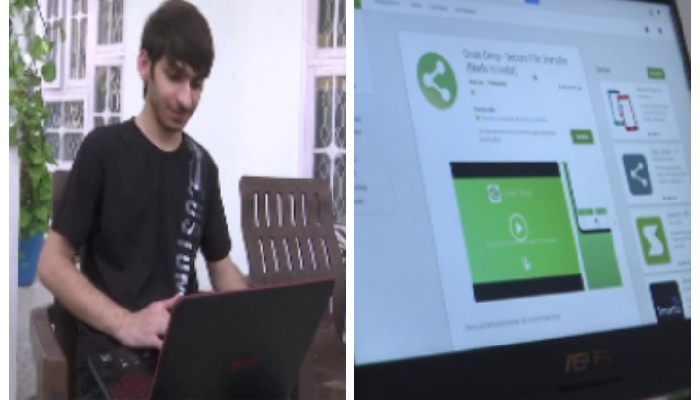
Rajouri, Aug 3: Ashfaq Mehmood Choudhary, a 17-year-old boy from Chattyear of Jammu and Kashmir's Rajouri district, has developed a file-sharing app 'Dodo Drop' which would enable users to share audios, videos, images, and texts between two devices without Internet access.

While speaking to media persons, Ashfaq Mehmood said that the 'Dodo Drop' application is an alternative to the Chinese 'SHAREit' app. "The Indian government has banned several Chinese apps due to data breaching, and among those apps was SHAREit which was used for sharing files.

Users faced a lot of problems due to the ban, and so I decided to make this file-sharing app. With 'Dodo Drop', users can share audios, videos, images, and even texts," he said.

Ashfaq said that it took him four weeks to develop the application, and it was launched on August 1 this year. The 'Dodo Drop' application has a transfer rate of up to 480 mbps, which is faster than the SHAREit app and is "quite easy" to use.

"Users can transfer data comprising photos, videos, audios, apps, texts, etc. between two devices with no Internet access. The transfers are fully encrypted and secure," he added.

"Our Prime Minister has always asserted the need for decreasing the dependency on foreign products and apps and to focus on the development of India-based apps. I tried to be part of the initiative of 'Aatmanirbhar Bharat' by developing an India-based file-sharing app. I want to develop global-standard apps for India," he added.

"We support and cooperate with him. He generates his own income by working on some projects and utilises it. We will continue to support him," said Parvez Ahmed Choudhary, Ashfaq's father.

In July, the Ministry of Electronics and Information Technology (MEITY) banned 47 apps, which were variants and cloned copies of the 59 apps banned earlier in June. These banned clones included SHAREit Lite, Tiktok Lite, Helo Lite, BIGO LIVE Lite, and VFY Lite.

The 59 apps had been banned by the Centre in June in view of the information available that they were engaged in activities which were "prejudicial to sovereignty and integrity and defence" of the country.

Almost all the apps banned had some preferential Chinese interest and the majority had parent Chinese companies.

The ban came amid border tensions with China in the Eastern Ladakh region.

Comments

Add new comment

  • Coastaldigest.com reserves the right to delete or block any comments.
  • Coastaldigset.com is not responsible for its readers’ comments.
  • Comments that are abusive, incendiary or irrelevant are strictly prohibited.
  • Please use a genuine email ID and provide your name to avoid reject.