


SDPI accuses police of anti-Muslim bias; DK MP says Hindus are victims

CD Network | Sumedha V
June 18, 2017

Mangaluru, Jun 18: Accusing Dakshina Kannada district police of being communally biased against Muslims, Social Democratic Party of India has said that several innocent Muslims have been targeted by the cops in the wake of recent communal disturbances in Kalladka town of Bantwal taluk.
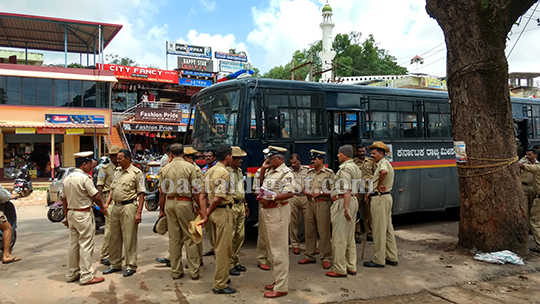
clashcommunal

Addressing a press conference at BC Road, near here, Ashraf Manchi, district secretary of SDPI, said the cases booked against the accused belonging to Muslim and Hindu communities in the aftermath of June 13 clash exposed the communal mindset of the police.

“Police have registered 10 cases in connection with Kalladka clash. However, they have registered complaints against 82 persons from Muslim community and only against 19 persons from Hindu community,” he said.

He said that though police have arrested nine persons each from Hindu and Muslim communities, Muslims have been slapped with cases under IPC Section 307 (attempt to murder), while most of the arrested Hindus have been slapped minor cases under weaker Sections like 324. “32 Muslims have been booked under Section 304, while only 4 members of the Sangh Parivar, which is mainly responsible for the incident have been booked under the same Section,” he lamented.

He said that activists of the Sangh Parivar had pelted stones on the Masjid and Madrasa from atop a building owned by Kalladka Prabhakar Bhat. “The president of the Masjid, Abubakar Haji, has informed the police regarding the damage caused. However, they have not registered case against any of the accused in the incident. Ironically, complaint has been registered against 30 Muslims on charge of pelting stones at a Sri Rama temple,” he said.

Mr Manchi also accused the police of committing atrocities against Muslims. “Bantwal Circle Inspector B K Manjayya and Bantwal town police station SI Rakshit A K, along with a team with no women police entered the houses of innocent Muslims late at night and committed atrocities against family members irrespective of women, elderly people and sick. The police also damaged the doors and windows of the Muslim houses during midnight raids. The shocked women have been admitted to a hospital in Mangaluru, but the police are not ready to take the statements of the victims,” he complained.

“In fact stones were pelted at SI A K Rakshit when he was trying to disperse the violent crowd near the Sri Rama Vidyakendra after dispersing crowd in front of the mosque. In this case police have named 23 accused. Ironically all of them are Muslims and they were also booked under Section 307,” said Munish Ali, a local SDPI leader and member of Bantwal Town Municipal Council.

Calling Kalladka clash as a pre-planned conspiracy of Sangh Parivar, he said that the government had completely failed in thwarting the plot of the communal outfits. “Their intention was to create a major communal riot. Had the district administration and police department taken enough precautionary measures after two innocent Muslim youths were stabbed on May 26 by Sangh Parivar activists, this wouldn’t have happed,” he said accusing both Congress and BJP of resorting to vote bank politics.

Police targeting innocent Hindus, says MP

Meanwhile Dakshina Kannada MP Nalin Kumar Kateel has accused the police of arresting innocent Hindus due to political pressure. “Both police department and communal mafia trying to suppress Hindu power and Hindu sentiments,” he told media persons in Puttur.

He said that the police department has become a mere puppet in the hands of the politicians in Congress ruled Karnataka. “The hands of able and efficient police officers have been tied. Even though miscreants of other communities are harassing Hindus, police are arresting innocent Hindus for the sake of head count,” he lamented.

He went on to claim that the police invoked the Goonda Act against innocent Hindu youths in order to create fear among Hindu society, while the real culprits are roaming free.

He said that BJP will extend full support to the protest scheduled to be organized by Hindu Jaagarana Vedike on June 24 at Kalladka. He said that BJP state president B S Yeddyurappa will also take part in the protest.

Comments

Abdullah
 - 
Monday, 19 Jun 2017

Wake up Mr. Khader, Bawa and Siddharamayya....
Else give your seat to others in next election.

abdul
 - 
Monday, 19 Jun 2017

Mr.MP we remember very well your statement on Karthik Raj murder case , and that proved you are unfit for this post and when real culprit got caught you disappeared with shobakaaaa ( one more unfit )

Add new comment

  • Coastaldigest.com reserves the right to delete or block any comments.
  • Coastaldigset.com is not responsible for its readers’ comments.
  • Comments that are abusive, incendiary or irrelevant are strictly prohibited.
  • Please use a genuine email ID and provide your name to avoid reject.
Ram Puniyani
January 14,2020

In the beginning of January 2020 two very disturbing events were reported from Pakistan. One was the attack on Nankana Sahib, the holy shrine where Sant Guru Nanak was born. While one report said that the place has been desecrated, the other stated that it was a fight between two Muslim groups. Prime Minister of Pakistan Imran Khan condemned the incident and the main accused Imran Chisti was arrested. The matter related to abduction and conversion of a Sikh girl Jagjit Kaur, daughter of Pathi (One who reads Holy Guru Granth Sahib in Gurudwara) of the Gurudwara. In another incident one Sikh youth Ravinder Singh, who was out on shopping for his marriage, was shot dead in Peshawar.

While these condemnable attacks took place on the Sikh minority in Pakistan, BJP was quick enough to jump to state that it is events like this which justify the Citizenship Amendment Act (CAA). Incidentally CAA is the Act which is discriminatory and relates to citizenship with Religion, which is not as per the norms of Indian constitution. There are constant debates and propaganda that population of Hindus has come down drastically in Pakistan and Bangla Desh. Amit Shah, the Home minister stated that in Pakistan the population of Hindus has come down from 23% at the time of partition to 3.7% at present. And in Bangla Desh it has come down from 22% to present 8%.

While not denying the fact that the religious minorities are getting a rough deal in both these countries, the figures which are presented are totally off the mark. These figures don’t take into consideration the painful migrations, which took place at the time of partition and formation of Bangla Desh later. Pakistan census figures tell a different tale. Their first census was held in 1951. As per this census the overall percentage of Non Muslim in Pakistan (East and West together) was 14.2%, of this in West Pakistan (Now Pakistan) it was 3.44 and in Eat Pakistan it was 23.2. In the census held in Pakistan 1998 it became 3.72%. As far as Bangla Desh is concerned the share of Non Muslims has gone down from 23.2 (1951) to 9.6% in 2011.

The largest minority of Pakistan is Ahmadis, (https://minorityrights.org/country/pakistan/) who are close to 4 Million and are not recognised as Muslims in Pakistan. In Bangla Desh the major migrations of Hindus from Bangla Desh took place in the backdrop of Pakistan army’s atrocities in the then East Pakistan.

As far as UN data on refugees in India it went up by 17% between 2016-2019 and largest numbers were from Tibet and Sri Lanka.  (https://www.un.org/en/development/desa/population/migration/publication…)

The state of minorities is in a way the index of strength of democracy. Most South Asian Countries have not been able to sustain democratic values properly. In Pakistan, the Republic began with Jinnah’s classic speech where secularism was to be central credo of Pakistan. This 11th August speech was in a way what the state policy should be, as per which people of all faiths are free to practice their religion. Soon enough the logic of ‘Two Nation theory” and formation of Pakistan, a separate state for Muslim took over. Army stepped in and dictatorship was to reign there intermittently. Democratic elements were suppressed and the worst came when Zia Ul Haq Islamized the state in collusion with Maulanas. The army was already a strong presence in Pakistan. The popular formulation for Pakistan was that it is ruled by three A’s, Army, America and Allah (Mullah).

Bangla Desh had a different trajectory. Its very formation was a nail in the coffin of ‘two nation theory’; that religion can be the basis of a state. Bangla Desh did begin as a secular republic but communal forces and secular forces kept struggling for their dominance and in 1988 it also became Islamic republic. At another level Myanmar, in the grip of military dictatorship, with democratic elements trying to retain their presence is also seeing a hard battle. Democracy or not, the army and Sanghas (Buddhist Sang has) are strong, in Myanmar as well. The most visible result is persecution of Rohingya Muslims.

Similar phenomenon is dominating in Sri Lanka also where Budhhist Sanghas and army have strong say in the political affairs, irrespective of which Government is ruling. Muslim and Christian minorities are a big victim there, while Tamils (Hindus, Christians etc.) suffered the biggest damage as ethnic and religious minorities. India had the best prospect of democracy, pluralism and secularism flourishing here. The secular constitution, the outcome of India’s freedom struggle, the leadership of Gandhi and Nehru did ensure the rooting of democracy and secularism in a strong way.

India so far had best democratic credentials amongst all the south Asian countries. Despite that though the population of minorities rose mainly due to poverty and illiteracy, their overall marginalisation was order of the day, it went on worsening with the rise of communal forces, with communal forces resorting to identity issues, and indulging in propaganda against minorities.

While other South Asian countries should had followed India to focus more on infrastructure and political culture of liberalism, today India is following the footsteps of Pakistan. The retrograde march of India is most visible in the issues which have dominated the political space during last few years. Issues like Ram Temple, Ghar Wapasi, Love Jihad, Beef-Cow are now finding their peak in CAA.

India’s reversal towards a polity with religion’s identity dominating the political scene was nicely presented by the late Pakistani poetess Fahmida Riaz in her poem, Tum bhi Hum Jaise Nikle (You also turned out to be like us). While trying to resist communal forces has been an arduous task, it is becoming more difficult by the day. This phenomenon has been variously called, Fundamentalism, Communalism or religious nationalism among others. Surely it has nothing to do with the religion as practiced by the great Saint and Sufi traditions of India; it resorts mainly to political mobilization by using religion as a tool.

Comments

Ashi
 - 
Tuesday, 14 Jan 2020

If Malaysia implement similar NRC/CAA, India and China are the loser.

Add new comment

  • Coastaldigest.com reserves the right to delete or block any comments.
  • Coastaldigset.com is not responsible for its readers’ comments.
  • Comments that are abusive, incendiary or irrelevant are strictly prohibited.
  • Please use a genuine email ID and provide your name to avoid reject.
News Network
April 10,2020

Bengaluru, Apr 10: Karnataka Chief Minister B S Yediyurappa, expressing his concern over the plight of stray animals struggling during lockdown, called upon people to feed the animals near their houses and provide them drinking water.

In a tweet he said "Due to scorching heat and Lockdown, cats, dogs and birds are suffering without water and food. In cities this situation much serious. So I appeal to people that people should see that dogs and birds their get food and water.

Please be kind and take some time off to feed stray animals and birds around your homes. Try providing them with water and leftovers so they're not parched and left hungry. Stray animals depend on wastes and leftovers from hotels and restaurants and have been hit by the Lockdown to check the spread of Corona virus.

Comments

Add new comment

  • Coastaldigest.com reserves the right to delete or block any comments.
  • Coastaldigset.com is not responsible for its readers’ comments.
  • Comments that are abusive, incendiary or irrelevant are strictly prohibited.
  • Please use a genuine email ID and provide your name to avoid reject.
News Network
April 21,2020

Bengaluru, Apr 21: Bengaluru Police and administration has issued prohibitory orders in the city, with exemptions to essential and emergency services, to enforce the COVID-19 lockdown.

"In exercise of the powers conferred under Section 144 (1) Code of Criminal Procedure, I, Bhaskar Rao, IPS, Commissioner of Police and Additional District Magistrate, Bengaluru city hereby issue a prohibitory order within the limits of Bengaluru city commissioner on midnight of April 20, 2020, to midnight May 3, 2020," the order issued on Monday said.

Section 144 of the CrPC pertains to the power conferred to a District Magistrate, a sub-divisional Magistrate or any other Executive Magistrate to issue orders in urgent cases of a nuisance of apprehended danger.

"As per the guidelines of the Ministry of Home Affairs, Government of India on the measures for containment of COVID-19 epidemic, it is imperative to take stringent measures in the jurisdiction of Commissioner of Bengaluru city to prevent the spread of the disease," the order said.

As per the order, the offices of the Government of India, its autonomous and subordinate offices and public corporations shall remain closed with the exception of defence, central armed police force, treasury, public utilities, disaster management, power generation, and post office, etc.

Offices to the state government, their autonomous bodies, corporation, etc shall also remain closed except police, home guard, civil defence, fire and emergency services, electricity, water, sanitation and Mandis operated by Agriculture Produce Market Committee, etc, it added.

It said that municipal bodies, with staff required for essential services, will also remain functional during this period. Other essential and emergency services, like hospitals, shops, etc have also been exempted from the prohibitory orders.

Comments

Add new comment

  • Coastaldigest.com reserves the right to delete or block any comments.
  • Coastaldigset.com is not responsible for its readers’ comments.
  • Comments that are abusive, incendiary or irrelevant are strictly prohibited.
  • Please use a genuine email ID and provide your name to avoid reject.