


SDPI accuses police of anti-Muslim bias; DK MP says Hindus are victims

CD Network | Sumedha V
June 18, 2017

Mangaluru, Jun 18: Accusing Dakshina Kannada district police of being communally biased against Muslims, Social Democratic Party of India has said that several innocent Muslims have been targeted by the cops in the wake of recent communal disturbances in Kalladka town of Bantwal taluk.
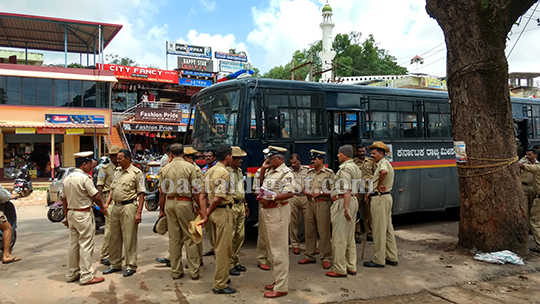
clashcommunal

Addressing a press conference at BC Road, near here, Ashraf Manchi, district secretary of SDPI, said the cases booked against the accused belonging to Muslim and Hindu communities in the aftermath of June 13 clash exposed the communal mindset of the police.

“Police have registered 10 cases in connection with Kalladka clash. However, they have registered complaints against 82 persons from Muslim community and only against 19 persons from Hindu community,” he said.

He said that though police have arrested nine persons each from Hindu and Muslim communities, Muslims have been slapped with cases under IPC Section 307 (attempt to murder), while most of the arrested Hindus have been slapped minor cases under weaker Sections like 324. “32 Muslims have been booked under Section 304, while only 4 members of the Sangh Parivar, which is mainly responsible for the incident have been booked under the same Section,” he lamented.

He said that activists of the Sangh Parivar had pelted stones on the Masjid and Madrasa from atop a building owned by Kalladka Prabhakar Bhat. “The president of the Masjid, Abubakar Haji, has informed the police regarding the damage caused. However, they have not registered case against any of the accused in the incident. Ironically, complaint has been registered against 30 Muslims on charge of pelting stones at a Sri Rama temple,” he said.

Mr Manchi also accused the police of committing atrocities against Muslims. “Bantwal Circle Inspector B K Manjayya and Bantwal town police station SI Rakshit A K, along with a team with no women police entered the houses of innocent Muslims late at night and committed atrocities against family members irrespective of women, elderly people and sick. The police also damaged the doors and windows of the Muslim houses during midnight raids. The shocked women have been admitted to a hospital in Mangaluru, but the police are not ready to take the statements of the victims,” he complained.

“In fact stones were pelted at SI A K Rakshit when he was trying to disperse the violent crowd near the Sri Rama Vidyakendra after dispersing crowd in front of the mosque. In this case police have named 23 accused. Ironically all of them are Muslims and they were also booked under Section 307,” said Munish Ali, a local SDPI leader and member of Bantwal Town Municipal Council.

Calling Kalladka clash as a pre-planned conspiracy of Sangh Parivar, he said that the government had completely failed in thwarting the plot of the communal outfits. “Their intention was to create a major communal riot. Had the district administration and police department taken enough precautionary measures after two innocent Muslim youths were stabbed on May 26 by Sangh Parivar activists, this wouldn’t have happed,” he said accusing both Congress and BJP of resorting to vote bank politics.

Police targeting innocent Hindus, says MP

Meanwhile Dakshina Kannada MP Nalin Kumar Kateel has accused the police of arresting innocent Hindus due to political pressure. “Both police department and communal mafia trying to suppress Hindu power and Hindu sentiments,” he told media persons in Puttur.

He said that the police department has become a mere puppet in the hands of the politicians in Congress ruled Karnataka. “The hands of able and efficient police officers have been tied. Even though miscreants of other communities are harassing Hindus, police are arresting innocent Hindus for the sake of head count,” he lamented.

He went on to claim that the police invoked the Goonda Act against innocent Hindu youths in order to create fear among Hindu society, while the real culprits are roaming free.

He said that BJP will extend full support to the protest scheduled to be organized by Hindu Jaagarana Vedike on June 24 at Kalladka. He said that BJP state president B S Yeddyurappa will also take part in the protest.

Comments

Abdullah
 - 
Monday, 19 Jun 2017

Wake up Mr. Khader, Bawa and Siddharamayya....
Else give your seat to others in next election.

abdul
 - 
Monday, 19 Jun 2017

Mr.MP we remember very well your statement on Karthik Raj murder case , and that proved you are unfit for this post and when real culprit got caught you disappeared with shobakaaaa ( one more unfit )

Add new comment

  • Coastaldigest.com reserves the right to delete or block any comments.
  • Coastaldigset.com is not responsible for its readers’ comments.
  • Comments that are abusive, incendiary or irrelevant are strictly prohibited.
  • Please use a genuine email ID and provide your name to avoid reject.
News Network
July 22,2020

Bengaluru, Jul 22: Karnataka's Covid-19 task force on Tuesday decided that the state government will regulate the supply of Remdesivir, the drug used in the treatment of coronavirus infected patients, to private hospitals to check black marketing and hoarding.

"Remdesivir which is currently available in the government hospitals will be supplied to private hospitals through the government.

This will help curb black marketing of this drug," Medical Education Minister K Sudhakar's office said in a release.

Along with Sudhakar, other task force members, including Health Minister Sriramulu, Deputy Chief Minister C N Ashwath Narayan and Chief Secretary T M Vijay Bhaskar attended the meeting. However, Home Minister Basavaraj Bommai was not part of it as he was out of Bengaluru.

At the meeting, the government has also fixed the rate for Covid-19 tests in private labs- Rs 2,000 for government referred cases and 3,000 for self-reporting cases.

It was also decided to purchase 4 lakh antigen test kits and 5 lakh swab test kits to ramp up testing, the release said, adding that approvals have also been given for additional drugs for the treatment of Covid-19 patients.

The decisions also included increasing monthly salary for Ayush doctors to 48,000, MBBS doctors to 80,000 and nurses to get 30,000 for next 6 months.

The task force also made it clear that private hospitals have to reserve 50 percent beds for the government for Covid-19 treatment. The remaining 50 percent can be used by the private hospitals for Covid-19 and non-Covid-19 treatment.

Private hospitals provide treatment under Ayushman Bharat scheme (ABARK) for Covid-19 patients.

Those cases in which treatment does not cover under the scheme can be charged as per the user charges, the release said.

A committee will be formed to supervise and recommend the purchase of equipment and medicines for Covid-19 treatment, which will be headed by ACS, ITBT Department.

Approval has been given for the procurement of N-95 masks and lakh PPE kits for the safety of healthcare workers. The decision also has been taken to connect oxygen pipeline to 4,736 beds in 17 government medical colleges, which will enable high flow oxygen for these beds besides being beneficial for future use as well.

According to the release, 16 RTPCR and 15 Automated RNA extraction units will be established to ramp up testing and this will help achieve the target of 50,000 tests per day. "On the whole approvals given for purchase of equipment and upgradation of existing facilities at government hospitals is estimated to be about Rs 500 Crore," it added.

Comments

Add new comment

  • Coastaldigest.com reserves the right to delete or block any comments.
  • Coastaldigset.com is not responsible for its readers’ comments.
  • Comments that are abusive, incendiary or irrelevant are strictly prohibited.
  • Please use a genuine email ID and provide your name to avoid reject.
coastaldigest.com web desk
June 21,2020

Mangaluru, Jun 21: A total of 51 private hospitals and medical colleges empanelled under the Suvarna Arogya Suraksha Trust (SAST) have been allowed to treat Covid-19 patients in Dakshina Kannada and Udupi district. Among them 30 are in Dakshina Kannada and 21 are in Udupi. Here is the full list:

Also Read: 518 private hospitals across Karnataka can now treat covid patients

Comments

Add new comment

  • Coastaldigest.com reserves the right to delete or block any comments.
  • Coastaldigset.com is not responsible for its readers’ comments.
  • Comments that are abusive, incendiary or irrelevant are strictly prohibited.
  • Please use a genuine email ID and provide your name to avoid reject.
Media Release
February 14,2020

Veteran journalist P. Sainath has said that the nation is in a crisis. And this crisis is not limited to just the rural area. It has become a national crisis at various areas such as agriculture, education, economy, job creation etc.

He was delivering the endowment lecture on the topic ‘Indian democracy at the post-liberalization and post-truth era’ at Media Manthan 2020 organized by the PG department of journalism and mass communication at St Aloysius College (Autonomous). 

Mr Sainath said that the many policies adopted in the 90s led to India becoming unusually unequal. Referring to the speech Ambedkar had made at the Constituent Assembly while handing over the draft of the Constitution, Mr Sainath said, “Ambedkar had warned about the weakness of Indian democracy that liberty without equality allows the supremacy of a few over the multitude. Liberty, equality and fraternity must be kept together as we cannot have one without the other.” 

Mr Sainath stated that the agrarian crisis was no longer about the loss of productivity, employment or about farmer suicide; it was a societal, civilizational crisis. Commenting on the lopsided policies such as cow-slaughter ban, he explained how cow slaughter ban had adversely affected many industries due to their interdependency. While Muslims who slaughtered cows were rendered helpless, the cattle traders who were mostly OBCs lost their earnings as the cattle prices crashed. An important industry like Kolhapur sandals industry in Maharashtra went bankrupt as a result of the cow slaughter ban in Maharashtra. He said the policymakers had no idea how the rural industries were interconnected. Demonetisation too devastated the rural economy as 98 percent of rural transactions happen through cash. 

Mr Sainath also spoke about the crisis of inequality which affects the Dalits and the Adivasis far more than anyone else as 90 percent of the rural households take home less than Rs 10,000/- per month. “Women are yet another group whose labour is never counted in the gross domestic product. Women and girls globally do unpaid work which amounts to about 12.5 billion working hours per year. Monetarily speaking, this is worth 10.8 trillion dollars,” Mr Sainath added. 

Speaking about the crisis of jobs Mr Sainath said that major companies were laying off employees just to create more profits for the investors and the adoption of artificial intelligence in the industry would further destroy millions of jobs.

Rector of St Aloysius College Institutions Fr Dionysius Vaz SJ, Principal Dr (Fr) Praveen Martis SJ, HOD of Journalism and Mass Communication department Dr (Fr) Melwyn Pinto SJ were present.

‘Veerappan and Vijay Mallya’s business models are interesting!’

Addressing the gathering during his endowment lecture on Friday, Mr Sainath made an interesting comment on the so called ‘revenue model’. “Whenever I visit IIMs and IITs for lectures on my PARI project, the students there ask me what my revenue model for my project is. I tell them that I do not have a revenue model. In fact, journalism does not begin with a revenue model. Gandhiji, Ambedkar, Bhagat Singh were all great journalists. But they did not have a revenue model,” Mr Sainath said.

On a lighter note, he said that the best revenue model that he liked was that of forest brigand Veerappan and liquor baron Vijay Mallya. “Veerappan ruled the forest for forty years and from the top ministers to the villagers he could dictate terms and liver royally. Similarly, Mallya’s revenue model was to steal the banks and run away abroad and live like a king,” Mr Sainath added.

Journalism is not and can never be a business. It is a calling, he opined. While newspaper can be a business, television can be a business, journalism per se cannot be reduced to a business. “Unfortunately today, journalists are recruited on a contract basis and they have no bargaining power; and there are no unions to fight for their cause. Hence, they are at the mercy of the corporate media houses for their survival and are made to write stories that cannot be called journalism,” Mr Sainath said.

Answering a question as to the pressures he faced as a journalist, he said that external pressures from the government or others could be very well handled. It is the internal pressures from once own media house that journalists find it difficult to manage.


Comments

Add new comment

  • Coastaldigest.com reserves the right to delete or block any comments.
  • Coastaldigset.com is not responsible for its readers’ comments.
  • Comments that are abusive, incendiary or irrelevant are strictly prohibited.
  • Please use a genuine email ID and provide your name to avoid reject.