


Second BJP leader in Meghalaya quits over Centre's new cattle slaughter rules

June 6, 2017

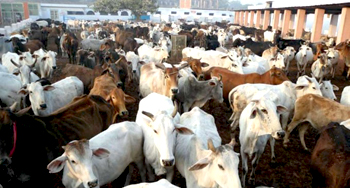
Tura (meghalaya), Jun 6: The Bharatiya Janata Party (BJP) in Meghalaya suffered yet another major political setback when one more senior party member quit over the Centre's new cattle trade and slaughter rules.cattle
Bachu Marak, the district president of the BJP in North Garo Hills, alleged that BJP leaders were “attempting to impose its non-secular ideology on the indigenous people in Meghalaya”.

Bachu Marak's resignation came after Bernard Marak's, who as the district president of the BJP in West Garo Hills, had accused that the leaders of the party were “not respecting the tradition and culture of the indigenous people”.

“As a responsible leader, I cannot mislead the people and allow them (BJP) to impose the non-secular ideology on us. They cannot impose the beef ban in our state,” Marak said over phone.

“Beef is one of our traditional diet and no government can restrict people's food habit. The moment they impose such restriction the ruling party would surely lose people's confidence,” he said.

State BJP President Shibun Lyngdoh, however, dismissed Marak's claim.

“He (Bachu Marak) is making such statement to mislead the people. The party has no intention to impose any anti-constitutional measures to the people. The objective of (Prime Minister Narendra) Modi government is to ensure all round development across India,” Lyngdoh told IANS.

Last week, some BJP leaders in the state had threatened to quit the party if the central government refused to repeal the new cattle trade and slaughter rules.

“Most party leaders in Meghalaya are not happy with the new rules which are directly affecting the socio-economic status of the people,” BJP Vice President John Antonius Lyngdoh said.

“We cannot accept the new rules on cattle trade and slaughter. We cannot go against our food behaviour besides putting the economic interest of those people dealing in cattle trade and slaughter in jeopardy,” he said.

Comments

Add new comment

  • Coastaldigest.com reserves the right to delete or block any comments.
  • Coastaldigset.com is not responsible for its readers’ comments.
  • Comments that are abusive, incendiary or irrelevant are strictly prohibited.
  • Please use a genuine email ID and provide your name to avoid reject.
Agencies
January 15,2020

Mumbai, Jan 15: The Reserve Bank of India (RBI) on Wednesday redistributed portfolios of Deputy Governors following the appointment of Michael Debabrata Patra to the post.

An official release said that NS Vishwanathan will handle co-ordination, Department of Regulation (DOR), Department of Communication (DoC), Enforcement Department, Inspection Department (ID), Risk Monitoring Department (RMD), and Secretary's Department.

BP Kanungo will look after Department of Currency Management (DCM), Department of External Investments and Operations (DEIO), Department of Government and Bank Accounts (DGBA), Department of Information Technology (DIT), Department of Payment and Settlement Systems (DPSS), Deposit Insurance and Credit Guarantee Corporation (DICGC), Foreign Exchange Department (FED), Internal Debt Management Department (IDMD), Legal Department (LD) and Right to Information (RIA) Division.

The release said that MK Jain will handle the Department of Supervision (DOS), Consumer Education and Protection Department (CEPD), Financial Inclusion and Development Department (FIDD), Human Resource Management Department (HRMD), HR Operations Unit (HR-OU), Premises Department (PD), Central Security Cell (CSC), and Rajbhasha Department.

Patra will look after the Monetary Policy Department including Forecasting and Modelling Unit (MPD/MU), Financial Markets Operations Department (FMOD), Financial Markets Regulation Department including Market Intelligence (FMRD/MI), International Department (Intl. D), Department of Economic and Policy Research (DEPR), Department of Statistics & Information Management (including Data and Information Management Unit) (DSIM/DIMU), Corporate Strategy and Budget Department (CSBD) and Financial Stability Unit.

Comments

Add new comment

  • Coastaldigest.com reserves the right to delete or block any comments.
  • Coastaldigset.com is not responsible for its readers’ comments.
  • Comments that are abusive, incendiary or irrelevant are strictly prohibited.
  • Please use a genuine email ID and provide your name to avoid reject.
Agencies
January 14,2020

Microsoft's Indian-origin CEO Satya Nadella on Monday voiced concern over the contentious Citizenship Amendment Act (CAA), saying what is happening is "sad" and he would love to see a Bangladeshi immigrant create the next unicorn in India.

His comments came while speaking to editors at a Microsoft event in Manhattan where he was asked about the contentious issue of CAA which grants citizenship to persecuted non-Muslim minorities from Pakistan, Bangladesh and Afghanistan.

"I think what is happening is sad... It's just bad.... I would love to see a Bangladeshi immigrant who comes to India and creates the next unicorn in India or becomes the next CEO of Infosys," Nadella was quoted as saying by Ben Smith, the Editor-in-Chief of New York-based BuzzFeed News.

In a statement issued by Microsoft India, Nadella said: "Every country will and should define its borders, protect national security and set immigration policy accordingly. And in democracies, that is something that the people and their governments will debate and define within those bounds.

"I’m shaped by my Indian heritage, growing up in a multicultural India and my immigrant experience in the United States. My hope is for an India where an immigrant can aspire to found a prosperous start-up or lead a multinational corporation benefitting Indian society and the economy at large".

The Centre last week issued a gazette notification announcing that the CAA has come into effect from January 10, 2020.

The CAA was passed by Parliament on December 11.

According to the legislation, members of Hindu, Sikh, Buddhist, Jain, Parsi and Christian communities who have come from Pakistan, Bangladesh and Afghanistan till December 31, 2014, due to religious persecution will not be treated as illegal immigrants but given Indian citizenship.

There have been widespread protests against the Act in different parts of the country.

In Uttar Pradesh, at least 19 persons were killed in anti-CAA protests.

Comments

Add new comment

  • Coastaldigest.com reserves the right to delete or block any comments.
  • Coastaldigset.com is not responsible for its readers’ comments.
  • Comments that are abusive, incendiary or irrelevant are strictly prohibited.
  • Please use a genuine email ID and provide your name to avoid reject.
News Network
March 4,2020

New Delhi, Mar 4: The government on Wednesday permitted NRIs to own up to 100 per cent stake in disinvestment-bound Air India.

The decision comes at a time when the government is looking to sell 100 per cent stake sale in the national carrier.

Union minister Prakash Javadekar said the Cabinet has approved allowing Non-Residents Indians (NRIs) to hold up to 100 per cent stake in Air India.

Allowing 100 per cent investment by Non-Resident Indians (NRIs) in the carrier would also not be in violation of SOEC norms. NRI investments would be treated as domestic investments.

Under the Substantial Ownership and Effective Control (SOEC) framework, which is followed in the airline industry globally, a carrier that flies overseas from a particular country should be substantially owned by that country's government or its nationals.

Currently, NRIs can acquire only 49 per cent in Air India. Foreign Direct Investment (FDI) in the airline is also 49 per cent through the government approval route.

As per the existing norms, 100 per cent FDI is permitted in scheduled domestic carriers, subject to certain conditions, including that it would not be applicable for overseas airlines.

In the case of scheduled airlines, 49 per cent FDI is permitted through automatic approval route and any such investment beyond that level requires government nod.

On January 27, the government came out witha Preliminary Information Memorandum (PIM) for Air India disinvestment. It has proposed selling 100 per cent stake in Air India along with budget airline Air India Express and the national carrier's 50 per cent stake in AISATS, an equal joint venture with Singapore Airlines.

Under the latest disinvestment plan, the successful bidder would have to take over only debt worth Rs 23,286.5 crore while the liabilities would be decided depending on current assets at the time of closing of the transaction.

This is the second attempt by the government in as many years to divest Air India, which has been in the red for long.

Comments

Add new comment

  • Coastaldigest.com reserves the right to delete or block any comments.
  • Coastaldigset.com is not responsible for its readers’ comments.
  • Comments that are abusive, incendiary or irrelevant are strictly prohibited.
  • Please use a genuine email ID and provide your name to avoid reject.