


The secrets of Udupi's Madhwa Brahmin kitchen leaked!

[email protected] (News Network | KM Acharya)
August 26, 2015

Udupi, Aug 26: What connects Bisi Bele Hulianna, Saaru, Modaka, Huggi, Majjige Palidya and Drakshi Gojju? These are some of the famed dishes of the Madhwa Brahmin community of Udupi, a coastal town in Karnataka where the Krishna temple acts as a pivot in people's lives.
brahmin

Laying out the geographical expanse and scientific logic to the regions Madhwa Brahmins vegetarian food habits, culinary expert Malati Srinivasan and arts and crafts connoisseur Geetha Rao showcase the hitherto unknown vegetarian recipes from Udupi in their book "The Udupi Kitchen."

The authors straddle the traditional and modern and list what was once easily cooked in Udupi households - spice powders, salads and chutneys, savoury snacks, desserts - and elaborate on several recipes which are all-time favourites like Bisi Bele Hulianna, Saaru, Masal Dose and Modaka.

While Bisi Bele Hulianna is a dish of spicy red gram, rice and vegetables, Saaru is spicy red gram soup, Huggi is rice and green gram with black pepper and cumin and Modaka is dumplings with coconut and jiggery filling.

Majjige Palidya is ash gourd with coconut and cumin in sour yoghurt and Drakshi Gojju is raisins in sweet, sour and spicy gravy.

Split into 12 sections, the Udupi Kitchen, published by Westland Ltd, celebrates vegetarian food with aplomb from a town where food is religion as well as a complete mouth-watering experience.

At the core of Udupi cuisine is the use of indigenous vegetables and fruits, cereals and pulses special to the Parashurama Kshetra and traditional Brahmins ate only vegetarian fare without onion and garlic.

According to the authors, Udupi cuisine has a vast variety and is not limited to tiffins or snacks.

"As I began working on this project, I realised how vast and varied our family’s repertoire of Udupi (Madhwa) cuisine was. I wrote down 175 recipes, but have used about a 100 of them in the book," says Srinivasan.

"Writing a cook book for both Indian and non-Indian readers required that a comprehensive multi-lingual glossary be compiled. It also meant using internationally accepted terminology: 'henchu' or 'tava' became griddle, bandle or 'kadhai' became wok, 'tappele' or 'bartan' became saucepan," says Rao.

She says for some kitchen tools like 'eelgemane' and 'ogarane chamcha', which had no "internationally understood" words, substitute words like curved knife blade and tempering-ladle had to be coined.

The story of Udupi cuisine is the story of how a temple-based, Brahmanical culinary tradition got modernised and became a global phenomenon. Food is religion in Udupi.

Fourteen varieties of food are cooked daily and offered to the deity at different times of the day. The food offered to god is 'naivediya', and the food eaten by human beings is 'prasada', food that is blessed.

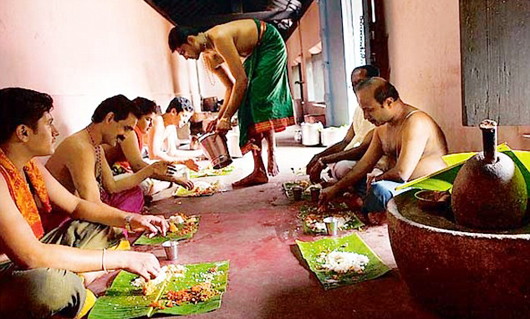
In Udupi, meals are served on banana leaves in a particular order. Many recipes and foods have also proven health benefits. For example, dishes made from the inner banana stem prevent kidney stones, pepper rasam helps with the lactation of new mothers, jackfruit seeds have high protein content and so on.

The authors also say that the original of the masal dose or the famous masala dosa is attributed to Udupi.

Before it was invented, plain dosa was served with potato playa, without onions, in a separate cup. With changing food tastes, the Udupi chefs began to saute the mashed potatoes with onions and spices.

"As onions were considered taboo food for orthodox Brahmins, it is said that the doses were stuffed with onion-laced playa, instead of served in a separate cup, so that the onion could be 'hidden'," the authors say.

Comments

Usha moorthy
 - 
Wednesday, 8 Jun 2016

I'm extremely pleased that I now have a book to refer to for genuine udupi food!!! Thanks to the authors for painstakingly bringing together these wonderful recipes!!;

Add new comment

  • Coastaldigest.com reserves the right to delete or block any comments.
  • Coastaldigset.com is not responsible for its readers’ comments.
  • Comments that are abusive, incendiary or irrelevant are strictly prohibited.
  • Please use a genuine email ID and provide your name to avoid reject.
Agencies
April 19,2020

French Nobel prize winning scientist Luc Montagnier has sparked a fresh controversy by claiming that the SARS-CoV-2 virus came from a lab, and is the result of an attempt to manufacture a vaccine against the AIDS virus.

In an interview given to French CNews channel and during a podcast by Pourquoi Docteur, professor Montagnier who co-discovered HIV (Human Immunodeficiency Virus) claimed the presence of elements of HIV in the genome of the coronavirus and even elements of the "germ of malaria" are highly suspect, according to a report in Asia Times.

"The Wuhan city laboratory has specialized in these coronaviruses since the early 2000s. They have expertise in this area," he was quoted as saying.

The theory that Covid-19 virus originated in the lab is making rounds for quite some time.

US President Donald Trump last week acknowledged Fox News report that the novel coronavirus may have been accidentally leaked by an intern working at the Wuhan Institute of Virology in China.

The Fox News, in an exclusive report, based on unnamed sources has claimed that though the virus is a naturally occurring strain among bats and not a bioweapon, but it was being studied in Wuhan laboratory.

The initial transmission of the virus was bat-to-human, the news channel said, adding that the "patient zero" worked at the laboratory. The lab employee was accidentally infected before spreading the disease among the common people outside the lab in Wuhan city.

Professor Montagnier was awarded the 2008 Nobel Prize in Medicine for the identification of AIDS virus, with his colleague professor Franeoise Barre-Sinoussi.

His fresh claim on coronavirus, however, received criticism from scientists, including his colleagues.

"Just in case you don't know. Dr Montagnier has been rolling downhill incredibly fast in the last few years. From baselessly defending homeopathy to becoming an antivaxxer. Whatever he says, just don't believe him," tweeted Juan Carlos Gabaldon.

As per a recent Washington Post, two years ago, the US embassy officials in China raised concerns about the insufficient biosafety at the Chinese government's Wuhan Institute of Virology where deadly viruses and infectious diseases are studied.

Though the institute, located quite close to the Wuhan wet market, is China's first biosafety level IV lab, the US state department had warned in 2018 about "serious shortage of appropriately trained technicians and investigators needed to safely operate this high-containment laboratory".

Comments

Add new comment

  • Coastaldigest.com reserves the right to delete or block any comments.
  • Coastaldigset.com is not responsible for its readers’ comments.
  • Comments that are abusive, incendiary or irrelevant are strictly prohibited.
  • Please use a genuine email ID and provide your name to avoid reject.
News Network
April 18,2020

Bengaluru, Apr 18: Hours after announcing that two-wheelers will be allowed to ply and that IT/BT companies can resume operations with 33 per cent strength, Chief Minister B S Yediyurappa on Saturday took a u-turn and rolled them back, citing “public opinion” as the reason. 

Earlier in the day, Yediyurappa announced that, after April 20, there will not be any restriction on the movement of two-wheelers in areas that are not COVID-19 containment zones. Yediyurappa also said that a third of IT/BT employees will be allowed to go to the office after April 20. 

“In the backdrop of public opinion and after discussions with senior officials, it has been decided that the prohibition on two-wheelers will continue throughout the lockdown period,” a statement from the Chief Minister’s Office said. “And in the IT/BT sector, only essential services will be allowed and the work-from-home policy will continue.” 

According to sources, the u-turn came following opposition from Yediyurappa’s Cabinet colleagues. “If I was in the meeting, I’d not have allowed it,” a minister said. Only Home Minister Basavaraj Bommai and Revenue Minister R Ashoka were in the meeting Yediyurappa held earlier in the day. The Opposition also stemmed from the fact that there was no need to make decisions on the lockdown when the Cabinet was scheduled to meet on April 20, sources said. 

The incoordination was apparent on Friday when Deputy Chief Minister CN Ashwath Narayan, the IT/BT minister, said 50 per cent of employees in the sector will be permitted to work while Yediyurappa said this would depend on the number of cases reported in the coming days. 

Other announcements made by Yediyurappa remain unchanged.

“Places, where COVID-19 cases are reported, will be identified as containment zones. In such containment zones, an incident commander will be appointed and given magisterial power. Teams comprising the police and health department officials will oversee the lockdown,” Yediyurappa said. “Lockdown will be much more stringent in these areas and no one will be allowed to step out. Essential supplies will be delivered home.”

According to Bommai, there were 32 containment zones in Bengaluru and ‘hotspots’ have been identified in eight districts.

With an eye on restarting economic activities, the government will allow construction work and industries. “In urban areas, construction work will be allowed to start wherever construction workers have the facility to stay on site,” Yediyurappa said. “The manufacturing sector in rural areas and industrial units located in the special economic zones (SEZ) and townships in urban areas will be allowed to function,” he said.

Stating that inter-state travel will be prohibited, Yediyurappa said the districts of Bengaluru Urban, Bengaluru Rural and Ramnagara will be considered as one only for the movement of industrial workers.

Asked about liquor sale, Yediyurappa said a decision will be taken after May 3. The government has already prohibited liquor sale till April 20 midnight.

Comments

Add new comment

  • Coastaldigest.com reserves the right to delete or block any comments.
  • Coastaldigset.com is not responsible for its readers’ comments.
  • Comments that are abusive, incendiary or irrelevant are strictly prohibited.
  • Please use a genuine email ID and provide your name to avoid reject.
News Network
April 3,2020

New Delhi, April 3: Chairman of Lulu Group, Yusuffali MA on Thursday contributed Rs 25 crores to the Prime Minister's Citizen Assistance and Relief in Emergency Situations (PM-CARES) to combat coronavirus.

"I have humbly contributed INR 25 Crores to the PM Cares Fund to support all relief works in India's fight against the COVID-19," Yusuffali said in a tweet.

Last month, Prime Minister Narendra Modi had created PM CARES Fund and appealed to all the countrymen to show their support for the cause.
The prime minister is the chairman of the trust and its members include the defence minister, the home minister and the finance minister.

Comments

Add new comment

  • Coastaldigest.com reserves the right to delete or block any comments.
  • Coastaldigset.com is not responsible for its readers’ comments.
  • Comments that are abusive, incendiary or irrelevant are strictly prohibited.
  • Please use a genuine email ID and provide your name to avoid reject.