


The secrets of Udupi's Madhwa Brahmin kitchen leaked!

[email protected] (News Network | KM Acharya)
August 26, 2015

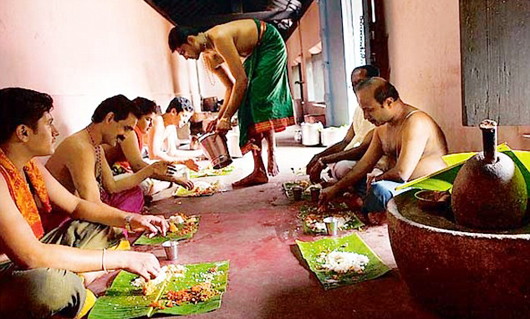
Udupi, Aug 26: What connects Bisi Bele Hulianna, Saaru, Modaka, Huggi, Majjige Palidya and Drakshi Gojju? These are some of the famed dishes of the Madhwa Brahmin community of Udupi, a coastal town in Karnataka where the Krishna temple acts as a pivot in people's lives.
brahmin

Laying out the geographical expanse and scientific logic to the regions Madhwa Brahmins vegetarian food habits, culinary expert Malati Srinivasan and arts and crafts connoisseur Geetha Rao showcase the hitherto unknown vegetarian recipes from Udupi in their book "The Udupi Kitchen."

The authors straddle the traditional and modern and list what was once easily cooked in Udupi households - spice powders, salads and chutneys, savoury snacks, desserts - and elaborate on several recipes which are all-time favourites like Bisi Bele Hulianna, Saaru, Masal Dose and Modaka.

While Bisi Bele Hulianna is a dish of spicy red gram, rice and vegetables, Saaru is spicy red gram soup, Huggi is rice and green gram with black pepper and cumin and Modaka is dumplings with coconut and jiggery filling.

Majjige Palidya is ash gourd with coconut and cumin in sour yoghurt and Drakshi Gojju is raisins in sweet, sour and spicy gravy.

Split into 12 sections, the Udupi Kitchen, published by Westland Ltd, celebrates vegetarian food with aplomb from a town where food is religion as well as a complete mouth-watering experience.

At the core of Udupi cuisine is the use of indigenous vegetables and fruits, cereals and pulses special to the Parashurama Kshetra and traditional Brahmins ate only vegetarian fare without onion and garlic.

According to the authors, Udupi cuisine has a vast variety and is not limited to tiffins or snacks.

"As I began working on this project, I realised how vast and varied our family’s repertoire of Udupi (Madhwa) cuisine was. I wrote down 175 recipes, but have used about a 100 of them in the book," says Srinivasan.

"Writing a cook book for both Indian and non-Indian readers required that a comprehensive multi-lingual glossary be compiled. It also meant using internationally accepted terminology: 'henchu' or 'tava' became griddle, bandle or 'kadhai' became wok, 'tappele' or 'bartan' became saucepan," says Rao.

She says for some kitchen tools like 'eelgemane' and 'ogarane chamcha', which had no "internationally understood" words, substitute words like curved knife blade and tempering-ladle had to be coined.

The story of Udupi cuisine is the story of how a temple-based, Brahmanical culinary tradition got modernised and became a global phenomenon. Food is religion in Udupi.

Fourteen varieties of food are cooked daily and offered to the deity at different times of the day. The food offered to god is 'naivediya', and the food eaten by human beings is 'prasada', food that is blessed.

In Udupi, meals are served on banana leaves in a particular order. Many recipes and foods have also proven health benefits. For example, dishes made from the inner banana stem prevent kidney stones, pepper rasam helps with the lactation of new mothers, jackfruit seeds have high protein content and so on.

The authors also say that the original of the masal dose or the famous masala dosa is attributed to Udupi.

Before it was invented, plain dosa was served with potato playa, without onions, in a separate cup. With changing food tastes, the Udupi chefs began to saute the mashed potatoes with onions and spices.

"As onions were considered taboo food for orthodox Brahmins, it is said that the doses were stuffed with onion-laced playa, instead of served in a separate cup, so that the onion could be 'hidden'," the authors say.

Comments

Usha moorthy
 - 
Wednesday, 8 Jun 2016

I'm extremely pleased that I now have a book to refer to for genuine udupi food!!! Thanks to the authors for painstakingly bringing together these wonderful recipes!!;

Add new comment

  • Coastaldigest.com reserves the right to delete or block any comments.
  • Coastaldigset.com is not responsible for its readers’ comments.
  • Comments that are abusive, incendiary or irrelevant are strictly prohibited.
  • Please use a genuine email ID and provide your name to avoid reject.
News Network
April 29,2020

New Delhi, Apr 29: WhatsApp on Tuesday said it will now allow up to eight people to connect on a group video call as an increasing number of people turn to digital platforms to connect with friends and family amid the COVID-19 pandemic.

The Facebook-owned company said over the last month, people on average are spending over 15 billion minutes talking each day on WhatsApp calls, well above a typical day before the pandemic.

"...we see that people all over the world are turning to voice and video calling on WhatsApp more than ever before. Group calling has been particularly useful and our users have asked to connect with more people at once," WhatsApp said in a blogpost.

Starting Tuesday, the company is doubling the number of participants one can have on a WhatsApp video or voice call from 4 to 8 people at a time, it added.

WhatsApp emphasised that like written messages, all calls on its platform are protected with end-to-end encryption.

"We have built group calling in a way that makes it available for as many users as possible, including people on lower-end devices and slow network conditions," it added.

Also Read: Coronavirus India update: State-wise total number of confirmed cases, deaths

WhatsApp said that to access the new, higher participant limit on WhatsApp calls, all participants in a call need to update to the latest version of WhatsApp available on iPhone or Android.

Video calling tools like Google Meet, Microsoft Teams, Zoom and others have also seen a significant jump in userbase and traffic as people connect while maintaining social distancing amid the coronavirus outbreak.

Last week, Facebook had introduced Messenger Rooms that will soon hold up to 50 people with no time limit.

It had added that the company will also add ways to create rooms from Instagram Direct, WhatsApp and Portal.

Noting that between WhatsApp and Messenger, more than 700 million accounts participate in calls every day, Facebook had said, adding that video calling on Messenger and WhatsApp more than doubled in many countries.

Also, views of Facebook Live and Instagram Live videos have also increased significantly in March, it said.

Comments

Add new comment

  • Coastaldigest.com reserves the right to delete or block any comments.
  • Coastaldigset.com is not responsible for its readers’ comments.
  • Comments that are abusive, incendiary or irrelevant are strictly prohibited.
  • Please use a genuine email ID and provide your name to avoid reject.
coastaldigest.com news network
June 28,2020

Mandya, Jun 28: Prime Minister Narendra Modi praised an 83-year-old farmer from Malavalli taluk in Mandya district of Karnataka for his efforts in water conservation.

While urging the people to focus on saving water, Modi, in his 'Man Ki Baat' on All India Radio quoted Kamegowda from Dasna Doddi village who single handedly dug small 16 ponds over the years in his farm land and in nearby hill while taking his animals for grazing.

"Kamegowda ji is an ordinary farmer, albeit possessing an extraordinary personality. He has achieved a personal feat that will leave anyone awestruck! Kamegowda ji, aged 80-85 takes out his animals for grazing but at the same time he has taken it upon himself to build new ponds in his area", the PM said in his Mann Ki Baat, a monthly radio address on Sunday.

To overcome problems of water scarcity in the area, Gowda started building small ponds. Thereby, he contributed a lot for water conservation, the PM said.

"... An octagenerarian like Kamegowda ji, till now, has dug 16 ponds through his hard work and the sweat of his brow. It is possible that the ponds he has constructed may not be very big but then his efforts are huge. Today, the entire area has got a new lease of life on account of these ponds," the PM said.

A little effort by us helps nature and environment quite significantly. Many of our countrymen are putting extraordinary efforts in this endeavour, the PM said. 

Kamegowda, used to take his sheep and goats to nearby hill for grazing. After finding no water to sheeps, he started digging ponds to address water scarcity. With collection of rain water, these lakes are brimming with water even during peak summer.

Comments

Add new comment

  • Coastaldigest.com reserves the right to delete or block any comments.
  • Coastaldigset.com is not responsible for its readers’ comments.
  • Comments that are abusive, incendiary or irrelevant are strictly prohibited.
  • Please use a genuine email ID and provide your name to avoid reject.
News Network
March 10,2020

Bengaluru, Mar 10: A 75-year-old man who arrived in Kalaburagi from Saudi Arabia on February 29 has been admitted to the isolation ward at Gulbarga Institute of Medical Sciences (GIMS) after he showed symptoms of coronavirus. 

His throat swab has been sent to the laboratory of Bengaluru’s Victoria Hospital. The district Health and Family Welfare Department is waiting for the report. 

The aged man who arrived from Saudi Arabia on February 28, was admitted to a private hospital on March 5 following fever and cough. As he showed the symptoms similar to coronavirus, the health of his family members has also been examined by the doctors and a close watch on them is being kept.

Recently, first confirmed positive case was reported from Whitefield in Bengaluru. The state government had also declared holiday for all primary schools in Bengaluru.

Comments

Add new comment

  • Coastaldigest.com reserves the right to delete or block any comments.
  • Coastaldigset.com is not responsible for its readers’ comments.
  • Comments that are abusive, incendiary or irrelevant are strictly prohibited.
  • Please use a genuine email ID and provide your name to avoid reject.