


The secrets of Udupi's Madhwa Brahmin kitchen leaked!

[email protected] (News Network | KM Acharya)
August 26, 2015

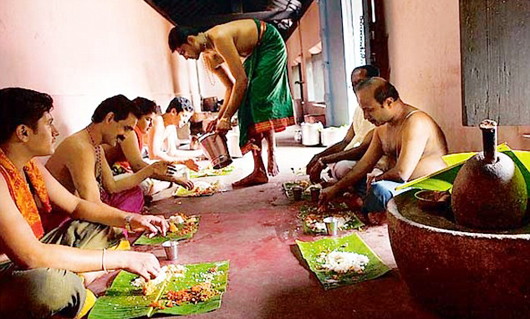
Udupi, Aug 26: What connects Bisi Bele Hulianna, Saaru, Modaka, Huggi, Majjige Palidya and Drakshi Gojju? These are some of the famed dishes of the Madhwa Brahmin community of Udupi, a coastal town in Karnataka where the Krishna temple acts as a pivot in people's lives.
brahmin

Laying out the geographical expanse and scientific logic to the regions Madhwa Brahmins vegetarian food habits, culinary expert Malati Srinivasan and arts and crafts connoisseur Geetha Rao showcase the hitherto unknown vegetarian recipes from Udupi in their book "The Udupi Kitchen."

The authors straddle the traditional and modern and list what was once easily cooked in Udupi households - spice powders, salads and chutneys, savoury snacks, desserts - and elaborate on several recipes which are all-time favourites like Bisi Bele Hulianna, Saaru, Masal Dose and Modaka.

While Bisi Bele Hulianna is a dish of spicy red gram, rice and vegetables, Saaru is spicy red gram soup, Huggi is rice and green gram with black pepper and cumin and Modaka is dumplings with coconut and jiggery filling.

Majjige Palidya is ash gourd with coconut and cumin in sour yoghurt and Drakshi Gojju is raisins in sweet, sour and spicy gravy.

Split into 12 sections, the Udupi Kitchen, published by Westland Ltd, celebrates vegetarian food with aplomb from a town where food is religion as well as a complete mouth-watering experience.

At the core of Udupi cuisine is the use of indigenous vegetables and fruits, cereals and pulses special to the Parashurama Kshetra and traditional Brahmins ate only vegetarian fare without onion and garlic.

According to the authors, Udupi cuisine has a vast variety and is not limited to tiffins or snacks.

"As I began working on this project, I realised how vast and varied our family’s repertoire of Udupi (Madhwa) cuisine was. I wrote down 175 recipes, but have used about a 100 of them in the book," says Srinivasan.

"Writing a cook book for both Indian and non-Indian readers required that a comprehensive multi-lingual glossary be compiled. It also meant using internationally accepted terminology: 'henchu' or 'tava' became griddle, bandle or 'kadhai' became wok, 'tappele' or 'bartan' became saucepan," says Rao.

She says for some kitchen tools like 'eelgemane' and 'ogarane chamcha', which had no "internationally understood" words, substitute words like curved knife blade and tempering-ladle had to be coined.

The story of Udupi cuisine is the story of how a temple-based, Brahmanical culinary tradition got modernised and became a global phenomenon. Food is religion in Udupi.

Fourteen varieties of food are cooked daily and offered to the deity at different times of the day. The food offered to god is 'naivediya', and the food eaten by human beings is 'prasada', food that is blessed.

In Udupi, meals are served on banana leaves in a particular order. Many recipes and foods have also proven health benefits. For example, dishes made from the inner banana stem prevent kidney stones, pepper rasam helps with the lactation of new mothers, jackfruit seeds have high protein content and so on.

The authors also say that the original of the masal dose or the famous masala dosa is attributed to Udupi.

Before it was invented, plain dosa was served with potato playa, without onions, in a separate cup. With changing food tastes, the Udupi chefs began to saute the mashed potatoes with onions and spices.

"As onions were considered taboo food for orthodox Brahmins, it is said that the doses were stuffed with onion-laced playa, instead of served in a separate cup, so that the onion could be 'hidden'," the authors say.

Comments

Usha moorthy
 - 
Wednesday, 8 Jun 2016

I'm extremely pleased that I now have a book to refer to for genuine udupi food!!! Thanks to the authors for painstakingly bringing together these wonderful recipes!!;

Add new comment

  • Coastaldigest.com reserves the right to delete or block any comments.
  • Coastaldigset.com is not responsible for its readers’ comments.
  • Comments that are abusive, incendiary or irrelevant are strictly prohibited.
  • Please use a genuine email ID and provide your name to avoid reject.
News Network
July 14,2020

Bengaluru, Jul 14: The Karnataka government on Tuesday made changes to the Land Reforms Act 1961 through an ordinance to allow non-agriculturists to buy and own farmland for farming.

“The Land Reforms Act has been amended through an ordinance and notified after Governor Vajubhai R Vala gave his assent to it on Monday night,” a Revenue Department official told media persons.

It now permits non-farmers to buy farmland and grow food crops. But they can’t use it for other activities.

“Sections 79 A, B and C of the Act have been repealed, paving way for bona fide citizens to invest in farmland and take to farming as a hobby, passion or additional occupation, which is rewarding,” the official said.

The amended Act will enable the state to attract investment in the farm sector and boost food output. The farm sector’s contribution to the state’s gross domestic product (GDP) has been less than the manufacturing and services sectors over the last two decades.

Criticism by farmers, the Congress and the JD(S) since the cabinet approved changes on June 11 forced the state government to retain section 80 of the Act, with an amendment, to prevent sale of dam water irrigated farmland.

“The ordinance has also added a new section (80A), which says relaxations under the Act will not apply to land given to farmers under the Karnataka SC and ST (Scheduled Caste and Tribe) Act 1978,” the official said.

The changes permit mortgage of farmland only to the state-run institutions, firms and cooperative societies specified in the Act. The ordinance also makes legal cases pending in courts against the sections amended redundant as the new Act addresses the concerns raised in them.

“Besides generating substantial revenue for the state government, the Act will now allow farmers who find the occupation non-remunerative and risky due to droughts/floods and labour shortage to sell their surplus land to urban buyers,” the official said.

Ruling BJP Rajya Sabha member KC Ramamurthy from Bengaluru said the amended Act would allow any citizen to buy farmland.

“Though hundreds of people petitioned successive governments for the past 45 years to abolish the ‘draconian’ sections, they were ignored. I compliment Chief Minister BS Yediyurappa and Revenue Minister R Ashoka for the decision to allow everyone to buy farmland irrespective of their occupation or profession,” Ramamurthy told media persons.

Comments

Add new comment

  • Coastaldigest.com reserves the right to delete or block any comments.
  • Coastaldigset.com is not responsible for its readers’ comments.
  • Comments that are abusive, incendiary or irrelevant are strictly prohibited.
  • Please use a genuine email ID and provide your name to avoid reject.
News Network
June 19,2020

Jun 19: BJP leader Devendra Fadnavis on Thursday said Maharashtra Chief Minister Uddhav Thackeray should sign an agreement with neighbouring Karnataka to avoid a repeat of flood in part of the state like it happened in August last year.

In August 2019, Kolhapur, Sangli districts and some other parts of the state faced unprecedented floods triggered by huge release of water from dams in western Maharashtra and from the Almatti dam in Karnataka.

Fadnavis said, The Maharashtra chief minister should hold an urgent meeting with the Karnataka chief minister and enter into an agreement over-discharge of water from the Almatti dam located on the border of both the states."

If water is not released from the Almatti dam in time, it will cause flooding in border areas of Maharashtra such as Kolhapur and Sangli.

"A pact between the two states would benefit both as it would help in keeping water levels in control, the former chief minister said.

The dams in the state already have sizeable water stock. It would be better if the chief minster schedules a meeting with the Karnataka chief minister regarding the same (agreement), the Leader of Opposition in the assembly said.

Comments

Add new comment

  • Coastaldigest.com reserves the right to delete or block any comments.
  • Coastaldigset.com is not responsible for its readers’ comments.
  • Comments that are abusive, incendiary or irrelevant are strictly prohibited.
  • Please use a genuine email ID and provide your name to avoid reject.
coastaldigst.com web desk
June 20,2020

New Delhi, Jun 20: As part of measures to check the spread of covid-19, Indian Railways is likely to stop distributing blankets and pillows in trains to AC passengers in coming days and it will make arrangements for sale at stalls on platforms.

The railways already stopped distributing blankets and pillows in 15 pair Special Rajdhani trains and 100 pair of fixed timetabled special trains, which is being operted at present. The system of not distributing blanks and pillows may continue in future once train operations normalise, said the official.

Passengers are encouraged to bring their own blankets and pillows. However same will be made available for purchase at shops so that if passengers want they can buy it, said an official.

The railways also made arrangements to sell sanitisers, masks and gloves at shops. The national transporter also said sale price should not exceed maximum retail price.

As per the Railway Board circular to zonal railways, " Amongst the items which fulfill the needs of travelling public and in keeping with the emphasis for providing safe and hygine travel facilities to passengers, it must be ensured that take away bedrolls kits/items other COVID-19 related protective items such as masks, sanitiser, gloves etc are also made available for sale through multi purpose stalls."

All items should be in good quality and will be sold only at MRP rate, circular said. The railways has also permanently removed curtains inside the AC coaches.

Comments

Add new comment

  • Coastaldigest.com reserves the right to delete or block any comments.
  • Coastaldigset.com is not responsible for its readers’ comments.
  • Comments that are abusive, incendiary or irrelevant are strictly prohibited.
  • Please use a genuine email ID and provide your name to avoid reject.