


The secrets of Udupi's Madhwa Brahmin kitchen leaked!

[email protected] (News Network | KM Acharya)
August 26, 2015

Udupi, Aug 26: What connects Bisi Bele Hulianna, Saaru, Modaka, Huggi, Majjige Palidya and Drakshi Gojju? These are some of the famed dishes of the Madhwa Brahmin community of Udupi, a coastal town in Karnataka where the Krishna temple acts as a pivot in people's lives.
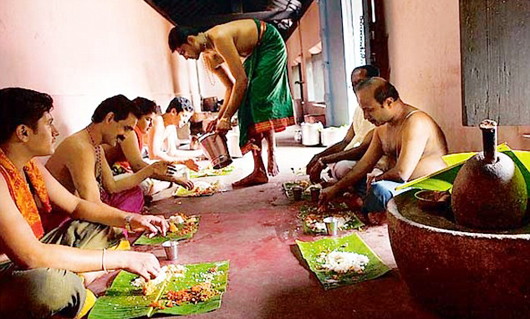
brahmin

Laying out the geographical expanse and scientific logic to the regions Madhwa Brahmins vegetarian food habits, culinary expert Malati Srinivasan and arts and crafts connoisseur Geetha Rao showcase the hitherto unknown vegetarian recipes from Udupi in their book "The Udupi Kitchen."

The authors straddle the traditional and modern and list what was once easily cooked in Udupi households - spice powders, salads and chutneys, savoury snacks, desserts - and elaborate on several recipes which are all-time favourites like Bisi Bele Hulianna, Saaru, Masal Dose and Modaka.

While Bisi Bele Hulianna is a dish of spicy red gram, rice and vegetables, Saaru is spicy red gram soup, Huggi is rice and green gram with black pepper and cumin and Modaka is dumplings with coconut and jiggery filling.

Majjige Palidya is ash gourd with coconut and cumin in sour yoghurt and Drakshi Gojju is raisins in sweet, sour and spicy gravy.

Split into 12 sections, the Udupi Kitchen, published by Westland Ltd, celebrates vegetarian food with aplomb from a town where food is religion as well as a complete mouth-watering experience.

At the core of Udupi cuisine is the use of indigenous vegetables and fruits, cereals and pulses special to the Parashurama Kshetra and traditional Brahmins ate only vegetarian fare without onion and garlic.

According to the authors, Udupi cuisine has a vast variety and is not limited to tiffins or snacks.

"As I began working on this project, I realised how vast and varied our family’s repertoire of Udupi (Madhwa) cuisine was. I wrote down 175 recipes, but have used about a 100 of them in the book," says Srinivasan.

"Writing a cook book for both Indian and non-Indian readers required that a comprehensive multi-lingual glossary be compiled. It also meant using internationally accepted terminology: 'henchu' or 'tava' became griddle, bandle or 'kadhai' became wok, 'tappele' or 'bartan' became saucepan," says Rao.

She says for some kitchen tools like 'eelgemane' and 'ogarane chamcha', which had no "internationally understood" words, substitute words like curved knife blade and tempering-ladle had to be coined.

The story of Udupi cuisine is the story of how a temple-based, Brahmanical culinary tradition got modernised and became a global phenomenon. Food is religion in Udupi.

Fourteen varieties of food are cooked daily and offered to the deity at different times of the day. The food offered to god is 'naivediya', and the food eaten by human beings is 'prasada', food that is blessed.

In Udupi, meals are served on banana leaves in a particular order. Many recipes and foods have also proven health benefits. For example, dishes made from the inner banana stem prevent kidney stones, pepper rasam helps with the lactation of new mothers, jackfruit seeds have high protein content and so on.

The authors also say that the original of the masal dose or the famous masala dosa is attributed to Udupi.

Before it was invented, plain dosa was served with potato playa, without onions, in a separate cup. With changing food tastes, the Udupi chefs began to saute the mashed potatoes with onions and spices.

"As onions were considered taboo food for orthodox Brahmins, it is said that the doses were stuffed with onion-laced playa, instead of served in a separate cup, so that the onion could be 'hidden'," the authors say.

Comments

Usha moorthy
 - 
Wednesday, 8 Jun 2016

I'm extremely pleased that I now have a book to refer to for genuine udupi food!!! Thanks to the authors for painstakingly bringing together these wonderful recipes!!;

Add new comment

  • Coastaldigest.com reserves the right to delete or block any comments.
  • Coastaldigset.com is not responsible for its readers’ comments.
  • Comments that are abusive, incendiary or irrelevant are strictly prohibited.
  • Please use a genuine email ID and provide your name to avoid reject.
News Network
April 8,2020

Bengaluru, Apr 8: Till date 181 COVID-19 positive cases have been confirmed in Karnataka including five deaths and 28 discharges, said State Government on Wednesday.

Six new positive cases have been reported from April 7, 5:00 PM to April 8, 12:00 noon, informed Karnataka Government in a bulletin.

Out of the six fresh cases one has been reported from Uttarakannada, two from Kalburgi, one from Mandya, one from Chikkaballapur and one from BBMP Bengaluru.

"In view of breaking the chain and containment of COVID-19, Karnataka State Board of Auqaf, Bengaluru has directed to all the managements not to allow any congregational prayers in the Masajid and the managements of the Qabrasthans (Muslim graveyards) / Darghas throughout the state and to suspend the visit of public on the occasion of SHAB-EBARAT on thursday, April 9," said State Government in its bulletin.

No public shall be allowed to perform religious rituals in the Qabrasthans/Darghas and all the gates of Qabrasthans/Darghas shall be kept closed.

All managements of Qabrasthans/Darghas shall take necessary action on the above directions and all Waqf officers, District Waqf Advisory Committee in state shall adhere to the orders and directed to circulate the same and to ensure the order is followed scrupulously, the State Government added.

India's tally of positive COVID-19 cases stands at 5,194, said the Ministry of Health and Family Welfare on Wednesday.

Out of the 5194 cases, 4,643 are reported to be active while 401 people have recovered or have been discharged and one has migrated. The death toll stands at 149.

Comments

Add new comment

  • Coastaldigest.com reserves the right to delete or block any comments.
  • Coastaldigset.com is not responsible for its readers’ comments.
  • Comments that are abusive, incendiary or irrelevant are strictly prohibited.
  • Please use a genuine email ID and provide your name to avoid reject.
News Network
March 30,2020

Bengaluru, Mar 30: The nationwide lockdown has left the state on the brink of a fresh agrarian crisis.

The lack of transport facilities spells doom for ready-to-harvest grapes worth Rs 500-600 crore in Bengaluru Rural, Chikkaballapur and Kolar districts. Unable to find buyers, several farmers have begun dumping their produce into compost pits.

On Sunday, Munishamappa, a farmer in Chikkaballapur, emptied four truckloads of grapes into the pit as buyers didn’t turn up due to the lockdown. “If the grapes wither and fall to the ground, it will affect the soil’s fertility and I will be forced to dispose of them,” he said.

Venkata Krishnappa, Munishamappa’s son, said their 1.5-acre vineyard yielded 25 tonnes of grapes. “Just before the lockdown, 10 tonnes were harvested and delivered to the market. Due to lack of transport, buyers haven’t turned up for the remaining 15 tonnes which we are dumping into the pit.”

For latest updates on coronavirus outbreak, click here

Anjaneya Reddy, a farmer leader, said that in Chikkaballapur alone, they have cultivated grapes on 2,000 acres. “Even if you consider 15 tonnes per acre as yield, there are about 30,000 tonnes ready to be harvested in the district. At a market rate of Rs 50 to Rs 60 per kilogram, the net worth will be Rs 200 crore to Rs 300 crore. And if you consider the crop in Kolar and Bengaluru Rural, grapes worth Rs 500 to Rs 600 crore are at stake,” he explained.

The ‘Dilkush’ grapes is the most preferred variety of domestic consumption, according to the farmers.

This apart, farmers would have invested about Rs 3 lakh to 4 lakh per acre on fertilisers, pesticide and labour. “With markets being shut and no of the transport facilities available, farmers are forced to dump their produce into pits. It is high time the government intervened and provided us with market options so that farmers can sell at an affordable price of Rs 30 to 40,” Reddy said.

Somu, a farmer in Ganjam village of Srirangapattana, dumped two tonnes of chikku (sapota) citing market shutdown in Mandya. Reddy appealed to the government to emulate the Maharashtra model where the government is helping farmers market fruits through Hopcoms or dairy units as nutrient supplements to people.

Comments

Add new comment

  • Coastaldigest.com reserves the right to delete or block any comments.
  • Coastaldigset.com is not responsible for its readers’ comments.
  • Comments that are abusive, incendiary or irrelevant are strictly prohibited.
  • Please use a genuine email ID and provide your name to avoid reject.
News Network
May 30,2020

Bengaluru, May 30: Bengaluru City civic body Bruhat Bengaluru Mahanagara Palike (BBMP) has slapped a fine of Rs 50,000 on the food delivery startup Swiggy for irresponsible disposal of waste, an official said on Friday.

"Thinking of food is great - Swiggy. Hope you also think of segregating waste and disposing of it responsibly," tweeted BBMP Solid Waste Management Special Commissioner D. Randeep.

Randeep said a penalty of Rs 50,000 was imposed on Swiggy Kitchen at Katriguppe in the city for the violation.

"The incident with respect to waste segregation has been brought to our notice and happened at one of our kitchens in Bengaluru," confirmed a Swiggy spokesperson to IANS without revealing the exact details.

He said the startup is aware of its civic responsibility and has stringent processes to ensure high standards of compliance.

"While we investigate and rectify the root cause of the matter, we are reinforcing necessary awareness on the best practices to be followed amongst our teams and partner network to ensure complete compliance with waste management," the spokesperson added.

Swiggy has been penalised earlier as well for its irresponsible disposal of waste.

Recently, the BBMP’s solid waste management department has also fined an apartment complex Rs 15,000 for not segregating waste into dry, wet and reject categories.

Waste disposal norms for apartments

"Segregation of waste is mandatory in apartments. Onus of enforcing segregation rules lies on the (apartment) association and waste should be segregated as dry, wet and reject," said Randeep.

InClover Grand Apartments at Baiyappanhalli was penalised for the offence of improper waste disposal. Similarly, BBMP marshals also caught and fined some people openly discarding waste in public spaces.

"Dear citizens, please change your old habits. Our marshals are watching and will fine those who throw garbage in public spaces," BBMP Special Commissioner Randeep said.

He shared the photographs of two scooter-borne individuals being caught in the act and penalised at Kuvempunagar in Bengaluru.

Comments

Add new comment

  • Coastaldigest.com reserves the right to delete or block any comments.
  • Coastaldigset.com is not responsible for its readers’ comments.
  • Comments that are abusive, incendiary or irrelevant are strictly prohibited.
  • Please use a genuine email ID and provide your name to avoid reject.