


The secrets of Udupi's Madhwa Brahmin kitchen leaked!

[email protected] (News Network | KM Acharya)
August 26, 2015

Udupi, Aug 26: What connects Bisi Bele Hulianna, Saaru, Modaka, Huggi, Majjige Palidya and Drakshi Gojju? These are some of the famed dishes of the Madhwa Brahmin community of Udupi, a coastal town in Karnataka where the Krishna temple acts as a pivot in people's lives.
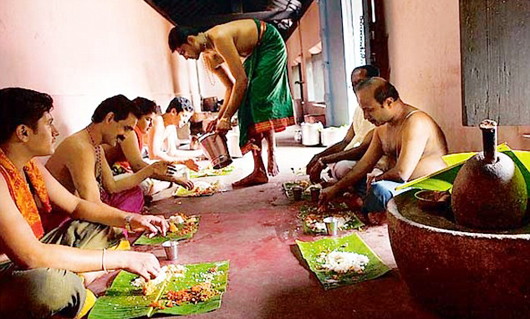
brahmin

Laying out the geographical expanse and scientific logic to the regions Madhwa Brahmins vegetarian food habits, culinary expert Malati Srinivasan and arts and crafts connoisseur Geetha Rao showcase the hitherto unknown vegetarian recipes from Udupi in their book "The Udupi Kitchen."

The authors straddle the traditional and modern and list what was once easily cooked in Udupi households - spice powders, salads and chutneys, savoury snacks, desserts - and elaborate on several recipes which are all-time favourites like Bisi Bele Hulianna, Saaru, Masal Dose and Modaka.

While Bisi Bele Hulianna is a dish of spicy red gram, rice and vegetables, Saaru is spicy red gram soup, Huggi is rice and green gram with black pepper and cumin and Modaka is dumplings with coconut and jiggery filling.

Majjige Palidya is ash gourd with coconut and cumin in sour yoghurt and Drakshi Gojju is raisins in sweet, sour and spicy gravy.

Split into 12 sections, the Udupi Kitchen, published by Westland Ltd, celebrates vegetarian food with aplomb from a town where food is religion as well as a complete mouth-watering experience.

At the core of Udupi cuisine is the use of indigenous vegetables and fruits, cereals and pulses special to the Parashurama Kshetra and traditional Brahmins ate only vegetarian fare without onion and garlic.

According to the authors, Udupi cuisine has a vast variety and is not limited to tiffins or snacks.

"As I began working on this project, I realised how vast and varied our family’s repertoire of Udupi (Madhwa) cuisine was. I wrote down 175 recipes, but have used about a 100 of them in the book," says Srinivasan.

"Writing a cook book for both Indian and non-Indian readers required that a comprehensive multi-lingual glossary be compiled. It also meant using internationally accepted terminology: 'henchu' or 'tava' became griddle, bandle or 'kadhai' became wok, 'tappele' or 'bartan' became saucepan," says Rao.

She says for some kitchen tools like 'eelgemane' and 'ogarane chamcha', which had no "internationally understood" words, substitute words like curved knife blade and tempering-ladle had to be coined.

The story of Udupi cuisine is the story of how a temple-based, Brahmanical culinary tradition got modernised and became a global phenomenon. Food is religion in Udupi.

Fourteen varieties of food are cooked daily and offered to the deity at different times of the day. The food offered to god is 'naivediya', and the food eaten by human beings is 'prasada', food that is blessed.

In Udupi, meals are served on banana leaves in a particular order. Many recipes and foods have also proven health benefits. For example, dishes made from the inner banana stem prevent kidney stones, pepper rasam helps with the lactation of new mothers, jackfruit seeds have high protein content and so on.

The authors also say that the original of the masal dose or the famous masala dosa is attributed to Udupi.

Before it was invented, plain dosa was served with potato playa, without onions, in a separate cup. With changing food tastes, the Udupi chefs began to saute the mashed potatoes with onions and spices.

"As onions were considered taboo food for orthodox Brahmins, it is said that the doses were stuffed with onion-laced playa, instead of served in a separate cup, so that the onion could be 'hidden'," the authors say.

Comments

Usha moorthy
 - 
Wednesday, 8 Jun 2016

I'm extremely pleased that I now have a book to refer to for genuine udupi food!!! Thanks to the authors for painstakingly bringing together these wonderful recipes!!;

Add new comment

  • Coastaldigest.com reserves the right to delete or block any comments.
  • Coastaldigset.com is not responsible for its readers’ comments.
  • Comments that are abusive, incendiary or irrelevant are strictly prohibited.
  • Please use a genuine email ID and provide your name to avoid reject.
coastaldigest.com web desk
June 14,2020

Benglauru, June 14: Even as schools are divided over providing online education, the state Higher Education Department is stressing on continuing online education.

Deputy Chief Minister and Higher Education Minister Dr C N Ashwath Narayan has stressed the need for digital learning to eliminate educational inequalities.

Taking part in a Webinar on ‘Digitising Higher Education - Challenges and Opportunities,’ organised by the Padmashree Institute of Management, he asked educational institutions to give emphasis to digital learning.

“Digital learning is a means to ensure quality education to all sections of the society without discrimination on the basis of caste, region and religion. This is a solution to eliminate discrimination. Through digital learning, a student in a remote village will also get an opportunity to learn from an experienced and highly qualified teacher.”

In addition to this, students are getting study material in digital form. Keeping these important aspects in mind, all educational institutions should give stress to digital learning without wasting any time,’’ he said.

He, however, admitted that digital learning has its own challenges like - quality internet connectivity, laptops and mobile gadgets.

“We are trying to find a solution to it by raising funds through Corporate Social Responsibility or through government funds,” he said. “We are making efforts to provide 4G network across the State,” he said.

Comments

Add new comment

  • Coastaldigest.com reserves the right to delete or block any comments.
  • Coastaldigset.com is not responsible for its readers’ comments.
  • Comments that are abusive, incendiary or irrelevant are strictly prohibited.
  • Please use a genuine email ID and provide your name to avoid reject.
News Network
April 28,2020

Bengaluru, Apr 28: Providing respite, Karnataka has decided to ‘conditionally’ allow economic activities to restart in green zones.

The green zones of Chamarajanagar, Koppal, Chikkamagaluru, Raichur, Chitradurga, Ramanagara, Hassan, Shivamogga, Haveri, Yadgir, Kolar, Davangere, Udupi and Kodagu will now see shops and industrial activities starting operations, according to an order issued by Chief Secretary TM Vijay Bhaskar on Tuesday.

Lockdown restrictions in the wake of COVID-19 will continue in Bengaluru Urban, Belagavi, Mysuru, Vijayapura, Bagalkot, Kalaburagi, Bidar and Dakshina Kannada. Here, only essential services and supplies will be allowed.

In green zones, all shops that include neighbourhood shops, standalone shops, shops in residential complexes within the limits of municipal corporations and municipalities can open with 50 per cent manpower but with masks and social distancing mandatory.

Shops in residential and marketing complexes are allowed to open in areas located outside municipal limits, the order states.

Multi-brand and single-brand malls will remain shut across Karnataka.

Industries operating in rural areas of these green zones (except Ramanagara) have been allowed to start. Also, manufacturing and other industrial establishments with access control in special economic zones and export-oriented units, industrial estates and industrial townships will be allowed to operate.

“These establishments shall make arrangements for stay of workers within their premises as far as possible and/ or adjacent buildings. The transportation of workers to workplace shall be arranged by the employers in dedicated transport by ensuring social distancing (sic),” Bhaskar said in the order.

This order comes a day after Chief Minister BS Yediyurappa participated in a video conference with Prime Minister Narendra Modi, and with all deputy commissioners.

No decision on relaxing lockdown restrictions has been taken for Ballari, Mandya, Bengaluru Rural, Gadag, Tumakuru, Chikkaballapur, Uttara Kannada and Dharwad. “The decision regarding opening of shops and industries in taluks where there are no active COVID-19 cases will be taken by the concerned district in-charge minister,” Bhaskar said.

Comments

Add new comment

  • Coastaldigest.com reserves the right to delete or block any comments.
  • Coastaldigset.com is not responsible for its readers’ comments.
  • Comments that are abusive, incendiary or irrelevant are strictly prohibited.
  • Please use a genuine email ID and provide your name to avoid reject.
News Network
February 25,2020

Mangaluru, Feb 25: Notorious gangster Ravi Poojary,

who has been extradited to India from Senegal, has 34 cases registered against him within the city police commissionerate.

Now in Bengaluru police custody for interrogation in connection with several cases there, Poojary faces cases relating to murder, murder attempt, extortion and threat calls in the city, police sources said.

Sources said the city police are trying to get Pujari for interrogation though it would take a while as the court has allowed Bengaluru police to keep him in custody for questioning and evidence taking for 15 days.

Most of the cases in the city against him, 28 of them, are in connection with threat calls.

He had allegedly made threat calls in 2015 to the then state ministers B Ramanath Rai and Abhayachandra Jain, demanding immediate arrest of the accused in the murder of Bajrang Dal worker Prashanth Poojary.

All the cases against Poojary in the city were registered between 2007 and 2018.

Cases involving murder, death threats and shootouts are among the cases to be investigated, the sources said.

A total of 28 cases of death threat calls, one of murder, three of shootouts, one of abduction and a case of funding his associates lodged in prison are the crimes being probed by the city police.

The cases are now pending in courts at different stages of trial.

Cases of making threat calls to businessmen using his associates demanding protection money have been registered at Moodbidri, Kavoor, Kadri, Konaje, Barke and Urwa police stations.

Some of his associates were imprisoned in 2012 in connection with threat calls to a businessman from Kinnigoli.

The case relating to providing them money while in prison was also registered in the same year.

Pujari, wanted in many cases including extortion and murder in different parts of the country, including Karnataka and who had been on the run for over 15 years, was deported to Senegal following his arrest and later extradited

He had jumped bail in Senegal last year after being arrested there.

Comments

Add new comment

  • Coastaldigest.com reserves the right to delete or block any comments.
  • Coastaldigset.com is not responsible for its readers’ comments.
  • Comments that are abusive, incendiary or irrelevant are strictly prohibited.
  • Please use a genuine email ID and provide your name to avoid reject.