


The secrets of Udupi's Madhwa Brahmin kitchen leaked!

[email protected] (News Network | KM Acharya)
August 26, 2015

Udupi, Aug 26: What connects Bisi Bele Hulianna, Saaru, Modaka, Huggi, Majjige Palidya and Drakshi Gojju? These are some of the famed dishes of the Madhwa Brahmin community of Udupi, a coastal town in Karnataka where the Krishna temple acts as a pivot in people's lives.
brahmin

Laying out the geographical expanse and scientific logic to the regions Madhwa Brahmins vegetarian food habits, culinary expert Malati Srinivasan and arts and crafts connoisseur Geetha Rao showcase the hitherto unknown vegetarian recipes from Udupi in their book "The Udupi Kitchen."

The authors straddle the traditional and modern and list what was once easily cooked in Udupi households - spice powders, salads and chutneys, savoury snacks, desserts - and elaborate on several recipes which are all-time favourites like Bisi Bele Hulianna, Saaru, Masal Dose and Modaka.

While Bisi Bele Hulianna is a dish of spicy red gram, rice and vegetables, Saaru is spicy red gram soup, Huggi is rice and green gram with black pepper and cumin and Modaka is dumplings with coconut and jiggery filling.

Majjige Palidya is ash gourd with coconut and cumin in sour yoghurt and Drakshi Gojju is raisins in sweet, sour and spicy gravy.

Split into 12 sections, the Udupi Kitchen, published by Westland Ltd, celebrates vegetarian food with aplomb from a town where food is religion as well as a complete mouth-watering experience.

At the core of Udupi cuisine is the use of indigenous vegetables and fruits, cereals and pulses special to the Parashurama Kshetra and traditional Brahmins ate only vegetarian fare without onion and garlic.

According to the authors, Udupi cuisine has a vast variety and is not limited to tiffins or snacks.

"As I began working on this project, I realised how vast and varied our family’s repertoire of Udupi (Madhwa) cuisine was. I wrote down 175 recipes, but have used about a 100 of them in the book," says Srinivasan.

"Writing a cook book for both Indian and non-Indian readers required that a comprehensive multi-lingual glossary be compiled. It also meant using internationally accepted terminology: 'henchu' or 'tava' became griddle, bandle or 'kadhai' became wok, 'tappele' or 'bartan' became saucepan," says Rao.

She says for some kitchen tools like 'eelgemane' and 'ogarane chamcha', which had no "internationally understood" words, substitute words like curved knife blade and tempering-ladle had to be coined.

The story of Udupi cuisine is the story of how a temple-based, Brahmanical culinary tradition got modernised and became a global phenomenon. Food is religion in Udupi.

Fourteen varieties of food are cooked daily and offered to the deity at different times of the day. The food offered to god is 'naivediya', and the food eaten by human beings is 'prasada', food that is blessed.

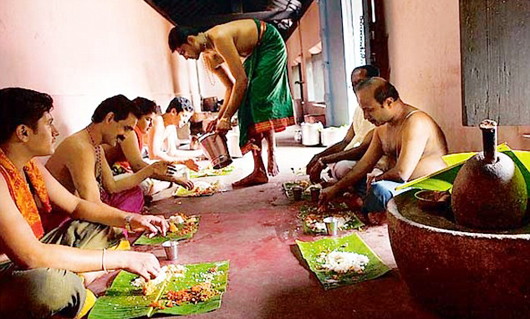
In Udupi, meals are served on banana leaves in a particular order. Many recipes and foods have also proven health benefits. For example, dishes made from the inner banana stem prevent kidney stones, pepper rasam helps with the lactation of new mothers, jackfruit seeds have high protein content and so on.

The authors also say that the original of the masal dose or the famous masala dosa is attributed to Udupi.

Before it was invented, plain dosa was served with potato playa, without onions, in a separate cup. With changing food tastes, the Udupi chefs began to saute the mashed potatoes with onions and spices.

"As onions were considered taboo food for orthodox Brahmins, it is said that the doses were stuffed with onion-laced playa, instead of served in a separate cup, so that the onion could be 'hidden'," the authors say.

Comments

Usha moorthy
 - 
Wednesday, 8 Jun 2016

I'm extremely pleased that I now have a book to refer to for genuine udupi food!!! Thanks to the authors for painstakingly bringing together these wonderful recipes!!;

Add new comment

  • Coastaldigest.com reserves the right to delete or block any comments.
  • Coastaldigset.com is not responsible for its readers’ comments.
  • Comments that are abusive, incendiary or irrelevant are strictly prohibited.
  • Please use a genuine email ID and provide your name to avoid reject.
News Network
May 23,2020

Bengaluru, May 23: It was a stampede-like situation near Palace Grounds in Bengaluru on Saturday afternoon. The incident took place after hundreds of migrants gathered and jostled to gain entry. The situation raises concerns as no social distancing norms were followed.

According to Chetan Singh Rathore, DCP Central, the reason behind the stampede-like situation was an en masse message. "What we heard was that an en masse message has been conveyed to the people of Manipur and Odisha that they would be able to go home on trains on Saturday. The message did not consider the capacity of the train which is only 1500 seating capacity for Manipur train and 1500 for Odisha train," he told media.

Singh further added, "But the people gathered were around 3000 in number for the Manipur train and 5000 for the Odisha train. Passengers with tickets and requisites were allowed to travel while others were asked to return home and wait for their turn to travel back home."

The state of Karnataka has eased lockdown restrictions across, allowing state transport services to run. Lately, the government has been running special Shramik trains from Karnataka to ferry migrant workers back to their hometowns.

Comments

Add new comment

  • Coastaldigest.com reserves the right to delete or block any comments.
  • Coastaldigset.com is not responsible for its readers’ comments.
  • Comments that are abusive, incendiary or irrelevant are strictly prohibited.
  • Please use a genuine email ID and provide your name to avoid reject.
News Network
May 15,2020

Bengaluru, May 15 Reformed underworld don N Muthappa Rai died battling cancer at a private hospital here on Friday, hospital sources said.

Rai, 68, was suffering from brain cancer for the past one year and was admitted at Manipal Hospital on Old Airport Road, where he died at 2.30 am, the sources said. Rai is survived by two sons.

Born into a Tulu-speaking Bunt family in Dakshina Kannada''s Puttur town, Rai entered the crime world at a very young age.

Karnataka police issued arrest warrants against Rai in eight cases, including murder and conspiracy.

In 2002, Rai was deported to India from the United Arab Emirates. On arrival, he was questioned by various investigation agencies such as the Central Bureau of Investigation (CBI), Research and Analysis Wing (RAW) and Intelligence Bureau (IB), and by the Karnataka police. He was later acquitted due to the lack of evidences.

In his reformed years, Rai founded charitable organisation ''Jaya Karnataka''.

Rai has appeared in Tulu film ''Kanchilda Baale'' in 2011 and Kannada film ''Katari Veera Surasundarangi'' in 2012.

Bollywood director Ram Gopal Varma wanted to make a movie based on Rai''s life. The film roped in actor Vivek Oberoi for the lead role and was shot in Bengaluru, Mangaluru, Mumbai, Dubai and London. However, it has not been released due to production delays.

Rai was enthusiastic about the film and even celebrated his birthday with Varma and Oberoi.

After his cancer diagnosis, Rai withdrew from public life and resigned from Jaya Karnataka.

His last rites are likely to be performed at Bidadi on Friday, family sources said.

Comments

Add new comment

  • Coastaldigest.com reserves the right to delete or block any comments.
  • Coastaldigset.com is not responsible for its readers’ comments.
  • Comments that are abusive, incendiary or irrelevant are strictly prohibited.
  • Please use a genuine email ID and provide your name to avoid reject.
News Network
March 7,2020

Thrissur, Mar 7: A local temple in Kerala is at the centre of a social media storm after the picture of a ''Brahmins-only toilet'' outside its main campus went viral on online platforms, prompting the management to remove the signboard.

The picture of three toilets, with signboards showing "Men", "Women" and "Brahmins", at the Kuttumukku Mahadeva Temple in Thrissur, has gone viral with many social media users viewing it as an unethical practise that can portray the progressive state in a bad light.

However, temple officials said the toilets were located outside the main campus and the board was brought to their notice only now.

Kannan, an official of the temple committee, said the board was placed nearly two decades ago and nobody raised any complaint against it so far.

"That particular toilet was being used by priests and other temple employees. We didn't even notice that board... As soon as we came to know about it, we removed it and affixed a staff-only board," he told PTI.

Also a CPI-M functionary and ward councillor, Kannan said the shrine and it's management was against all kinds of unethical customs.

The temple official said they were planning to pursue legal measures against the man who posted the photo of the toilets on social media.

"We suspect that he did it deliberately to create issues during the time of the festival and to tarnish the shrine's reputation. Not only that, the photo he shared was an old one though he claimed that it was taken during the time of the festival, " he said.

Comments

Add new comment

  • Coastaldigest.com reserves the right to delete or block any comments.
  • Coastaldigset.com is not responsible for its readers’ comments.
  • Comments that are abusive, incendiary or irrelevant are strictly prohibited.
  • Please use a genuine email ID and provide your name to avoid reject.