


The secrets of Udupi's Madhwa Brahmin kitchen leaked!

[email protected] (News Network | KM Acharya)
August 26, 2015

Udupi, Aug 26: What connects Bisi Bele Hulianna, Saaru, Modaka, Huggi, Majjige Palidya and Drakshi Gojju? These are some of the famed dishes of the Madhwa Brahmin community of Udupi, a coastal town in Karnataka where the Krishna temple acts as a pivot in people's lives.
brahmin

Laying out the geographical expanse and scientific logic to the regions Madhwa Brahmins vegetarian food habits, culinary expert Malati Srinivasan and arts and crafts connoisseur Geetha Rao showcase the hitherto unknown vegetarian recipes from Udupi in their book "The Udupi Kitchen."

The authors straddle the traditional and modern and list what was once easily cooked in Udupi households - spice powders, salads and chutneys, savoury snacks, desserts - and elaborate on several recipes which are all-time favourites like Bisi Bele Hulianna, Saaru, Masal Dose and Modaka.

While Bisi Bele Hulianna is a dish of spicy red gram, rice and vegetables, Saaru is spicy red gram soup, Huggi is rice and green gram with black pepper and cumin and Modaka is dumplings with coconut and jiggery filling.

Majjige Palidya is ash gourd with coconut and cumin in sour yoghurt and Drakshi Gojju is raisins in sweet, sour and spicy gravy.

Split into 12 sections, the Udupi Kitchen, published by Westland Ltd, celebrates vegetarian food with aplomb from a town where food is religion as well as a complete mouth-watering experience.

At the core of Udupi cuisine is the use of indigenous vegetables and fruits, cereals and pulses special to the Parashurama Kshetra and traditional Brahmins ate only vegetarian fare without onion and garlic.

According to the authors, Udupi cuisine has a vast variety and is not limited to tiffins or snacks.

"As I began working on this project, I realised how vast and varied our family’s repertoire of Udupi (Madhwa) cuisine was. I wrote down 175 recipes, but have used about a 100 of them in the book," says Srinivasan.

"Writing a cook book for both Indian and non-Indian readers required that a comprehensive multi-lingual glossary be compiled. It also meant using internationally accepted terminology: 'henchu' or 'tava' became griddle, bandle or 'kadhai' became wok, 'tappele' or 'bartan' became saucepan," says Rao.

She says for some kitchen tools like 'eelgemane' and 'ogarane chamcha', which had no "internationally understood" words, substitute words like curved knife blade and tempering-ladle had to be coined.

The story of Udupi cuisine is the story of how a temple-based, Brahmanical culinary tradition got modernised and became a global phenomenon. Food is religion in Udupi.

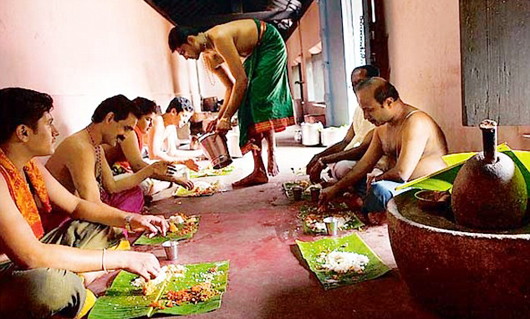
Fourteen varieties of food are cooked daily and offered to the deity at different times of the day. The food offered to god is 'naivediya', and the food eaten by human beings is 'prasada', food that is blessed.

In Udupi, meals are served on banana leaves in a particular order. Many recipes and foods have also proven health benefits. For example, dishes made from the inner banana stem prevent kidney stones, pepper rasam helps with the lactation of new mothers, jackfruit seeds have high protein content and so on.

The authors also say that the original of the masal dose or the famous masala dosa is attributed to Udupi.

Before it was invented, plain dosa was served with potato playa, without onions, in a separate cup. With changing food tastes, the Udupi chefs began to saute the mashed potatoes with onions and spices.

"As onions were considered taboo food for orthodox Brahmins, it is said that the doses were stuffed with onion-laced playa, instead of served in a separate cup, so that the onion could be 'hidden'," the authors say.

Comments

Usha moorthy
 - 
Wednesday, 8 Jun 2016

I'm extremely pleased that I now have a book to refer to for genuine udupi food!!! Thanks to the authors for painstakingly bringing together these wonderful recipes!!;

Add new comment

  • Coastaldigest.com reserves the right to delete or block any comments.
  • Coastaldigset.com is not responsible for its readers’ comments.
  • Comments that are abusive, incendiary or irrelevant are strictly prohibited.
  • Please use a genuine email ID and provide your name to avoid reject.
News Network
February 19,2020

Chikkamagaluru, Feb 19: A 31-year-old homemaker was murdered and valuables, including 100gm of gold and 2kg of silver, were reported missing from her house in Kadur town of Chikkamagaluru district late Monday evening. Her 11-month-old son, who was with her at the time of the attack, had a miraculous escape.

Police said Kavita's husband Dr Revath was away in his clinic in the town's Kadur-Birur road along with their first son, 5. Kavita, who has done MA and from Udupi, and the dentist married seven years ago.

District superintendent of police Harish Pandey has formed a special team to probe the incident that took place in Lakshmish Nagar in the town.

According to police, Kavita spoke to her husband around 6.45pm on Monday and didn't answer his subsequent calls, triggering a strong suspicion in him that something was amiss. He called his relatives living nearby to check on his wife. The relatives rushed to the house only to find the main door locked.

Since Kavita didn't answer the doorbell, they force-entered the house from the rear door and found her in a pool of blood. She was taken to a private clinic where doctors declared her brought dead.

Police said the woman was killed by a sharp weapon by slitting her throat between 6.45pm and 8.15pm. The rooms and almirahs had been found ransacked. At least 100gm gold ornaments, 2kg of silver and cash were missing from the house.

Comments

Add new comment

  • Coastaldigest.com reserves the right to delete or block any comments.
  • Coastaldigset.com is not responsible for its readers’ comments.
  • Comments that are abusive, incendiary or irrelevant are strictly prohibited.
  • Please use a genuine email ID and provide your name to avoid reject.
coastaldigest.com news network
May 12,2020

Manama: Kannada Sangha Bahrain President Mr. Pradeep Shetty and Vice President of Bahrain's prestigious KHK HEROES Foundation Mohammed Mansoor on Monday, May 11, met The Second Secretary (Consular & CW) of the Embassy of India, Bahrain Mr. P. K. Chowdhury in the Indian Embassy. 

The situation, problems and relief of Indians and Kannadigas residing in Bahrain during the COVID 19 Pandemic was discussed in detail. The distribution of food (dry ration) kits, as well as those seeking repatriation, was also discussed in the meeting.

When asked about the repatriation of distressed Kannadigas, the Second Secretary said that though the number of Kannadigas who wish to return home is not much compared to the rest of the states, still Embassy is compiling all the information and will do the needful soon. 

Mr. Shetty and Mr. Mansoor told the Second Secretary that those who are in problem can contact them and they are ready to do their best.

Comments

Add new comment

  • Coastaldigest.com reserves the right to delete or block any comments.
  • Coastaldigset.com is not responsible for its readers’ comments.
  • Comments that are abusive, incendiary or irrelevant are strictly prohibited.
  • Please use a genuine email ID and provide your name to avoid reject.
News Network
May 29,2020

New Delhi, May 29: Opining that there is no harm in importing ideas from abroad Swadeshi Jagran Manch, an affiliate of Rashtriya Swayamsevak Sangh, has suggested that India should take a cue from Pakistan and turn the “locust threat” into “chicken feed.

In an interview, Ashwani Mahajan, national co-convener of Swadeshi Jagran Manch (SJM) said: “I saw an article which shows that Pakistan has turned the locust threat into an opportunity by converting it into chicken feed”

“If there is a good idea originating from anywhere, we should be open to exploring such ideas. We should adopt good ideas. There is no harm in that,” he added.

He also shared the article on Twitter and wrote: “Pakistan turns locust threat into chicken feed. Need to understand the idea and replicate it in India.”

The article stated “an innovative pilot project in Pakistan’s Okara district offers a sustainable solution in which farmers earn money by trapping locusts that are turned into high-protein chicken feed by animal feed mills”.

“It was the brainchild of Muhammad Khurshid, a civil servant in the Ministry of National Food Security and Research, and Johar Ali, a bio-technologist from the Pakistan Agricultural Research Council,” according to the article.

Both Pakistan and India have been hit by locust attacks. These are desert locusts, which is one of the 12 species of short-horned grasshoppers. Swarms can comprise billions and travel up to 130 km in a day.

India has been battling the locust attacks with moderate success since December. However, the onset of monsoon could bring more trouble.

Comments

Add new comment

  • Coastaldigest.com reserves the right to delete or block any comments.
  • Coastaldigset.com is not responsible for its readers’ comments.
  • Comments that are abusive, incendiary or irrelevant are strictly prohibited.
  • Please use a genuine email ID and provide your name to avoid reject.