


The secrets of Udupi's Madhwa Brahmin kitchen leaked!

[email protected] (News Network | KM Acharya)
August 26, 2015

Udupi, Aug 26: What connects Bisi Bele Hulianna, Saaru, Modaka, Huggi, Majjige Palidya and Drakshi Gojju? These are some of the famed dishes of the Madhwa Brahmin community of Udupi, a coastal town in Karnataka where the Krishna temple acts as a pivot in people's lives.
brahmin

Laying out the geographical expanse and scientific logic to the regions Madhwa Brahmins vegetarian food habits, culinary expert Malati Srinivasan and arts and crafts connoisseur Geetha Rao showcase the hitherto unknown vegetarian recipes from Udupi in their book "The Udupi Kitchen."

The authors straddle the traditional and modern and list what was once easily cooked in Udupi households - spice powders, salads and chutneys, savoury snacks, desserts - and elaborate on several recipes which are all-time favourites like Bisi Bele Hulianna, Saaru, Masal Dose and Modaka.

While Bisi Bele Hulianna is a dish of spicy red gram, rice and vegetables, Saaru is spicy red gram soup, Huggi is rice and green gram with black pepper and cumin and Modaka is dumplings with coconut and jiggery filling.

Majjige Palidya is ash gourd with coconut and cumin in sour yoghurt and Drakshi Gojju is raisins in sweet, sour and spicy gravy.

Split into 12 sections, the Udupi Kitchen, published by Westland Ltd, celebrates vegetarian food with aplomb from a town where food is religion as well as a complete mouth-watering experience.

At the core of Udupi cuisine is the use of indigenous vegetables and fruits, cereals and pulses special to the Parashurama Kshetra and traditional Brahmins ate only vegetarian fare without onion and garlic.

According to the authors, Udupi cuisine has a vast variety and is not limited to tiffins or snacks.

"As I began working on this project, I realised how vast and varied our family’s repertoire of Udupi (Madhwa) cuisine was. I wrote down 175 recipes, but have used about a 100 of them in the book," says Srinivasan.

"Writing a cook book for both Indian and non-Indian readers required that a comprehensive multi-lingual glossary be compiled. It also meant using internationally accepted terminology: 'henchu' or 'tava' became griddle, bandle or 'kadhai' became wok, 'tappele' or 'bartan' became saucepan," says Rao.

She says for some kitchen tools like 'eelgemane' and 'ogarane chamcha', which had no "internationally understood" words, substitute words like curved knife blade and tempering-ladle had to be coined.

The story of Udupi cuisine is the story of how a temple-based, Brahmanical culinary tradition got modernised and became a global phenomenon. Food is religion in Udupi.

Fourteen varieties of food are cooked daily and offered to the deity at different times of the day. The food offered to god is 'naivediya', and the food eaten by human beings is 'prasada', food that is blessed.

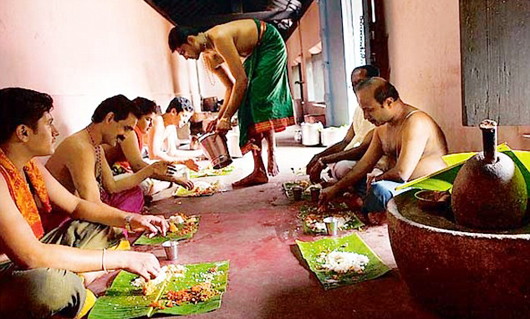
In Udupi, meals are served on banana leaves in a particular order. Many recipes and foods have also proven health benefits. For example, dishes made from the inner banana stem prevent kidney stones, pepper rasam helps with the lactation of new mothers, jackfruit seeds have high protein content and so on.

The authors also say that the original of the masal dose or the famous masala dosa is attributed to Udupi.

Before it was invented, plain dosa was served with potato playa, without onions, in a separate cup. With changing food tastes, the Udupi chefs began to saute the mashed potatoes with onions and spices.

"As onions were considered taboo food for orthodox Brahmins, it is said that the doses were stuffed with onion-laced playa, instead of served in a separate cup, so that the onion could be 'hidden'," the authors say.

Comments

Usha moorthy
 - 
Wednesday, 8 Jun 2016

I'm extremely pleased that I now have a book to refer to for genuine udupi food!!! Thanks to the authors for painstakingly bringing together these wonderful recipes!!;

Add new comment

  • Coastaldigest.com reserves the right to delete or block any comments.
  • Coastaldigset.com is not responsible for its readers’ comments.
  • Comments that are abusive, incendiary or irrelevant are strictly prohibited.
  • Please use a genuine email ID and provide your name to avoid reject.
Agencies
July 30,2020

New Delhi, Jul 29: Air Commodore Hilal Ahmad Rather has become a buzz name in Kashmir overnight. Hilal saw off the first batch of Rafale jets which took off from France to India on Monday. Among other things, he has also been associated with the weaponisation of the Rafale aircraft for acclimatisation to Indian requirements.

Hilal is presently India's Air Attache in France.

The career details of this officer of the Indian Air Force (IAF) read like the decoration scroll of the best flying officer anywhere in the world.

Born in the south Kashmir's Anantnag district to middle-class parents, Hilal's father, late Mohammad Abdullah Rather retired as a deputy superintendent of police (Dy SP) in J&K police department. He has three sisters and is the only son of his parents. Hilal studied in Sainik School in Nagrota town of Jammu district.

He was commissioned in IAF as a fighter pilot on December 17, 1988, became flight lieutenant in 1993, wing commander in 2004, group captain in 2016 and air commodore in 2019.

He graduated from defence services staff college (DSSC). He also graduated from air war college (USA) with distinction. He won the sword of honour in NDA. Hilal is also the recipient of Vayu Sena Medal and Vishisht Seva medal.

With an impeccable record of 3,000 accident-free flying hours on mirage-2000, MIG-21 and Kiran aircraft, Hilal's name will now forever be associated with Rafale in India.

Comments

Add new comment

  • Coastaldigest.com reserves the right to delete or block any comments.
  • Coastaldigset.com is not responsible for its readers’ comments.
  • Comments that are abusive, incendiary or irrelevant are strictly prohibited.
  • Please use a genuine email ID and provide your name to avoid reject.
News Network
June 19,2020

Bengaluru, Jun 19: COVID-19 cases in Karnataka has breached the 8,000 mark, as the state on Friday reported 337 new cases and ten related fatalities, taking the total number of infections to 8,281 and death toll to 124.

Also, total discharges in the state breached 5,000 mark, with 230 patients getting discharged in a day after recovery.

As of June 19 evening, cumulatively 8,281 COVID-19 positive cases have been confirmed in the state, which includes 124 deaths and 5,210 discharges, the health department said in its bulletin.

It said out of 2,943 active cases, 2,865 patients are in isolation at designated hospitals and are stable, while 78 are in ICU.

The ten dead include- seven from Bengaluru urban, two from Bidar and one from Vijayapura.

Out of the 337 new cases, 93 are returnees from other states, majority of them from neighboring Maharashtra,while 11 are those who returned from other countries.

The remaining cases include contacts of patients earlier tested positive, those with history of SARI and ILI, among others.

Among the districts where the new cases were reported, Bengaluru accounted for 138 cases, followed by Kalaburagi 52, Ballari 37, Hassan 18, Dakshina Kannada 13, Davangere 12, Udupi 11; Bidar 10, six each from Mysuru and Koppal, four each from Yadgir, Kolar and Bengaluru rural, three each from Mandya, Dharwad, Chikkaballapura, Bagalkote and Ramanagara, two each from Tumakuru and Chikkamagaluru, and one each from Belagavi, Uttara Kannada and Shivamogga.

Kalaburagi district tops the list of positive cases, with 1,126 infections, followed by Udupi 1,050 and Bengaluru urban 982.

Among discharges Udupi tops the list with 944 discharges, followed by Kalaburagi 646 and Yadgir 477.

A total of 4,84,060 samples were tested so far, out of which 10,553 were tested on Thursday alone.

According to the bulletin,4,64,338 samples have been reported as negative, and out of them 9,862 were reported negative today.

Comments

Add new comment

  • Coastaldigest.com reserves the right to delete or block any comments.
  • Coastaldigset.com is not responsible for its readers’ comments.
  • Comments that are abusive, incendiary or irrelevant are strictly prohibited.
  • Please use a genuine email ID and provide your name to avoid reject.
coastaldigest.com news network
June 28,2020

Bengaluru, Jun 28: Karnataka Minister for Medical Education Dr K Sudhakar faced criticism by netizens after he shared a TikTok video sent by his daughter and wife, who are currently undergoing treatment in a COVID-19 facility.

TikTok is a Chinese video-sharing social networking service owned by ByteDance, a Beijing-based internet technology company founded in 2012 by Zhang Yiming.

Dr Sudhakar’s father, his wife and daughter who tested positive for Covid-19 has been admitted to a designated facility and in order to make his birthday memorable, his daughter sent him greetings through TikTok video.

When the minister shared the TikTok video, people pointed out that the minister should know better and that he should urge his family to boycott the Chinese video-sharing platform and lead by example.

Many were miffed that a BJP leader put up a TikTok video at a time when tensions are running high between India and China along the Line of Actual Control (LAC) in eastern Ladakh.

Comments

Add new comment

  • Coastaldigest.com reserves the right to delete or block any comments.
  • Coastaldigset.com is not responsible for its readers’ comments.
  • Comments that are abusive, incendiary or irrelevant are strictly prohibited.
  • Please use a genuine email ID and provide your name to avoid reject.