


The secrets of Udupi's Madhwa Brahmin kitchen leaked!

[email protected] (News Network | KM Acharya)
August 26, 2015

Udupi, Aug 26: What connects Bisi Bele Hulianna, Saaru, Modaka, Huggi, Majjige Palidya and Drakshi Gojju? These are some of the famed dishes of the Madhwa Brahmin community of Udupi, a coastal town in Karnataka where the Krishna temple acts as a pivot in people's lives.
brahmin

Laying out the geographical expanse and scientific logic to the regions Madhwa Brahmins vegetarian food habits, culinary expert Malati Srinivasan and arts and crafts connoisseur Geetha Rao showcase the hitherto unknown vegetarian recipes from Udupi in their book "The Udupi Kitchen."

The authors straddle the traditional and modern and list what was once easily cooked in Udupi households - spice powders, salads and chutneys, savoury snacks, desserts - and elaborate on several recipes which are all-time favourites like Bisi Bele Hulianna, Saaru, Masal Dose and Modaka.

While Bisi Bele Hulianna is a dish of spicy red gram, rice and vegetables, Saaru is spicy red gram soup, Huggi is rice and green gram with black pepper and cumin and Modaka is dumplings with coconut and jiggery filling.

Majjige Palidya is ash gourd with coconut and cumin in sour yoghurt and Drakshi Gojju is raisins in sweet, sour and spicy gravy.

Split into 12 sections, the Udupi Kitchen, published by Westland Ltd, celebrates vegetarian food with aplomb from a town where food is religion as well as a complete mouth-watering experience.

At the core of Udupi cuisine is the use of indigenous vegetables and fruits, cereals and pulses special to the Parashurama Kshetra and traditional Brahmins ate only vegetarian fare without onion and garlic.

According to the authors, Udupi cuisine has a vast variety and is not limited to tiffins or snacks.

"As I began working on this project, I realised how vast and varied our family’s repertoire of Udupi (Madhwa) cuisine was. I wrote down 175 recipes, but have used about a 100 of them in the book," says Srinivasan.

"Writing a cook book for both Indian and non-Indian readers required that a comprehensive multi-lingual glossary be compiled. It also meant using internationally accepted terminology: 'henchu' or 'tava' became griddle, bandle or 'kadhai' became wok, 'tappele' or 'bartan' became saucepan," says Rao.

She says for some kitchen tools like 'eelgemane' and 'ogarane chamcha', which had no "internationally understood" words, substitute words like curved knife blade and tempering-ladle had to be coined.

The story of Udupi cuisine is the story of how a temple-based, Brahmanical culinary tradition got modernised and became a global phenomenon. Food is religion in Udupi.

Fourteen varieties of food are cooked daily and offered to the deity at different times of the day. The food offered to god is 'naivediya', and the food eaten by human beings is 'prasada', food that is blessed.

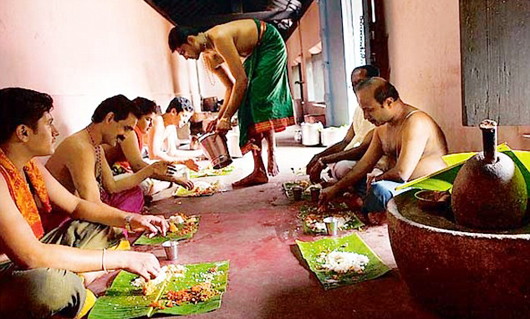
In Udupi, meals are served on banana leaves in a particular order. Many recipes and foods have also proven health benefits. For example, dishes made from the inner banana stem prevent kidney stones, pepper rasam helps with the lactation of new mothers, jackfruit seeds have high protein content and so on.

The authors also say that the original of the masal dose or the famous masala dosa is attributed to Udupi.

Before it was invented, plain dosa was served with potato playa, without onions, in a separate cup. With changing food tastes, the Udupi chefs began to saute the mashed potatoes with onions and spices.

"As onions were considered taboo food for orthodox Brahmins, it is said that the doses were stuffed with onion-laced playa, instead of served in a separate cup, so that the onion could be 'hidden'," the authors say.

Comments

Usha moorthy
 - 
Wednesday, 8 Jun 2016

I'm extremely pleased that I now have a book to refer to for genuine udupi food!!! Thanks to the authors for painstakingly bringing together these wonderful recipes!!;

Add new comment

  • Coastaldigest.com reserves the right to delete or block any comments.
  • Coastaldigset.com is not responsible for its readers’ comments.
  • Comments that are abusive, incendiary or irrelevant are strictly prohibited.
  • Please use a genuine email ID and provide your name to avoid reject.
News Network
March 30,2020

Bengaluru, Mar 30: Coffee Day Enterprises Ltd (CDEL) has received the first tranche of Rs 2,000 crore following disinvestment of Global Village Techparks to repay debts following the death of its founder V G Siddhartha.
In August last year, CDEL executed definitive agreements with entities belonging to Blackstone Group and Salarpuria Sattva Group for investment in GV Techparks, a wholly-owned subsidiary of group company Tanglin Development Ltd (TDL), at an enterprise value of Rs 2,700 crore.
The balance amount is expected to be received after the receipt of few statutory approvals, CDEL said in a statement.
"Out of the money received in first tranche, the company has paid off its debts in full including principal and interest amounting to Rs 1,644 crore to the lenders despite difficult economic conditions," it said.
Post this payment, the consolidated debt of the company and its subsidiaries stands at Rs 3,200 crore as on March 27. This includes debt of Rs 1,400 crore of its subsidiary Sical Logistics Ltd where disinvestment process is in progress.
"The company and subsidiaries have repaid around Rs 4,000 crore to the lenders since the beginning of this financial year," CDEL said.
"With the continuous support of stakeholders of the company, the current management is working to ensure better liquidity and operational efficiency. The company is confident of the future ahead despite various challenges," it added.
The company has been in rough waters after its founder V G Siddhartha took his own life as debt strains began to emerge in his company. Since his death in July last year, CDEL has been trying to divest its assets to pare debts.
On July 30, 2019, CDEL informed stock exchanges about Siddhartha's disappearance. In a letter that was purportedly written by him, the Cafe Coffee Day founder said: "I could not take any more pressure from one of the private equity partners forcing me to buy back shares."

Comments

Add new comment

  • Coastaldigest.com reserves the right to delete or block any comments.
  • Coastaldigset.com is not responsible for its readers’ comments.
  • Comments that are abusive, incendiary or irrelevant are strictly prohibited.
  • Please use a genuine email ID and provide your name to avoid reject.
News Network
July 8,2020

Bengaluru, Jul 8: In yet another revenue generation measure, the Revenue department has issued an order permitting the sale of government land leased to various religious, industrial and other organisations.

Officials say that around Rs 2,250 crore will be generated in Bengaluru Urban district alone, if the order is implemented.

While rules for the process are yet to be formed, it has directed deputy commissioners of various districts to submit proposals for the sale of such lands leased by the government to various institutions under the Karnataka Land Grant Rules, 1969. The order came after a recent Cabinet decision. 

The order issued on July 6 says that government lands leased to private organisations, trusts, industries, educational, social welfare, religious and agricultural purposes can be regularised by paying the guidance value of the land, provided the organisation continued to use the land for the same purpose it was granted for.

If an organisation or trust wanted to convert the land for other purposes, it will be charged twice the guidance value. According to the order, land leased to organisations that are unwilling to purchase the land will be surveyed. “DCs should initiate measures to survey such lands and recover the unused land to the government,” it said.

Revenue Principal Secretary N Manjunath Prasad told DH that rules for the sale of such lands will be formulated shortly. “We have directed deputy commissioners to compile the extent of land leased to various organisations in their respective districts,” he said, noting that 921 acres were leased to private parties in Bengaluru Urban district.

From the 921 acres, the state government used to receive an annual rent of Rs 6.50 crore per year. Sale of leased land in Bengaluru Urban alone will generate around Rs 2,250 crore at current guidance values, Prasad said. 

The government is also pushing for regularisation of unauthorised buildings on Bangalore Development Authority (BDA) land and auction of corner sites to mobilise resources due to the severe economic difficulties in the wake of the Covid-19 pandemic and the state’s reduced share in central taxes.

Comments

Add new comment

  • Coastaldigest.com reserves the right to delete or block any comments.
  • Coastaldigset.com is not responsible for its readers’ comments.
  • Comments that are abusive, incendiary or irrelevant are strictly prohibited.
  • Please use a genuine email ID and provide your name to avoid reject.
News Network
April 14,2020

Thiruvananthapuram, Apr 14: Amid Covid-19 lockdown,

Keralites celebrated a low key "Vishu" ,the Malayalam new year, on Tuesday, hoping that days of plenty, prosperity and peace will return.

People woke up in the early hours to see the auspicious "Vishu kani", symbolising hope, promise and fine prospects they wish to have in the year ahead.

The ritual comprises arranging on platters auspicious articles like seasonal fruits, vegetables, flower, gold and clothes which together form the first sight when the family members wake up on the Vishu day.

Normally, Keralites dressed in their traditional attire throng temples across the state.

However, this year due to the lockdown restrictions, temple visits were given a go by.

The famed Sri Krishna temple at Guruvayur and the Lord Ayyappa shrine at Sabarimala witnesses heavy rush of devotees during the vishu day.

But pilgrims were not allowed inside and only temple officials and security personnel were present for the"Vishu kani".

Rehaman, a small time trader, said very few people have come out for vishu purchases due to the restricitons.

It is fine as it is for a good cause, while Radha, a young woman said she could not celebrate the festival.

"We have no money, no job. With whatever little we have, we are celebrating the festival", she said.

87-year-old Vilasini Nambiar, a retired college professor, said vishu has visited the state during a most bewildering time.

"It should however remind us that every mountain must have its valley, desert its oasis, every storm cloud its rainbow, every night its day.

We are prepared to believe that we will overcome this misfortune", she said.

President Ram Nath Kovind, Prime Minister, Narendra Modi, Home minister, Amit Shah, Kerala Governor, Arif Mohammed Khan and Chief Minister, Pinarayi Vijayan, were among those who greeted people on the occasion of Vishu.

Comments

Add new comment

  • Coastaldigest.com reserves the right to delete or block any comments.
  • Coastaldigset.com is not responsible for its readers’ comments.
  • Comments that are abusive, incendiary or irrelevant are strictly prohibited.
  • Please use a genuine email ID and provide your name to avoid reject.