


The secrets of Udupi's Madhwa Brahmin kitchen leaked!

[email protected] (News Network | KM Acharya)
August 26, 2015

Udupi, Aug 26: What connects Bisi Bele Hulianna, Saaru, Modaka, Huggi, Majjige Palidya and Drakshi Gojju? These are some of the famed dishes of the Madhwa Brahmin community of Udupi, a coastal town in Karnataka where the Krishna temple acts as a pivot in people's lives.
brahmin

Laying out the geographical expanse and scientific logic to the regions Madhwa Brahmins vegetarian food habits, culinary expert Malati Srinivasan and arts and crafts connoisseur Geetha Rao showcase the hitherto unknown vegetarian recipes from Udupi in their book "The Udupi Kitchen."

The authors straddle the traditional and modern and list what was once easily cooked in Udupi households - spice powders, salads and chutneys, savoury snacks, desserts - and elaborate on several recipes which are all-time favourites like Bisi Bele Hulianna, Saaru, Masal Dose and Modaka.

While Bisi Bele Hulianna is a dish of spicy red gram, rice and vegetables, Saaru is spicy red gram soup, Huggi is rice and green gram with black pepper and cumin and Modaka is dumplings with coconut and jiggery filling.

Majjige Palidya is ash gourd with coconut and cumin in sour yoghurt and Drakshi Gojju is raisins in sweet, sour and spicy gravy.

Split into 12 sections, the Udupi Kitchen, published by Westland Ltd, celebrates vegetarian food with aplomb from a town where food is religion as well as a complete mouth-watering experience.

At the core of Udupi cuisine is the use of indigenous vegetables and fruits, cereals and pulses special to the Parashurama Kshetra and traditional Brahmins ate only vegetarian fare without onion and garlic.

According to the authors, Udupi cuisine has a vast variety and is not limited to tiffins or snacks.

"As I began working on this project, I realised how vast and varied our family’s repertoire of Udupi (Madhwa) cuisine was. I wrote down 175 recipes, but have used about a 100 of them in the book," says Srinivasan.

"Writing a cook book for both Indian and non-Indian readers required that a comprehensive multi-lingual glossary be compiled. It also meant using internationally accepted terminology: 'henchu' or 'tava' became griddle, bandle or 'kadhai' became wok, 'tappele' or 'bartan' became saucepan," says Rao.

She says for some kitchen tools like 'eelgemane' and 'ogarane chamcha', which had no "internationally understood" words, substitute words like curved knife blade and tempering-ladle had to be coined.

The story of Udupi cuisine is the story of how a temple-based, Brahmanical culinary tradition got modernised and became a global phenomenon. Food is religion in Udupi.

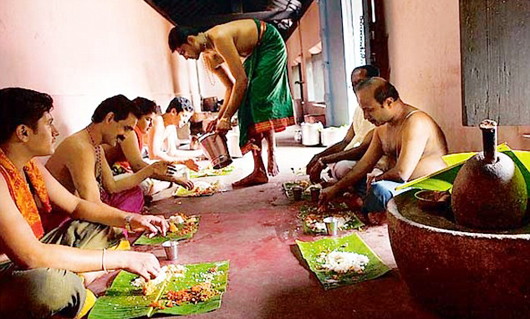
Fourteen varieties of food are cooked daily and offered to the deity at different times of the day. The food offered to god is 'naivediya', and the food eaten by human beings is 'prasada', food that is blessed.

In Udupi, meals are served on banana leaves in a particular order. Many recipes and foods have also proven health benefits. For example, dishes made from the inner banana stem prevent kidney stones, pepper rasam helps with the lactation of new mothers, jackfruit seeds have high protein content and so on.

The authors also say that the original of the masal dose or the famous masala dosa is attributed to Udupi.

Before it was invented, plain dosa was served with potato playa, without onions, in a separate cup. With changing food tastes, the Udupi chefs began to saute the mashed potatoes with onions and spices.

"As onions were considered taboo food for orthodox Brahmins, it is said that the doses were stuffed with onion-laced playa, instead of served in a separate cup, so that the onion could be 'hidden'," the authors say.

Comments

Usha moorthy
 - 
Wednesday, 8 Jun 2016

I'm extremely pleased that I now have a book to refer to for genuine udupi food!!! Thanks to the authors for painstakingly bringing together these wonderful recipes!!;

Add new comment

  • Coastaldigest.com reserves the right to delete or block any comments.
  • Coastaldigset.com is not responsible for its readers’ comments.
  • Comments that are abusive, incendiary or irrelevant are strictly prohibited.
  • Please use a genuine email ID and provide your name to avoid reject.
News Network
June 26,2020

Bengaluru, Jun 26: Karnataka's Commercial Taxes Department has sealed off an undeclared warehouse with imported goods worth Rs 4 crore in Bengaluru and found 60 GST registrations linked to a Chinese national from Wuhan.

The tax department officials found 25,446 China-made electronic and fast-moving consumer goods worth Rs 4 crore stored in the warehouse which was not declared to the tax authorities.

Commissioner of Commercial Taxes MS Srikar said in a statement that the officers noticed that one person from Wuhan City, China, got the premises in Bengaluru on lease.

They also found that about 60 registrations (both central and state jurisdictions) under the GST Act, in the name of a number of persons for online trading of imported China-made goods, had a single address which was vacant.

Most of the registrations were found irregular in the filing of returns and payment of tax. Majority of the firms either filed nil returns or were non-filers. The registration data showed that one business was registered in 2017-18, 43 in 2018-19, 14 in 2019-20 and two in 2020-21. Most of the 60 firms were private limited companies and 24 persons were interchangeably directors in 58 firms.

At the time of raid, neither the lessee, the Chinese national, nor any of the other 59 registered taxable persons were available at the business premises and no one came forward to participate in the proceedings in spite of providing sufficient time.

It is learnt that the Chinese national is operating the business from Wuhan City since January 2020 with the assistance of some of his agents/employees in Bengaluru.

It has also been learnt that multiple registrations are being taken for a better rating on e-commerce platforms, Srikar said.

The raids were led by Nitesh K Patil, Additional Commissioner, Enforcement, South Zone.
The Commercial Taxes Department is closely watching the genuineness of newly registered persons and conducting post-registration verification visits.

Any registration taken with mala fide intention of evading taxes will be dealt with seriously, the Commissioner said. 

Comments

Add new comment

  • Coastaldigest.com reserves the right to delete or block any comments.
  • Coastaldigset.com is not responsible for its readers’ comments.
  • Comments that are abusive, incendiary or irrelevant are strictly prohibited.
  • Please use a genuine email ID and provide your name to avoid reject.
coastaldigest.com news network
July 7,2020

Mangaluru, Jul 7: The government of Kerala has barred movement of daily pass holders — professionals and workers — between Kasaragod district and Karnataka’s Dakshina Kannada district following a spurt in COVID-19 cases.

Kerala Revenue Minister E. Chandrasekaran announced the decision at a meeting on Monday in Kasaragod. Both district administrations had in June issued passes to daily travellers in their districts to travel in connection with their work.

Those from Dakshina Kannada intending to work in Kasaragod have to remain in Kasaragod for 28 days if they wish to continue and those from Kasaragod would have to remain in Dakshina Kannada for 28 days if they wish to continue their work, the Minister said.

Thousands from Kasaragod travel daily to Mangaluru and surrounding areas in connection with their work. Their travel past Talapady check post on NH 66 was facilitated by daily e-passes.

Similarly, many from Dakshina Kannada, particularly doctors and healthcare workers, travel daily to Kasaragod with daily e-passes issued by the Kasaragod administration.

Comments

Add new comment

  • Coastaldigest.com reserves the right to delete or block any comments.
  • Coastaldigset.com is not responsible for its readers’ comments.
  • Comments that are abusive, incendiary or irrelevant are strictly prohibited.
  • Please use a genuine email ID and provide your name to avoid reject.
coastaldigest.com web desk
July 27,2020

New Delhi, Jul 27: A month after banning 59 Chinese applications, the government of Indian has now reportedly banned 47 more apps of Chinese origin in the country. According to sources, the 47 banned Chinese apps were operating as clones of the earlier banned apps. 

The list of the 47 Chinese applications banned by the Indian government will be released soon.

India has also prepared a list of over 250 Chinese apps, including apps linked to Alibaba, that it will examine for any user privacy or national security violations, government sources said. The list also includes Tencent-backed gaming app PUBG.

Some top gaming Chinese applications are also expected to be banned in the new list that is being drawn up, sources said. The Chinese applications, that are being reviewed, have allegedly been sharing data with the Chinese agencies.

Today's decision follows after a high-profile ban of 59 Chinese apps including TikTok, as border tensions continued in Ladakh after a violent, fatal face-off between the Indian and Chinese armies. The government said these apps were engaged in activities that were prejudicial to the sovereignty, integrity and defence of India.

A government press release announcing the ban stated: "The Ministry of Information Technology, invoking it's power under section 69A of the Information Technology Act read with the relevant provisions of the Information Technology (Procedure and Safeguards for Blocking of Access of Information by Public) Rules 2009 and in view of the emergent nature of threats has decided to block 59 apps since in view of information available they are engaged in activities which is prejudicial to sovereignty and integrity of India, defence of India, security of state and public order".

A day later, Google said it has removed all the banned applications from the Play Store. Following the ban, TikTok refuted the claims that suggest it will pursue legal action against the Indian government for banning the app in India.

Reacting to the 59 apps banned by India, the Chinese Foreign Ministry said the country is "strongly concerned regarding the decision of the Indian government".

“China is strongly concerned, verifying the situation,” Chinese Foreign Ministry spokesperson Zhao Lijian was quoted as saying by news agency ANI.

"We want to stress that the Chinese government always asks Chinese businesses to abide by international and local laws-regulations. The Indian government has a responsibility to uphold the legal rights of international investors including Chinese ones," Zhao Lijian said.

Comments

Add new comment

  • Coastaldigest.com reserves the right to delete or block any comments.
  • Coastaldigset.com is not responsible for its readers’ comments.
  • Comments that are abusive, incendiary or irrelevant are strictly prohibited.
  • Please use a genuine email ID and provide your name to avoid reject.