


The secrets of Udupi's Madhwa Brahmin kitchen leaked!

[email protected] (News Network | KM Acharya)
August 26, 2015

Udupi, Aug 26: What connects Bisi Bele Hulianna, Saaru, Modaka, Huggi, Majjige Palidya and Drakshi Gojju? These are some of the famed dishes of the Madhwa Brahmin community of Udupi, a coastal town in Karnataka where the Krishna temple acts as a pivot in people's lives.
brahmin

Laying out the geographical expanse and scientific logic to the regions Madhwa Brahmins vegetarian food habits, culinary expert Malati Srinivasan and arts and crafts connoisseur Geetha Rao showcase the hitherto unknown vegetarian recipes from Udupi in their book "The Udupi Kitchen."

The authors straddle the traditional and modern and list what was once easily cooked in Udupi households - spice powders, salads and chutneys, savoury snacks, desserts - and elaborate on several recipes which are all-time favourites like Bisi Bele Hulianna, Saaru, Masal Dose and Modaka.

While Bisi Bele Hulianna is a dish of spicy red gram, rice and vegetables, Saaru is spicy red gram soup, Huggi is rice and green gram with black pepper and cumin and Modaka is dumplings with coconut and jiggery filling.

Majjige Palidya is ash gourd with coconut and cumin in sour yoghurt and Drakshi Gojju is raisins in sweet, sour and spicy gravy.

Split into 12 sections, the Udupi Kitchen, published by Westland Ltd, celebrates vegetarian food with aplomb from a town where food is religion as well as a complete mouth-watering experience.

At the core of Udupi cuisine is the use of indigenous vegetables and fruits, cereals and pulses special to the Parashurama Kshetra and traditional Brahmins ate only vegetarian fare without onion and garlic.

According to the authors, Udupi cuisine has a vast variety and is not limited to tiffins or snacks.

"As I began working on this project, I realised how vast and varied our family’s repertoire of Udupi (Madhwa) cuisine was. I wrote down 175 recipes, but have used about a 100 of them in the book," says Srinivasan.

"Writing a cook book for both Indian and non-Indian readers required that a comprehensive multi-lingual glossary be compiled. It also meant using internationally accepted terminology: 'henchu' or 'tava' became griddle, bandle or 'kadhai' became wok, 'tappele' or 'bartan' became saucepan," says Rao.

She says for some kitchen tools like 'eelgemane' and 'ogarane chamcha', which had no "internationally understood" words, substitute words like curved knife blade and tempering-ladle had to be coined.

The story of Udupi cuisine is the story of how a temple-based, Brahmanical culinary tradition got modernised and became a global phenomenon. Food is religion in Udupi.

Fourteen varieties of food are cooked daily and offered to the deity at different times of the day. The food offered to god is 'naivediya', and the food eaten by human beings is 'prasada', food that is blessed.

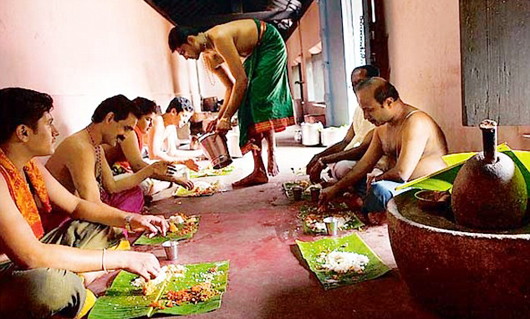
In Udupi, meals are served on banana leaves in a particular order. Many recipes and foods have also proven health benefits. For example, dishes made from the inner banana stem prevent kidney stones, pepper rasam helps with the lactation of new mothers, jackfruit seeds have high protein content and so on.

The authors also say that the original of the masal dose or the famous masala dosa is attributed to Udupi.

Before it was invented, plain dosa was served with potato playa, without onions, in a separate cup. With changing food tastes, the Udupi chefs began to saute the mashed potatoes with onions and spices.

"As onions were considered taboo food for orthodox Brahmins, it is said that the doses were stuffed with onion-laced playa, instead of served in a separate cup, so that the onion could be 'hidden'," the authors say.

Comments

Usha moorthy
 - 
Wednesday, 8 Jun 2016

I'm extremely pleased that I now have a book to refer to for genuine udupi food!!! Thanks to the authors for painstakingly bringing together these wonderful recipes!!;

Add new comment

  • Coastaldigest.com reserves the right to delete or block any comments.
  • Coastaldigset.com is not responsible for its readers’ comments.
  • Comments that are abusive, incendiary or irrelevant are strictly prohibited.
  • Please use a genuine email ID and provide your name to avoid reject.
News Network
February 4,2020

Bengaluru, Feb 4: A 33-year old woman techie allegedly stabbed her mother to death and made a murderous assault on her younger brother before fleeing their home here, police said on Tuesday.

According to police, the woman fatally stabbed her mother using a knife and attacked the brother early on Monday.

The injured brother has been hospitalised here.

A search was on for the techie and the motive for her action under investigation, police said.

The woman, employed as a software engineer with a company here, earlier had told her mother and 30-year old brother that she has been transferred to Hyderabad and she may have to relocate.

The brother told police that in the early morning on Monday he saw his sister searching something desperately and offered to assist, which she refused.

However, minutes later she made a murderous assault on him, he told police, adding when he screamed for help and called his mother, his sister said she has killed their mother.

She stabbed him and attacked with an iron rod before fleeing, her brother told police.

The body of the mother was found in another room in the house.

"We are still investigating the matter. We are not clear about the motive behind the murder," a police officer told media adding the woman was yet to be arrested.

Comments

Add new comment

  • Coastaldigest.com reserves the right to delete or block any comments.
  • Coastaldigset.com is not responsible for its readers’ comments.
  • Comments that are abusive, incendiary or irrelevant are strictly prohibited.
  • Please use a genuine email ID and provide your name to avoid reject.
News Network
February 19,2020

Bengaluru, Feb 19: Pointing out that there was a deliberate attempt to cover up police excesses by implicating innocent persons at whim, the Karnataka High Court on Tuesday granted conditional bail to 21 people who were accused by police of involving in violence during the protests against the Citizenship Amendment Act (CAA) in Mangaluru.

Allowing the bail petitions of Ashik and 20 others from Udupi and Dakshina Kannada districts, Justice John Michael Cunha said the overzealousness of the police is also evident from the fact that FIRs were registered under Section 307 of IPC against the persons killed by the police themselves.

“In an offence involving a large number of people, the identity and participation of each accused must be fixed with reasonable certainty. In the present cases, the identity appears to have been fixed on the basis of their affiliation to PFI and they being members of the Muslim community. Though it is stated that the involvement of the petitioners is captured in CCTV footage and photographs, no such material is produced before the court showing the presence of any of the petitioners at the spot, armed with deadly weapons,” the judge noted.

In the statement of objections filed by the State Public Prosecutor-I, it was stated that there was a hint of Muslim youths holding protest on December 19, 2019, opposing the implementation of CAA. Prohibitory orders were clamped in that connection. This assertion indicated that the common object of the assembly was to oppose the implementation of CAA and National Register for Citizens (NRC) which, by itself, was not an “unlawful object”, the judge pointed out.

‘Pics show cops throwing stones at crowd’

Justice Cunha also said the material collected by the investigators did not contain any specific evidence regarding the presence of any of the petitioners at the spot. On the other hand, omnibus allegations were made against the Muslim crowd of 1,500-2,000, alleging that they were armed with weapons like stones, soda bottles and glass pieces. The photographs produced by the SPP depicted that hardly any member of the crowd were armed with weapons, except one of them holding a bottle. In none of these photographs, police station or policemen were seen in the vicinity, the judge noted.

“On the other hand, photographs produced by the petitioners show that the policemen themselves were pelting stones at the crowd. The petitioners have produced copies of the complaints lodged by the dependants of the deceased who died due to police firing and the endorsement made thereon reveals that even though the law required the police to register independent FIRs in view of the specific complaint made against the police officers making out cognizable offences, the police have failed to register FIRs. This goes to show that a deliberate attempt is underway to cover up police excesses by implicating innocent persons at the whims and caprice of the police,” the judge observed.

In the wake of counter-allegations against the police and in the backdrop of their failure to register FIRs based on complaints lodged by the families of victims, the possibility of false and mistaken implication could not be ruled out, the judge said. In these circumstances, it would be a travesty of justice to deny bail to the petitioners and sacrifice their liberties to the mercy of the district administration and police. The records indicate that a deliberate attempt has been made to trump up evidence and to deprive the liberties of the petitioners by fabricating evidence. None of the petitioners have any criminal antecedents, the court said.

“The allegations levelled against the petitioners are not punishable with death or imprisonment for life. There is no direct evidence to connect them with the alleged offence. The investigation appears to be malafide and partisan. In the circumstances, in order to protect the rights and liberties of the petitioners, it is necessary to admit them to bail,” the judge said.

The petitioners were arrested and remanded in judicial custody after the anti-CAA protests on charges of being members of an unlawful assembly, armed with lethal weapons, attempting to set fire to the North Police Station in Mangaluru, obstructing the police from discharging their duties and causing damage to public property, etc., on December 19 in violation of the prohibitory orders. They moved the High Court as their bail pleas had been rejected by a sessions court in Dakshina Kannada.

Comments

Add new comment

  • Coastaldigest.com reserves the right to delete or block any comments.
  • Coastaldigset.com is not responsible for its readers’ comments.
  • Comments that are abusive, incendiary or irrelevant are strictly prohibited.
  • Please use a genuine email ID and provide your name to avoid reject.
coastaldigest.com news network
May 22,2020

It has been 33 years since the night of 22 May, 1987 when nearly 50 Muslim men from Hashimpura, a settlement in Meerut were rounded up and packed into the rear of a truck of the Provincial Armed Constabulary (PAC), an armed police of Uttar Pradesh. It was the blessed month of Ramadan and all the Muslims were fasting.

That night 42 of those on board the truck were killed in two massacres in neighbouring Ghaziabad district. One along the Upper Ganga canal near Muradnagar, the other along the Hindon canal in Makanpur, on the border with Delhi.

The cops had returned home after dumping the dead bodies into the canal. A few days later, the dead bodies were found floating in the canal and a case of murder was registered. 

Vir Bahadur Singh was the chief minister of Uttar Pradesh and Rajiv Gandhi was the prime minister of India when this incident took place. 

Not much has changed for the survivors and the relatives of the victims even today. The wounds are still fresh. Hashimpura remains devoid of basic municipal amenities, the erring silence on the narrow lanes of the locality amid the activities of a daily life speaks of the horror of the fateful day in 1987.

The massacre was the result of one among the many outcomes of the decision taken by the Rajiv Gandhi government to open the locks of Babri Masjid. After a month of rioting, the situation was tense in various parts of Meerut, and a lot spilled over in the nearby areas.

Timeline

May 22, 1987

Nearly 50 Muslims picked up by the PAC personnel from Hashimpura village in Meerut, Uttar Pradesh.
Victims later shot and bodies thrown into a canal. 42 persons declared dead.

1988

UP government orders CB-CID probe in the case.

February 1994

CB-CID submits inquiry report indicting over 60 PAC and police personnel of all ranks.

May 20, 1996

Charge sheet filed against 19 accused before Chief Judicial Magistrate, Ghaziabad by CB-CID of Uttar Pradesh police. 161 people listed as witnesses.

September 2002

Case transferred to Delhi by the Supreme Court on a petition by the families of victims and survivors.

July 2006

Delhi court frames charges of murder, attempt to murder, tampering with evidence and conspiracy under the IPC against 17 accused.

March 8, 2013

Trial court dismisses Subramanian Swamy's plea seeking probe into the alleged role of P Chidambaram, then Minister of State for Home, in the matter.

January 22, 2015

Trial court reserves judgement.

March 21, 2015

Court acquits 16 surviving accused giving them benefit of doubt regarding their identity.

May 18, 2015

Trial court decision challenged in the Delhi HC by the victims' families and eyewitnesses who survived the incident.

May 29, 2015

HC issues notice to the 16 PAC personnel on Uttar Pradesh government's appeal against the trial court verdict.

December 2015

National Human Rights Commission is impleaded in the matter. NHRC also seeks further probe into the massacre.

February 17, 2016

HC tags Swamy's appeal with the other petitions in the matter.

September 6, 2018

Delhi HC reserves verdict in the case.

October 31, 2018

Delhi HC convicts 16 former PAC personnel for life after finding them guilty of the murder of 42 people.

Comments

Add new comment

  • Coastaldigest.com reserves the right to delete or block any comments.
  • Coastaldigset.com is not responsible for its readers’ comments.
  • Comments that are abusive, incendiary or irrelevant are strictly prohibited.
  • Please use a genuine email ID and provide your name to avoid reject.