


The secrets of Udupi's Madhwa Brahmin kitchen leaked!

[email protected] (News Network | KM Acharya)
August 26, 2015

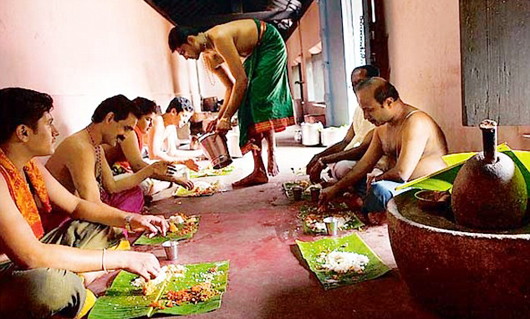
Udupi, Aug 26: What connects Bisi Bele Hulianna, Saaru, Modaka, Huggi, Majjige Palidya and Drakshi Gojju? These are some of the famed dishes of the Madhwa Brahmin community of Udupi, a coastal town in Karnataka where the Krishna temple acts as a pivot in people's lives.
brahmin

Laying out the geographical expanse and scientific logic to the regions Madhwa Brahmins vegetarian food habits, culinary expert Malati Srinivasan and arts and crafts connoisseur Geetha Rao showcase the hitherto unknown vegetarian recipes from Udupi in their book "The Udupi Kitchen."

The authors straddle the traditional and modern and list what was once easily cooked in Udupi households - spice powders, salads and chutneys, savoury snacks, desserts - and elaborate on several recipes which are all-time favourites like Bisi Bele Hulianna, Saaru, Masal Dose and Modaka.

While Bisi Bele Hulianna is a dish of spicy red gram, rice and vegetables, Saaru is spicy red gram soup, Huggi is rice and green gram with black pepper and cumin and Modaka is dumplings with coconut and jiggery filling.

Majjige Palidya is ash gourd with coconut and cumin in sour yoghurt and Drakshi Gojju is raisins in sweet, sour and spicy gravy.

Split into 12 sections, the Udupi Kitchen, published by Westland Ltd, celebrates vegetarian food with aplomb from a town where food is religion as well as a complete mouth-watering experience.

At the core of Udupi cuisine is the use of indigenous vegetables and fruits, cereals and pulses special to the Parashurama Kshetra and traditional Brahmins ate only vegetarian fare without onion and garlic.

According to the authors, Udupi cuisine has a vast variety and is not limited to tiffins or snacks.

"As I began working on this project, I realised how vast and varied our family’s repertoire of Udupi (Madhwa) cuisine was. I wrote down 175 recipes, but have used about a 100 of them in the book," says Srinivasan.

"Writing a cook book for both Indian and non-Indian readers required that a comprehensive multi-lingual glossary be compiled. It also meant using internationally accepted terminology: 'henchu' or 'tava' became griddle, bandle or 'kadhai' became wok, 'tappele' or 'bartan' became saucepan," says Rao.

She says for some kitchen tools like 'eelgemane' and 'ogarane chamcha', which had no "internationally understood" words, substitute words like curved knife blade and tempering-ladle had to be coined.

The story of Udupi cuisine is the story of how a temple-based, Brahmanical culinary tradition got modernised and became a global phenomenon. Food is religion in Udupi.

Fourteen varieties of food are cooked daily and offered to the deity at different times of the day. The food offered to god is 'naivediya', and the food eaten by human beings is 'prasada', food that is blessed.

In Udupi, meals are served on banana leaves in a particular order. Many recipes and foods have also proven health benefits. For example, dishes made from the inner banana stem prevent kidney stones, pepper rasam helps with the lactation of new mothers, jackfruit seeds have high protein content and so on.

The authors also say that the original of the masal dose or the famous masala dosa is attributed to Udupi.

Before it was invented, plain dosa was served with potato playa, without onions, in a separate cup. With changing food tastes, the Udupi chefs began to saute the mashed potatoes with onions and spices.

"As onions were considered taboo food for orthodox Brahmins, it is said that the doses were stuffed with onion-laced playa, instead of served in a separate cup, so that the onion could be 'hidden'," the authors say.

Comments

Usha moorthy
 - 
Wednesday, 8 Jun 2016

I'm extremely pleased that I now have a book to refer to for genuine udupi food!!! Thanks to the authors for painstakingly bringing together these wonderful recipes!!;

Add new comment

  • Coastaldigest.com reserves the right to delete or block any comments.
  • Coastaldigset.com is not responsible for its readers’ comments.
  • Comments that are abusive, incendiary or irrelevant are strictly prohibited.
  • Please use a genuine email ID and provide your name to avoid reject.
News Network
April 9,2020

Kasaragod, April 9: After Supreme Court intervened and settled the Border issue with Karnataka authorities who had consented to allow the critically-ill patients from in and around Kasaragod and nearby areas to cross over to nearby Mangalore for getting urgent and critical care treatment, the Karnataka authorities is alleged to continue to be hostile either by blocking way ahead or turning a deaf ear to the patients reaching there.

It was on Wednesday onwards that the check post at Thalapadi near here on the Kozhikode-Mangalore National Highway was opened for the critically-ill patients to cross over to Mangalore hospitals for medical treatment.

However, reports reaching here said two out of the three critically-ill patients, who made it to Mangalore were allegedly ill-treated or given no treatment forcing them to return back to Kerala.

Comments

Add new comment

  • Coastaldigest.com reserves the right to delete or block any comments.
  • Coastaldigset.com is not responsible for its readers’ comments.
  • Comments that are abusive, incendiary or irrelevant are strictly prohibited.
  • Please use a genuine email ID and provide your name to avoid reject.
coastaldigest.com news network
May 17,2020

Benglauru, May 17: A garment company manager jumped to death from his third-floor house on Saturday, four days after having killed his wife and wrapping her body in a blanket. 

Manish Kumar, 42, gave a relative and neighbours frightening moments before committing suicide at AECS Layout, Kudlu Gate, Southeast Bengaluru. The relative had come over after Kumar’s brother called him from Delhi, saying he had stopped responding to phone calls. 

The relative, who lives in Hongasandra, arrived at Kumar’s house around noon. He knocked on the door which was bolted from the inside but didn’t get a response. When he asked the neighbours, they said they didn’t have a clue. The relative and the neighbours decided to break the door open. 

But as they entered the house, they got the shock of their lives. Kumar was slitting his wrist with a blade. He then ran into the bathroom and locked himself in. They followed him and asked him to open the door. But he ignored them. They had to break open the bathroom door, too. By this time, Kumar had slashed his hands, chest and other parts of the body. Waving the blade at them, he asked them to stay away. 

Even the relative and the neighbours pleaded with him to drop the blade, he ran out and jumped off the building. He was taken to a hospital but it was too late. 

A bigger shock awaited them. They felt a foul smell emanating from the house. When they went in, they found the decomposed body of Kumar’s wife, Sandhya, 35, wrapped in a blanket. They called the cops. 

Police found a death note purportedly written by Kumar on May 12. “We suspect he killed her on that day,” said a police officer investigating the case. 

Police said the death note specifies what made Kumar kill his wife and commit suicide. Sandhya suspected him of having an affair since he regularly chatted up some bar dancers he had met in Gurgaon and Delhi. She accessed his phone and saw the calls and the WhatsApp messages he had sent them. The issue rocked their marital life and they often fought over it. He then decided to kill his wife and commit suicide, as per the death note. 

Police said Kumar appeared to have spent the last four days at home, with his wife’s body wrapped in the blanket. “We don’t know whether he tried to dispose of the body or didn’t want to see it,” the officer said. Police couldn’t determine how he killed her and are waiting for the post-mortem report. 

Joshi Srinath Mahadev, DCP (Southeast), said the couple hailed from Bihar. “We are waiting for Sandhya’s relatives to arrive in Bengaluru. A case of murder and suicide has been registered at the Parappana Agrahara police station.” Another officer said the couple had a love marriage.

Comments

Add new comment

  • Coastaldigest.com reserves the right to delete or block any comments.
  • Coastaldigset.com is not responsible for its readers’ comments.
  • Comments that are abusive, incendiary or irrelevant are strictly prohibited.
  • Please use a genuine email ID and provide your name to avoid reject.
coastaldigest.com web desk
July 25,2020

Bengaluru, July 25: A 105-year-old person from Bengaluru’s Basaveshwar Nagar, who was under treatment for covid-19 at a hospital for past five days, breathed his last today. He was a former government account who retired in 1973. He was the oldest known covid-19 patient in the state so far.

Many members of the patient's family are said to be infected and are hospitalised at various facilities. The funeral will be overseen by two uninfected family members.

The patient 74411 died on Saturday morning at around 9 a.m., said Dr Prasanna, Managing Director of Pristine Hospital And Research Centre where the former was admitted.

“The patient was initially doing well when he admitted on July 20. He did not have significant lung changes when he was admitted. However, after three days, his blood pressure started to drop so he was put on oxygen in the ICU. Yesterday morning, with continued deterioration, he was placed on non-invasive ventilator support,” Dr Prasanna said.

“Finally, by last night, his oxygen saturation levels began to plummet abruptly and we had to intubate him for ventilator support. His condition continued to deteriorate, however. The cause of death was respiratory failure and the onset of sepsis,” he added.

Although earmarked for supplies of Remdesivir by the government, the hospital did not receive the drugs. An appeal to Dr K Sudhakar, Minister of Medical Education by the hospital staff resulted in an assurance that the medication would arrive. “However, in the end, we had to source the medication ourselves on Friday,” medical staff said.

Dr Thrilok Chandra, Head, Critical Care Support Unit (CCSU), which oversees the care of critical or vulnerable-aged Covid-19 patients, had said that Patient 74411 had been diagnosed early. “He was identified when the disease was still in the early stages in his body. He only had symptoms of Influenza-Like Illness (ILI), so the symptoms were not severe,” Dr Chandra had said.

“It’s very sad. We were rooting for him to pull through. He had no comorbidities at all. He had been bed-ridden from last year, but he was healthy. His only potential comorbidity was his advanced age,” Dr Prasanna said.

According to government data, 34% of Covid-19 fatalities in India are aged between 60 and 74 years of age. Fourteen per cent are aged above 74.

Comments

Add new comment

  • Coastaldigest.com reserves the right to delete or block any comments.
  • Coastaldigset.com is not responsible for its readers’ comments.
  • Comments that are abusive, incendiary or irrelevant are strictly prohibited.
  • Please use a genuine email ID and provide your name to avoid reject.