


The secrets of Udupi's Madhwa Brahmin kitchen leaked!

[email protected] (News Network | KM Acharya)
August 26, 2015

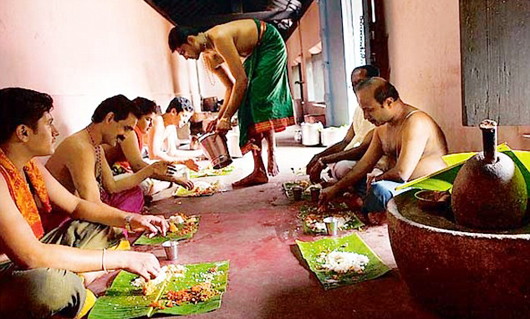
Udupi, Aug 26: What connects Bisi Bele Hulianna, Saaru, Modaka, Huggi, Majjige Palidya and Drakshi Gojju? These are some of the famed dishes of the Madhwa Brahmin community of Udupi, a coastal town in Karnataka where the Krishna temple acts as a pivot in people's lives.
brahmin

Laying out the geographical expanse and scientific logic to the regions Madhwa Brahmins vegetarian food habits, culinary expert Malati Srinivasan and arts and crafts connoisseur Geetha Rao showcase the hitherto unknown vegetarian recipes from Udupi in their book "The Udupi Kitchen."

The authors straddle the traditional and modern and list what was once easily cooked in Udupi households - spice powders, salads and chutneys, savoury snacks, desserts - and elaborate on several recipes which are all-time favourites like Bisi Bele Hulianna, Saaru, Masal Dose and Modaka.

While Bisi Bele Hulianna is a dish of spicy red gram, rice and vegetables, Saaru is spicy red gram soup, Huggi is rice and green gram with black pepper and cumin and Modaka is dumplings with coconut and jiggery filling.

Majjige Palidya is ash gourd with coconut and cumin in sour yoghurt and Drakshi Gojju is raisins in sweet, sour and spicy gravy.

Split into 12 sections, the Udupi Kitchen, published by Westland Ltd, celebrates vegetarian food with aplomb from a town where food is religion as well as a complete mouth-watering experience.

At the core of Udupi cuisine is the use of indigenous vegetables and fruits, cereals and pulses special to the Parashurama Kshetra and traditional Brahmins ate only vegetarian fare without onion and garlic.

According to the authors, Udupi cuisine has a vast variety and is not limited to tiffins or snacks.

"As I began working on this project, I realised how vast and varied our family’s repertoire of Udupi (Madhwa) cuisine was. I wrote down 175 recipes, but have used about a 100 of them in the book," says Srinivasan.

"Writing a cook book for both Indian and non-Indian readers required that a comprehensive multi-lingual glossary be compiled. It also meant using internationally accepted terminology: 'henchu' or 'tava' became griddle, bandle or 'kadhai' became wok, 'tappele' or 'bartan' became saucepan," says Rao.

She says for some kitchen tools like 'eelgemane' and 'ogarane chamcha', which had no "internationally understood" words, substitute words like curved knife blade and tempering-ladle had to be coined.

The story of Udupi cuisine is the story of how a temple-based, Brahmanical culinary tradition got modernised and became a global phenomenon. Food is religion in Udupi.

Fourteen varieties of food are cooked daily and offered to the deity at different times of the day. The food offered to god is 'naivediya', and the food eaten by human beings is 'prasada', food that is blessed.

In Udupi, meals are served on banana leaves in a particular order. Many recipes and foods have also proven health benefits. For example, dishes made from the inner banana stem prevent kidney stones, pepper rasam helps with the lactation of new mothers, jackfruit seeds have high protein content and so on.

The authors also say that the original of the masal dose or the famous masala dosa is attributed to Udupi.

Before it was invented, plain dosa was served with potato playa, without onions, in a separate cup. With changing food tastes, the Udupi chefs began to saute the mashed potatoes with onions and spices.

"As onions were considered taboo food for orthodox Brahmins, it is said that the doses were stuffed with onion-laced playa, instead of served in a separate cup, so that the onion could be 'hidden'," the authors say.

Comments

Usha moorthy
 - 
Wednesday, 8 Jun 2016

I'm extremely pleased that I now have a book to refer to for genuine udupi food!!! Thanks to the authors for painstakingly bringing together these wonderful recipes!!;

Add new comment

  • Coastaldigest.com reserves the right to delete or block any comments.
  • Coastaldigset.com is not responsible for its readers’ comments.
  • Comments that are abusive, incendiary or irrelevant are strictly prohibited.
  • Please use a genuine email ID and provide your name to avoid reject.
coastaldigest.com web desk
July 2,2020

When the black and white photos of the ‘London to Calcutta (Kolkata) bus service’ went viral on social media recently, the response of some of the netizens was “stop spreading fake news!” But, it isn’t a fake news. The late 1950s indeed offered people a lavish bus trip from London to Kolkata. 

While one of the viral images shows passengers at the Victoria Coach Station, London, boarding 'Albert', the other image show the same bus travelling through a valley. In another image the bus is stationed at a tourist spot. All these photos were captured during the bus’ maiden international journey in 1957.  

An image of the bus ticket is also making rounds on social media, that shows the route of the bus — London, Belgium, West Germany, Austria,Yugoslavia, Bulgaria, Turkey, Iran, Afghanistan, West Pakistan, India. The route in India followed Delhi, Agra, Allahabad, Banaras and finally Calcutta.

The ticket shows that a one side travel cost 145 pounds (13,644 Rupees at the present day) back then, and it was inclusive of all the luxury provided during the run.

The luxurious bus provided the facilities of reading, individual sleeping bunks, radio/taped music for parties and pleasure and fan heaters, among other things. The brochure reads, "Your complete home while you travel."

Some of the tour highlights included Banaras on the Ganges, The Taj Mahal, The Raj Path, The Rhine Valley and The Peacock Throne. Passengers reportedly got free shopping days in New Delhi, Tehran, Salzburg, Kabul, Istanbul and Vienna.

Comments

Add new comment

  • Coastaldigest.com reserves the right to delete or block any comments.
  • Coastaldigset.com is not responsible for its readers’ comments.
  • Comments that are abusive, incendiary or irrelevant are strictly prohibited.
  • Please use a genuine email ID and provide your name to avoid reject.
coastaldigest.com news network
June 10,2020

Udupi, June 10: Philanthropist and businessman Haji P K Abuswalih Kannangar passed away today at a private hospital in Mangaluru. He was 85. 

He was a resident of Pombathota house at Kannangar in Kaup taluk of Udupi district.

He was the proprietor of Green Store in Mudigere for past five decades and also was a coffee planter. 

He had served as the president of Muhayaddin Juma Masjid at Mudigere Hand-post in the past. He was also former president of Mudigere Taluk unit of Indian National Congress.

Comments

Add new comment

  • Coastaldigest.com reserves the right to delete or block any comments.
  • Coastaldigset.com is not responsible for its readers’ comments.
  • Comments that are abusive, incendiary or irrelevant are strictly prohibited.
  • Please use a genuine email ID and provide your name to avoid reject.
KT
April 12,2020

Apr 12: The board and management of troubled NMC Healthcare should be held accountable for the financial irregularities, said Abdulaziz Al Ghurair, chairman of the UAE Banks Federation.

"Banks have dealt with the exposure professionally and they lent to a company which was listed on FTSE-100 index with world-class regulator and the world's largest audit firm doing their audit. Even if they present their balance sheet today, people will still lend to them. This is a world-class fraud and the management and board members should be held accountable. We should have a different track to handle this company. It is not a normal track that we can go," Al Ghurair said during a virtual press conference on Sunday.

It is estimated that the more than 80 local, regional and international banks have exposure to healthcare firm. The UAE bourses had asked all the listed companies in the UAE to announce their exposure. The UAE banks last week announced nearly Dh10 billion exposure to NMC Healthcare, which is owned by the billionaire BR Shetty.

Abu Dhabi Commercial Bank has the highest exposure to NMC at Dh3 billion. Dubai Islamic Bank and its subsidiary Noor Bank announced Dh2 billion exposure while Emirates NBD and its Shariah-compliant unit Emirates Islamic Bank revealed Dh747.34 million exposure. Ajman Bank has Dh151.8 million while Al Salam Bank pegged its exposure at Dh161.5 million. All these lenders revealed their exposure for the first time on Sunday.

Abu Dhabi Islamic Bank said it had extended Dh1.07 billion in financing to NMC Healthcare, and an additional Dh113.67 million exposure to Islamic bonds issued by NMC.National Bank of Fujairah pegged its exposure to NMC at Dh289.1 million, while Sharjah-based United Arab Bank said its exposure was Dh135.3 million.

NMC recently revised its debt position to $6.6 billion, well above earlier estimates.

London's High Court last week placed hospital operator NMC Health into administration, on the application of Abu Dhabi Commercial Bank.

"I know leading bank in UAE have already legal guardian of the company so now management cannot hide anything. The new team will manage and discover what happened," said Al Ghurair.

Comments

Add new comment

  • Coastaldigest.com reserves the right to delete or block any comments.
  • Coastaldigset.com is not responsible for its readers’ comments.
  • Comments that are abusive, incendiary or irrelevant are strictly prohibited.
  • Please use a genuine email ID and provide your name to avoid reject.