


The secrets of Udupi's Madhwa Brahmin kitchen leaked!

[email protected] (News Network | KM Acharya)
August 26, 2015

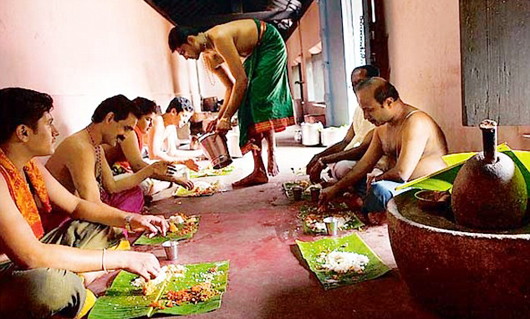
Udupi, Aug 26: What connects Bisi Bele Hulianna, Saaru, Modaka, Huggi, Majjige Palidya and Drakshi Gojju? These are some of the famed dishes of the Madhwa Brahmin community of Udupi, a coastal town in Karnataka where the Krishna temple acts as a pivot in people's lives.
brahmin

Laying out the geographical expanse and scientific logic to the regions Madhwa Brahmins vegetarian food habits, culinary expert Malati Srinivasan and arts and crafts connoisseur Geetha Rao showcase the hitherto unknown vegetarian recipes from Udupi in their book "The Udupi Kitchen."

The authors straddle the traditional and modern and list what was once easily cooked in Udupi households - spice powders, salads and chutneys, savoury snacks, desserts - and elaborate on several recipes which are all-time favourites like Bisi Bele Hulianna, Saaru, Masal Dose and Modaka.

While Bisi Bele Hulianna is a dish of spicy red gram, rice and vegetables, Saaru is spicy red gram soup, Huggi is rice and green gram with black pepper and cumin and Modaka is dumplings with coconut and jiggery filling.

Majjige Palidya is ash gourd with coconut and cumin in sour yoghurt and Drakshi Gojju is raisins in sweet, sour and spicy gravy.

Split into 12 sections, the Udupi Kitchen, published by Westland Ltd, celebrates vegetarian food with aplomb from a town where food is religion as well as a complete mouth-watering experience.

At the core of Udupi cuisine is the use of indigenous vegetables and fruits, cereals and pulses special to the Parashurama Kshetra and traditional Brahmins ate only vegetarian fare without onion and garlic.

According to the authors, Udupi cuisine has a vast variety and is not limited to tiffins or snacks.

"As I began working on this project, I realised how vast and varied our family’s repertoire of Udupi (Madhwa) cuisine was. I wrote down 175 recipes, but have used about a 100 of them in the book," says Srinivasan.

"Writing a cook book for both Indian and non-Indian readers required that a comprehensive multi-lingual glossary be compiled. It also meant using internationally accepted terminology: 'henchu' or 'tava' became griddle, bandle or 'kadhai' became wok, 'tappele' or 'bartan' became saucepan," says Rao.

She says for some kitchen tools like 'eelgemane' and 'ogarane chamcha', which had no "internationally understood" words, substitute words like curved knife blade and tempering-ladle had to be coined.

The story of Udupi cuisine is the story of how a temple-based, Brahmanical culinary tradition got modernised and became a global phenomenon. Food is religion in Udupi.

Fourteen varieties of food are cooked daily and offered to the deity at different times of the day. The food offered to god is 'naivediya', and the food eaten by human beings is 'prasada', food that is blessed.

In Udupi, meals are served on banana leaves in a particular order. Many recipes and foods have also proven health benefits. For example, dishes made from the inner banana stem prevent kidney stones, pepper rasam helps with the lactation of new mothers, jackfruit seeds have high protein content and so on.

The authors also say that the original of the masal dose or the famous masala dosa is attributed to Udupi.

Before it was invented, plain dosa was served with potato playa, without onions, in a separate cup. With changing food tastes, the Udupi chefs began to saute the mashed potatoes with onions and spices.

"As onions were considered taboo food for orthodox Brahmins, it is said that the doses were stuffed with onion-laced playa, instead of served in a separate cup, so that the onion could be 'hidden'," the authors say.

Comments

Usha moorthy
 - 
Wednesday, 8 Jun 2016

I'm extremely pleased that I now have a book to refer to for genuine udupi food!!! Thanks to the authors for painstakingly bringing together these wonderful recipes!!;

Add new comment

  • Coastaldigest.com reserves the right to delete or block any comments.
  • Coastaldigset.com is not responsible for its readers’ comments.
  • Comments that are abusive, incendiary or irrelevant are strictly prohibited.
  • Please use a genuine email ID and provide your name to avoid reject.
coastaldigest.com news network
February 16,2020

Mangaluru, Feb 16: A 45 year-old man committed suicide by jumping into Netravati River from the bridge near Thokkottu along with his six-year-old son in the early hours of Sunday here, police said.

The deceased have been identified as Gopalkrishna Rai and his son Aneesh Rai, residents of Baltila in Bantwal.

According to the police, Gopalkrishna along with his wife Ashwini Rai and son had come to Konaje for a family programme. At about 4:30 a.m. he came to the bridge with his son, left a suicide note and jumped into the river.

Comments

Add new comment

  • Coastaldigest.com reserves the right to delete or block any comments.
  • Coastaldigset.com is not responsible for its readers’ comments.
  • Comments that are abusive, incendiary or irrelevant are strictly prohibited.
  • Please use a genuine email ID and provide your name to avoid reject.
News Network
May 2,2020

Bengaluru, May 2: The Centre’s classification of districts created confusion in Karnataka as the state’s own categorisation deviates significantly from the health ministry’s list.

For instance, the Centre put the number of districts in the red zone in state at three, while the state Covid-19 war room puts it at 14. Bengaluru Urban and Mysuru figure in the red zone in both lists. While Bengaluru Rural with zero active cases on May 1makes it to the Centre’s red-zone list, it is in the orange zone according to the state.

In addition to these two, the state classifies Belagavi, Kalaburagi, Vijayapura, Bagalkot, Mandya, Bidar, Dakshina Kannada, Chikkaballapura, Dharwad, Gadag, Tumakuru and Davanagere as red-zone districts.

State Covid war-room authorities said they would take a look at the Centre’s criteria for classification and take a call. Besides, incharge Munish Mudgil pointed out that states are allowed to make additions to the red and orange zones. According to the Centre’s list, Karnataka has 13 districts in the orange zone and 14 in the green zone.

Sudan said, “the districts were earlier designated as hotspots or red zones, orange zones and green zones primarily based on the cumulative cases reported and the doubling rate. Since recovery rates have gone up, the districts are now being designated across various zones duly broad-basing the criteria.

This classification takes into consideration incidence of cases, doubling rate, extent of testing and surveillance feedback. A district will be considered under the green zone if there are no confirmed cases so far or if there is no reported case in the past 21 days.”

Comments

Add new comment

  • Coastaldigest.com reserves the right to delete or block any comments.
  • Coastaldigset.com is not responsible for its readers’ comments.
  • Comments that are abusive, incendiary or irrelevant are strictly prohibited.
  • Please use a genuine email ID and provide your name to avoid reject.
coastaldigest.com news network
July 18,2020

Udupi, Jul 18: Noted multi-lingual scholar Dr Uliyar Padmanabha Upadhyaya passed away last night at a private hospital in Manipal. The 88-year-old was survived by a son and a daughter.

His wife Susheela Uadhyaya, who was also a multi-lingual scholar, had passed away in January 2014 at the age of 77. The duo had compiled the six-volume Tulu Lexicon. Its first volume was published in 1988 and the last volume in 1997.

Son of Sitaram Upadhyaya, who was a scholar in the court of the Raja of Travancore, Dr Padmanabha was born on April 10, 1932 at Uliyar in Majur Village near Kaup in Udupi district. 

The Upadhyaya couple had conducted serious research work in linguistics and folk culture and produced a number of books-some of them jointly, some individually and some in collaboration with others. 

Dr Padmanabha had acquired three Master of Arts degrees in Sanskrit, Kannada and Linguistics from Madras, Kerala and Pune Universities, Vidwan in Hindi and PhD in Linguistics from the Pune University for his thesis titled “A Comparative Study of Kannada Dialects”.

He was a visiting Professor at the Universities of London and Paris. He knew Hindi, Kannada, Tulu, Malayalam, Tamil, English, French and Olof, the language of Senegal in Africa.

His works include Nanjanagudu Kannada (Vokkaliga Dialect), Coorg Kannada, Kuruba - A Dravidian Language, Kannada - A Phonetic Language, Malayalam Language and Literature (with Ms. Susheela), Effect of Bilingualism on Bidar Kannada, Coimbatore Tamil, Kannada as Spoken by Different Population Groups in Mysore City, Dravidian and Negro African: Ethno Linguistic Study (with Ms. Susheela), Conversational Kannada, Coastal Karnataka and Bhuta Worship: Aspects of a Ritualistic Theatre (with Ms. Susheela).

Also Read: Eminent linguist Dr Susheela P Upadhyaya no more

Comments

Add new comment

  • Coastaldigest.com reserves the right to delete or block any comments.
  • Coastaldigset.com is not responsible for its readers’ comments.
  • Comments that are abusive, incendiary or irrelevant are strictly prohibited.
  • Please use a genuine email ID and provide your name to avoid reject.