


The secrets of Udupi's Madhwa Brahmin kitchen leaked!

[email protected] (News Network | KM Acharya)
August 26, 2015

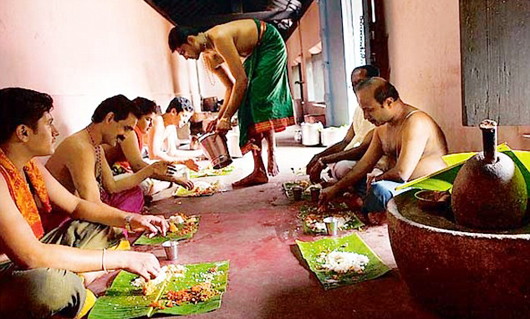
Udupi, Aug 26: What connects Bisi Bele Hulianna, Saaru, Modaka, Huggi, Majjige Palidya and Drakshi Gojju? These are some of the famed dishes of the Madhwa Brahmin community of Udupi, a coastal town in Karnataka where the Krishna temple acts as a pivot in people's lives.
brahmin

Laying out the geographical expanse and scientific logic to the regions Madhwa Brahmins vegetarian food habits, culinary expert Malati Srinivasan and arts and crafts connoisseur Geetha Rao showcase the hitherto unknown vegetarian recipes from Udupi in their book "The Udupi Kitchen."

The authors straddle the traditional and modern and list what was once easily cooked in Udupi households - spice powders, salads and chutneys, savoury snacks, desserts - and elaborate on several recipes which are all-time favourites like Bisi Bele Hulianna, Saaru, Masal Dose and Modaka.

While Bisi Bele Hulianna is a dish of spicy red gram, rice and vegetables, Saaru is spicy red gram soup, Huggi is rice and green gram with black pepper and cumin and Modaka is dumplings with coconut and jiggery filling.

Majjige Palidya is ash gourd with coconut and cumin in sour yoghurt and Drakshi Gojju is raisins in sweet, sour and spicy gravy.

Split into 12 sections, the Udupi Kitchen, published by Westland Ltd, celebrates vegetarian food with aplomb from a town where food is religion as well as a complete mouth-watering experience.

At the core of Udupi cuisine is the use of indigenous vegetables and fruits, cereals and pulses special to the Parashurama Kshetra and traditional Brahmins ate only vegetarian fare without onion and garlic.

According to the authors, Udupi cuisine has a vast variety and is not limited to tiffins or snacks.

"As I began working on this project, I realised how vast and varied our family’s repertoire of Udupi (Madhwa) cuisine was. I wrote down 175 recipes, but have used about a 100 of them in the book," says Srinivasan.

"Writing a cook book for both Indian and non-Indian readers required that a comprehensive multi-lingual glossary be compiled. It also meant using internationally accepted terminology: 'henchu' or 'tava' became griddle, bandle or 'kadhai' became wok, 'tappele' or 'bartan' became saucepan," says Rao.

She says for some kitchen tools like 'eelgemane' and 'ogarane chamcha', which had no "internationally understood" words, substitute words like curved knife blade and tempering-ladle had to be coined.

The story of Udupi cuisine is the story of how a temple-based, Brahmanical culinary tradition got modernised and became a global phenomenon. Food is religion in Udupi.

Fourteen varieties of food are cooked daily and offered to the deity at different times of the day. The food offered to god is 'naivediya', and the food eaten by human beings is 'prasada', food that is blessed.

In Udupi, meals are served on banana leaves in a particular order. Many recipes and foods have also proven health benefits. For example, dishes made from the inner banana stem prevent kidney stones, pepper rasam helps with the lactation of new mothers, jackfruit seeds have high protein content and so on.

The authors also say that the original of the masal dose or the famous masala dosa is attributed to Udupi.

Before it was invented, plain dosa was served with potato playa, without onions, in a separate cup. With changing food tastes, the Udupi chefs began to saute the mashed potatoes with onions and spices.

"As onions were considered taboo food for orthodox Brahmins, it is said that the doses were stuffed with onion-laced playa, instead of served in a separate cup, so that the onion could be 'hidden'," the authors say.

Comments

Usha moorthy
 - 
Wednesday, 8 Jun 2016

I'm extremely pleased that I now have a book to refer to for genuine udupi food!!! Thanks to the authors for painstakingly bringing together these wonderful recipes!!;

Add new comment

  • Coastaldigest.com reserves the right to delete or block any comments.
  • Coastaldigset.com is not responsible for its readers’ comments.
  • Comments that are abusive, incendiary or irrelevant are strictly prohibited.
  • Please use a genuine email ID and provide your name to avoid reject.
News Network
May 20,2020

Bengaluru, May 20: Ride-sharing company Ola Cabs said on Wednesday it will lay off 1,400 of its employees due to business uncertainty caused by the coronavirus pandemic while the revenue has come down by 95 per cent in the past two months.

"The COVID crisis continues to unfold all around us causing unprecedented economic and social destruction. It has also become evident that the coronavirus will not be eliminated any time soon," wrote co-founder and CEO Bhavish Aggarwal to all Ola employees.

"In these circumstances, today I write to all of you with the toughest decision I have ever taken -- the need to downsize our organisation and let go of 1,400 of our valued employees," he said.

Aggarwal said the fallout of virus has been very tough for the cab aggregating industry in particular. "The company's revenue has come down by 95 per cent over the past two months," he said.

Initially, he said, the company hoped it would be a short-lived crisis and that its impact would be temporary. "But unfortunately, it is not been a short crisis. And the prognosis ahead for our business is very unclear and uncertain. It is going to take a long time for people to go out and about like before."
With more companies preferring to have a large number of employees work from home, air travel limited to essential trips and vacations being put off for better times, the impact of this crisis is definitely going to be long-drawn, said Aggarwal.

"The world is not going to revert to the pre-COVID era anytime soon. Social distancing, anxiety and an abundance of caution will be the operating principles for everyone," he told employees.

Aggarwal said the crisis necessitates the need to conserve cash aggressively so that Ola is able to invest in opportunities in the future, adding the downsizing exercise has been a very tough and sad decision for the management team to make.

"While we restructure our organisation to the new realities of our business, we are also going to recommit ourselves to strengthening our operational excellence and leverage a lot more technology to improve efficiencies and reduce cost across all parts of our business," he said.

Comments

Add new comment

  • Coastaldigest.com reserves the right to delete or block any comments.
  • Coastaldigset.com is not responsible for its readers’ comments.
  • Comments that are abusive, incendiary or irrelevant are strictly prohibited.
  • Please use a genuine email ID and provide your name to avoid reject.
News Network
January 11,2020

Bengaluru, Jan 11: Scholar and writer M Chidanadamurthy passed away at a private hospital here on Saturday.

He was 88 and is survived by wife, son and daughter.
He was a well-known scholar in Karnataka specialising in the history of Kannada language and ancient Karnataka.

He was also known for his campaign to conserve the monuments Hampi and to secure classical language status to Kannada Language. Murthy has also articulated that uniform civil code and an anti-conversion law must be enacted by the Government in India.

Murthy was the head of the department of Kannada Bangalore University. He was also associated with Kannada Shakti Kendra. As a historian most of Murthy's work has focused on scientific study of the Kannada Inscriptions.

He has attempted to contextualise inscriptions in their socio cultural setup. He has produced many books on the history of Kannada language and Karnataka. He has guided many research students.

Murthy was recipient of Rajayothsava, Sathiya Academy Award , Papama award and Alava’s Nudisiri award.
His mortal remains were kept at his residence for his fellow mates and relatives.

Several dignatories like B S Yediyurappa, S L Bhyrappa, S Suresh Kumar, V Somanna expressed their condolences to the veteran's death.

The final rituals will be held on Sunday with state honour.

Comments

Add new comment

  • Coastaldigest.com reserves the right to delete or block any comments.
  • Coastaldigset.com is not responsible for its readers’ comments.
  • Comments that are abusive, incendiary or irrelevant are strictly prohibited.
  • Please use a genuine email ID and provide your name to avoid reject.
News Network
February 28,2020

Bengaluru, Feb 28: Historian S. Shettar, 85, breathed his last early on February 28 in Bengaluru. He was suffering from respiratory problems and was hospitalised for over a week.

Shettar was known for his multi-disciplinary work, encompassing linguistics, epigraphy, anthropology, the study of religions and art history. He had extensively worked on the Jain practice of ritual death in Karnataka and Asoka edicts. He had studied and compiled early edicts in Kannada and worked extensively on the growth of Kannada language down the ages.

Born in 1935 at Hampasagara, Ballari district, he went on to study at Cambridge University and started his career as a Professor of History at Karnatak University, Dharwad, his alma mater. He later headed the National Museum Institute of the History of Art, Conservation and Museology in 1978 and Indian Council for Historical Research in 1996. He was also a visiting professor at the National Institute of Advanced Studies, Bengaluru.

He was a bilingual historian who wrote in English for most of his career, but started writing in Kannada in later years. In the last two decades, he developed a keen interest in linguistics and wrote multiple books on classical Kannada and Prakrit. His 2007 book “Shangam Tamilagam” is considered a seminal work in the study of the early period of Dravidian languages. It won him Bhasha Samman from Central Sahitya Akademi. He later wrote two works on Halegannada, classical Kannada. His most recent work was “Prakrita Jagadvalaya” in 2018.

Comments

Add new comment

  • Coastaldigest.com reserves the right to delete or block any comments.
  • Coastaldigset.com is not responsible for its readers’ comments.
  • Comments that are abusive, incendiary or irrelevant are strictly prohibited.
  • Please use a genuine email ID and provide your name to avoid reject.