


The secrets of Udupi's Madhwa Brahmin kitchen leaked!

[email protected] (News Network | KM Acharya)
August 26, 2015

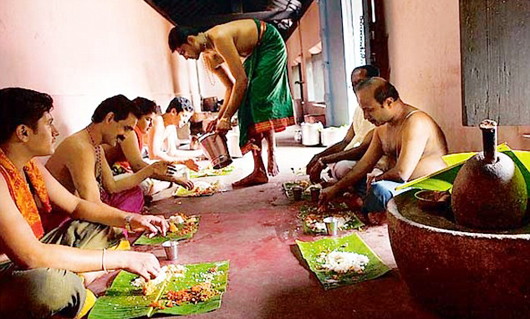
Udupi, Aug 26: What connects Bisi Bele Hulianna, Saaru, Modaka, Huggi, Majjige Palidya and Drakshi Gojju? These are some of the famed dishes of the Madhwa Brahmin community of Udupi, a coastal town in Karnataka where the Krishna temple acts as a pivot in people's lives.
brahmin

Laying out the geographical expanse and scientific logic to the regions Madhwa Brahmins vegetarian food habits, culinary expert Malati Srinivasan and arts and crafts connoisseur Geetha Rao showcase the hitherto unknown vegetarian recipes from Udupi in their book "The Udupi Kitchen."

The authors straddle the traditional and modern and list what was once easily cooked in Udupi households - spice powders, salads and chutneys, savoury snacks, desserts - and elaborate on several recipes which are all-time favourites like Bisi Bele Hulianna, Saaru, Masal Dose and Modaka.

While Bisi Bele Hulianna is a dish of spicy red gram, rice and vegetables, Saaru is spicy red gram soup, Huggi is rice and green gram with black pepper and cumin and Modaka is dumplings with coconut and jiggery filling.

Majjige Palidya is ash gourd with coconut and cumin in sour yoghurt and Drakshi Gojju is raisins in sweet, sour and spicy gravy.

Split into 12 sections, the Udupi Kitchen, published by Westland Ltd, celebrates vegetarian food with aplomb from a town where food is religion as well as a complete mouth-watering experience.

At the core of Udupi cuisine is the use of indigenous vegetables and fruits, cereals and pulses special to the Parashurama Kshetra and traditional Brahmins ate only vegetarian fare without onion and garlic.

According to the authors, Udupi cuisine has a vast variety and is not limited to tiffins or snacks.

"As I began working on this project, I realised how vast and varied our family’s repertoire of Udupi (Madhwa) cuisine was. I wrote down 175 recipes, but have used about a 100 of them in the book," says Srinivasan.

"Writing a cook book for both Indian and non-Indian readers required that a comprehensive multi-lingual glossary be compiled. It also meant using internationally accepted terminology: 'henchu' or 'tava' became griddle, bandle or 'kadhai' became wok, 'tappele' or 'bartan' became saucepan," says Rao.

She says for some kitchen tools like 'eelgemane' and 'ogarane chamcha', which had no "internationally understood" words, substitute words like curved knife blade and tempering-ladle had to be coined.

The story of Udupi cuisine is the story of how a temple-based, Brahmanical culinary tradition got modernised and became a global phenomenon. Food is religion in Udupi.

Fourteen varieties of food are cooked daily and offered to the deity at different times of the day. The food offered to god is 'naivediya', and the food eaten by human beings is 'prasada', food that is blessed.

In Udupi, meals are served on banana leaves in a particular order. Many recipes and foods have also proven health benefits. For example, dishes made from the inner banana stem prevent kidney stones, pepper rasam helps with the lactation of new mothers, jackfruit seeds have high protein content and so on.

The authors also say that the original of the masal dose or the famous masala dosa is attributed to Udupi.

Before it was invented, plain dosa was served with potato playa, without onions, in a separate cup. With changing food tastes, the Udupi chefs began to saute the mashed potatoes with onions and spices.

"As onions were considered taboo food for orthodox Brahmins, it is said that the doses were stuffed with onion-laced playa, instead of served in a separate cup, so that the onion could be 'hidden'," the authors say.

Comments

Usha moorthy
 - 
Wednesday, 8 Jun 2016

I'm extremely pleased that I now have a book to refer to for genuine udupi food!!! Thanks to the authors for painstakingly bringing together these wonderful recipes!!;

Add new comment

  • Coastaldigest.com reserves the right to delete or block any comments.
  • Coastaldigset.com is not responsible for its readers’ comments.
  • Comments that are abusive, incendiary or irrelevant are strictly prohibited.
  • Please use a genuine email ID and provide your name to avoid reject.
News Network
April 7,2020

Bengaluru, Apr 7: Leader of Opposition in Karnataka Siddaramaiah on Monday urged Chief Minister B S Yediyurappa to announce a special package to help farmers, agriculture labourers and also working class in various sectors who are affected by the lockdown.

Mr Siddaramaiah put forth his demands during a telephonic conversation and the Chief Minister positively responding to it informed that he will formulate a programme keeping in mind the suggestions made by the Opposition, a statement from the LoP's office said.

It said, the Chief Minister also spoke to Mr Siddaramaiah regarding the government's decision to stop supply of free food for poor and needy through Indira Canteens.

Mr Siddaramaiah on Saturday had written to Yediyurappa urging him to utilise Indira Canteens efficiently and provide food for poor and needy until the coronavirus crisis and lockdown is over.

The former Chief Minister's letter had come a day after the state government had decided not to provide free food at Indira Canteens as concerns were raised about the quality and misuse that was happening.

It had, however, decided to continue to provide subsidised food- breakfast at Rs 5 and lunch and dinner at Rs 10, as usual.

Mr Yediyurappa during the phone conversation on Monday appraised Siddaramaiah that the decision to supply food by fixing a price was taken to stop misuse that was happening.

Mr Siddaramaiah, however, insisted the government should provide food free of cost to the poor and needy, by taking care that misuse doesn't happen.

The senior Congress leader asked the Chief Minister to take action against errant officials who allowed misuse to happen, the statement said, adding that Yediyurappa has promised to look into it.

Initially, the government last month had decided that the state subsidised Indira Canteens would provide food packets free of cost to the poor and needy in the wake of the lockdown.

Comments

Add new comment

  • Coastaldigest.com reserves the right to delete or block any comments.
  • Coastaldigset.com is not responsible for its readers’ comments.
  • Comments that are abusive, incendiary or irrelevant are strictly prohibited.
  • Please use a genuine email ID and provide your name to avoid reject.
News Network
February 10,2020

Bengaluru, Feb 10: Smoke entered wards at Sagar Hospital following a short circuit in the UPS room, said the fire department here on Sunday.

"Smoke entered wards at Sagar Hospital in Bengaluru, following a short circuit in the UPS room at the hospital today. Patients have been shifted from the site of the incident, as a precaution," the fire department in Bengaluru said.

"No fire incident reported and the situation is under control now," the fire department said.

Comments

Add new comment

  • Coastaldigest.com reserves the right to delete or block any comments.
  • Coastaldigset.com is not responsible for its readers’ comments.
  • Comments that are abusive, incendiary or irrelevant are strictly prohibited.
  • Please use a genuine email ID and provide your name to avoid reject.
Charan Kumar | coastaldigest.com
June 24,2020

Bengaluru, June 24: City-based I Monetary Advisory (IMA), which duped thousands of families, mostly Muslims, in the name of halal investment, has become a bitter reality of "we were robbed by our own people". All the accused except its CEO Mohammad Mansoor Khan have been released on bail in this ponzi scam worth thousands of crores of rupees.

The scam has not only been investigated by SIT and CBI, but it has reverberated many times in the Assembly, corridors of power, and in the courts.

Around 80,000 investors are in trouble after the Monetary Advisory (IMA) scam came to light. Many investors have left this world, many families have split, many marriages have broken down and many have become unemployed, homeless, helpless and hapless. One of the senior IAS office, who had faced arrest in the scam, reportedly killed himself just a day ago.

It has been more than a year since this multi-billion scam came to light. But the affected families still do not see any ray of hope. The government, led by senior IAS officer Harsh Gupta, has set up a special competent authority to address investor grievances in the matter.

According to information provided by Harsh Gupta, investors have to be paid Rs 2,900 crore. But the value of the company's assets seized so far could be around Rs 450 crore. The process of auctioning the assets has not started yet. The authority has developed an online portal for submission of claim forms from investors. But the process of taking applications has not started yet. Syed Gulab, a social worker overseeing the case, says that after all the claim forms have been submitted, we will get a clear picture about the exact number of investors and the total amount of arrears. But this process may take a few more months to complete.

Senior journalist Maqbool Ahmed Siraj says that IMA has systematically deceived people in the name of halal investment through capital scheme. In 2006, Muhammad Mansoor Khan, a one-time small businessman, set up a company. He began to attract large number of investors by creating the greed for more profit among middle class and poor people.

By 2015, the company had received money from more than 12,000 investors and continued to pay monthly profits. By the time the company closed in 2019, 80,000 people had invested their hard-earned money here. In Bengaluru, the company expanded its reach by investing in two major gold showrooms, hospitals, schools, several medical stores, a publishing center, a supermarket, and real estate firm.

Mr Siraj says that Mansoor Khan and his team not only lured the poor and middle class to pursue their own interests but also created a favourable atmosphere for their so called business by winning the hearts of politicians, government officials, clerics, religious institutions and media.

Unsuspecting people invested their money in a bid to make more profit in less time. When the company stopped making profits and Mansoor Khan suddenly fled on June 9, 2019, the investors woke up the to the reality.

Apart from residents of Bengaluru and other parts of Karnataka, people from Tamil Nadu, Andhra Pradesh, Telangana, Maharashtra other states also have invested their money.

Comments

Add new comment

  • Coastaldigest.com reserves the right to delete or block any comments.
  • Coastaldigset.com is not responsible for its readers’ comments.
  • Comments that are abusive, incendiary or irrelevant are strictly prohibited.
  • Please use a genuine email ID and provide your name to avoid reject.