The secrets of Udupi's Madhwa Brahmin kitchen leaked!

[email protected] (News Network | KM Acharya)
August 26, 2015

Udupi, Aug 26: What connects Bisi Bele Hulianna, Saaru, Modaka, Huggi, Majjige Palidya and Drakshi Gojju? These are some of the famed dishes of the Madhwa Brahmin community of Udupi, a coastal town in Karnataka where the Krishna temple acts as a pivot in people's lives.
brahmin

Laying out the geographical expanse and scientific logic to the regions Madhwa Brahmins vegetarian food habits, culinary expert Malati Srinivasan and arts and crafts connoisseur Geetha Rao showcase the hitherto unknown vegetarian recipes from Udupi in their book "The Udupi Kitchen."

The authors straddle the traditional and modern and list what was once easily cooked in Udupi households - spice powders, salads and chutneys, savoury snacks, desserts - and elaborate on several recipes which are all-time favourites like Bisi Bele Hulianna, Saaru, Masal Dose and Modaka.

While Bisi Bele Hulianna is a dish of spicy red gram, rice and vegetables, Saaru is spicy red gram soup, Huggi is rice and green gram with black pepper and cumin and Modaka is dumplings with coconut and jiggery filling.

Majjige Palidya is ash gourd with coconut and cumin in sour yoghurt and Drakshi Gojju is raisins in sweet, sour and spicy gravy.

Split into 12 sections, the Udupi Kitchen, published by Westland Ltd, celebrates vegetarian food with aplomb from a town where food is religion as well as a complete mouth-watering experience.

At the core of Udupi cuisine is the use of indigenous vegetables and fruits, cereals and pulses special to the Parashurama Kshetra and traditional Brahmins ate only vegetarian fare without onion and garlic.

According to the authors, Udupi cuisine has a vast variety and is not limited to tiffins or snacks.

"As I began working on this project, I realised how vast and varied our family’s repertoire of Udupi (Madhwa) cuisine was. I wrote down 175 recipes, but have used about a 100 of them in the book," says Srinivasan.

"Writing a cook book for both Indian and non-Indian readers required that a comprehensive multi-lingual glossary be compiled. It also meant using internationally accepted terminology: 'henchu' or 'tava' became griddle, bandle or 'kadhai' became wok, 'tappele' or 'bartan' became saucepan," says Rao.

She says for some kitchen tools like 'eelgemane' and 'ogarane chamcha', which had no "internationally understood" words, substitute words like curved knife blade and tempering-ladle had to be coined.

The story of Udupi cuisine is the story of how a temple-based, Brahmanical culinary tradition got modernised and became a global phenomenon. Food is religion in Udupi.

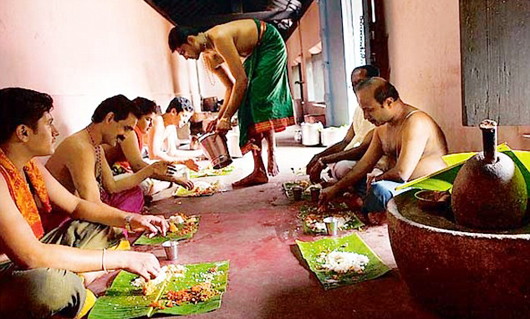
Fourteen varieties of food are cooked daily and offered to the deity at different times of the day. The food offered to god is 'naivediya', and the food eaten by human beings is 'prasada', food that is blessed.

In Udupi, meals are served on banana leaves in a particular order. Many recipes and foods have also proven health benefits. For example, dishes made from the inner banana stem prevent kidney stones, pepper rasam helps with the lactation of new mothers, jackfruit seeds have high protein content and so on.

The authors also say that the original of the masal dose or the famous masala dosa is attributed to Udupi.

Before it was invented, plain dosa was served with potato playa, without onions, in a separate cup. With changing food tastes, the Udupi chefs began to saute the mashed potatoes with onions and spices.

"As onions were considered taboo food for orthodox Brahmins, it is said that the doses were stuffed with onion-laced playa, instead of served in a separate cup, so that the onion could be 'hidden'," the authors say.

Comments

Usha moorthy
 - 
Wednesday, 8 Jun 2016

I'm extremely pleased that I now have a book to refer to for genuine udupi food!!! Thanks to the authors for painstakingly bringing together these wonderful recipes!!;

Add new comment

  • Coastaldigest.com reserves the right to delete or block any comments.
  • Coastaldigset.com is not responsible for its readers’ comments.
  • Comments that are abusive, incendiary or irrelevant are strictly prohibited.
  • Please use a genuine email ID and provide your name to avoid reject.
News Network
March 12,2020

Bengaluru, Mar 12: The Karnataka government on Wednesday clarified that no coronavirus "emergency" has been declared in the state and that all the schools and offices will remain open.

Earlier, there were fake reports that Karnataka has declared "coronavirus as an epidemic" in the state.

In a statement, Karnataka health commissioner Pankaj Kumar Pandey refuted the reports doing rounds on social media which said Karnataka had declared COVID-19 as a "state epidemic".

Refuting the rumours, he added that all the schools, offices and other institutions will continue to function normally in the state.

The Karnataka government earlier today issued temporary regulation which asked all government and private hospitals to have flu corners for screening of suspected cases of COVID-19.

According to the regulation, no person/institution shall use print or electronic media to spread mis-information on COVID-19 without prior permission of the department of health & family welfare. If a person is found indulging in any such activity, they will be punished, it said.

The Karnataka government also started a campaign called 'Namaste over Handshake' that encourages people to greet in the traditional Indian style, to tackle the spread of the virus.

The state has reported four positive cases of coronavirus so far.

India, so far, has 60 confirmed cases of coronavirus, including 16 Italians tourists.

Comments

Add new comment

  • Coastaldigest.com reserves the right to delete or block any comments.
  • Coastaldigset.com is not responsible for its readers’ comments.
  • Comments that are abusive, incendiary or irrelevant are strictly prohibited.
  • Please use a genuine email ID and provide your name to avoid reject.
Ram Puniyani
July 20,2020

As Covid 19 has created havoc all rounds, the rulers of certain countries are using it to further intensify their set agendas. The democratic freedoms are being curtailed in certain forms, the reaction to which has come in America in the form of a campaign, which is opposing “stifling” cultural climate that is imposing “ideological conformity” and weakening “norms of open debate and toleration of differences”. In India similar intimidations have been intensified. In addition the occasion has been used by the sectarian forces first to link the spread of Corona to Muslim community and now in the name of reducing the burden of curriculum certain chapters on core concepts related to Indian nationalism are being deleted from the text books.

It has been reported that chapters on federalism, citizenship, nationalism, secularism, Human Rights, Legal Aid and Local Self Government and the like are being dropped. Education has been an important area for communal forces and they constantly keep saying that leftists have dominated the curriculum content, it suffers from the impact of Macaulay, Marx and Mohammad and so needs to be Indianized. The first such attempt was done when BJP came to power in 1998 as NDA and had Murli Manohar Joshi as the MHRD minister. He brought the changes which were termed as ‘saffronization of education’. Their focus is more on social science. Some of the highlights of this were introduction of subjects like Astrology and Paurohitya, and chapters defending caste system, nationalism of the type of Hitler was praised.

With defeat of NDA in 2004, the UPA did try to rectify some of these distortions. Again after 2014 the RSS affiliates working in the area of education have been active, interacting with MHRD officials to impress upon them the need to change the curriculum matching with their Hindu nationalist agenda. Its ‘Shiksha Sanskriti Utthan Nyas’ has been asking for removal of English, Urdu words in the texts. It has asked for removal of thoughts of Rabindranath Tagore on Nationalism, extracts of autobiography of M F Husain, references to benevolence of Muslim rulers, references to BJP being Hindu party, apology of Dr. Manmohan Singh for anti Sikh pogrom of 1984, the reference to killings of Gujarat carnage in 2002 among others. This they call as Bhartiykaran of syllabus.

As RSS is a multithreaded hydra one of its pracharak Dinanath Batra has set up ‘Shiksha Bachao Abhiyan Samiti’ which has been pressurizing various publishers to drop the books which are not conforming to their ideology. One recalls their pressuring withdrawal of Wendy Doniger’s ‘The Hindus’, as it does present the ancient India through the concerns of dalits and women. Mr. Batra has already come out with a set of nine books for school curriculum, giving the RSS view of the past and RSS understanding of social sciences. These have already been translated into Gujarati and thousands of the sets of these books are being used in Gujarat Schools.

The present step of deleting parts of curriculum which gives the basics of Indian Nationalism, secularism and human rights is a further step in the same direction. These are the topics which have made the Hindu nationalists uncomfortable during last few years. They have been defaming secularism. They removed it from the preamble of Indian constitution, when they put out an ad on the eve of Republic day in 2015. From last few decades since the Ram Temple movement was brought up, simultaneously the secular ethos of India’s freedom movement and secular values of Indian constitution have been constantly criticized. Many an RSS ideologues and BJP leaders have been asking for change of Indian Constitution for this very reason.

Secularism is part of the concept of Indian nationalism. In the name of religious nationalism, sectarian divisive nationalism they have been attacking various student leaders in particular. When we study Nationalism, the very genesis of Indian nationalism tells us the plurality of our freedom movement with its anti colonial roots. The struggle was for Indian nationalism and so the Muslims and Hindu communalists kept aloof from this great struggle against colonial masters, it was this struggle which built the Indian nation with all its diversity.

Similarly as we have equal rights as citizens the chapters on citizenship are being dropped. Federalism has been the core part of India’s administrative and political structure. As the dictatorial tendencies are becoming stronger, federalism is bound to suffer and that explains the dropping of this subject. Democracy is decentralization of power. Power reaching the lowermost part of the system, the villages and average citizens. This got reflected in Local self Government. The power is distributed among villages, cities, state and center. By removing chapters on federalism and local self government, the indications of the ideology of ruling party are on display.

While we are not dealing with all the portents of the planned omissions, one more aspect that related to dropping of chapter on Human rights needs our attention. The concept of Human rights and dignity are interlinked. This concept of Human rights also has international ramifications. India is signatory to many an UN covenants related to Human rights. The indications are clear that now rights will be for the few elite and ‘duties’ for the large deprived sections will be put on the forefront.

In a way this incidental ‘Corona gifted opportunity’ to the ruling Government is being fully used to enhance the agenda of ruling party in the arena of Educational Curriculum. The part of curriculum with which the ruling party is uncomfortable is being removed. This act of omission does supplement their other acts of commission in changing the shape of educational curriculum, which are reflected in RSS affiliates’ suggestions to MHRD regarding Bhartiyakaran of contents of syllabus. As per this the things like regarding the great epics like Ramayana and Mahabharata as History, the things like India having all the stem cell technology, plastic surgery, aviation science etc. will have a place in the changes planned by communal forces!

Comments

Add new comment

  • Coastaldigest.com reserves the right to delete or block any comments.
  • Coastaldigset.com is not responsible for its readers’ comments.
  • Comments that are abusive, incendiary or irrelevant are strictly prohibited.
  • Please use a genuine email ID and provide your name to avoid reject.
coastaldigest.com news network
June 17,2020

Mangaluru, June 17: As many as 47 buses have been arranged by the district administration to transport 1,043 II PU students from the border areas of Kerala to the respective examination centres in Dakshina Kannada.

The II PU English examination, which was postponed in Karnataka due to covid lockdown, will be held on June 18. A total of 26,942 students are expected to appear for the examination across the district. Among them 6322 students have chosen to write their exam in the centres near to their hometown, following the COVID-19 pandemic. As many as 1,043 students are expected to come from Kerala.

22 KSRTC buses and 11 schools buses have been arranged from Talapady toll gate near Mariyashrama Church, 2 each KSRTC buses from Punyakoti Nagara in Mudipu, Bayar and Anekal in Vittal border, 1 KSRTC bus from Pathur in Kurnadu border, 3 KSRTC buses from Saradka in Vittal border, school buses from Kayar Padav in Puttur border, Panjikallu in Sullia border, Karike in Sullia border and Alatti Baddadka have been arranged.

The students have been asked to be present at a designated place to board the bus at 7 am and have to get their hall ticket and identity card, said DC Sindhu B Rupesh.

All the students should mandatorily wear masks and use sanitisers before entering the examination centres. The principals of colleges, where students from Kerala, are studying have been asked to deploy staff to make arrangements to ensure that students reach the examination centres on time and get back home after the exam.

Comments

Add new comment

  • Coastaldigest.com reserves the right to delete or block any comments.
  • Coastaldigset.com is not responsible for its readers’ comments.
  • Comments that are abusive, incendiary or irrelevant are strictly prohibited.
  • Please use a genuine email ID and provide your name to avoid reject.