


The secrets of Udupi's Madhwa Brahmin kitchen leaked!

[email protected] (News Network | KM Acharya)
August 26, 2015

Udupi, Aug 26: What connects Bisi Bele Hulianna, Saaru, Modaka, Huggi, Majjige Palidya and Drakshi Gojju? These are some of the famed dishes of the Madhwa Brahmin community of Udupi, a coastal town in Karnataka where the Krishna temple acts as a pivot in people's lives.
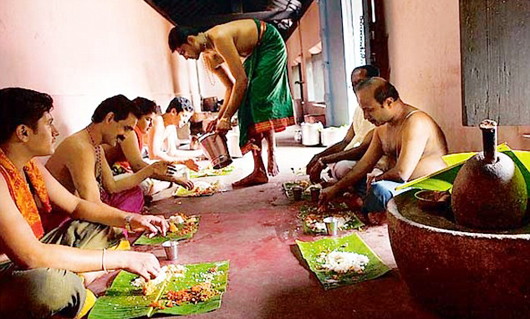
brahmin

Laying out the geographical expanse and scientific logic to the regions Madhwa Brahmins vegetarian food habits, culinary expert Malati Srinivasan and arts and crafts connoisseur Geetha Rao showcase the hitherto unknown vegetarian recipes from Udupi in their book "The Udupi Kitchen."

The authors straddle the traditional and modern and list what was once easily cooked in Udupi households - spice powders, salads and chutneys, savoury snacks, desserts - and elaborate on several recipes which are all-time favourites like Bisi Bele Hulianna, Saaru, Masal Dose and Modaka.

While Bisi Bele Hulianna is a dish of spicy red gram, rice and vegetables, Saaru is spicy red gram soup, Huggi is rice and green gram with black pepper and cumin and Modaka is dumplings with coconut and jiggery filling.

Majjige Palidya is ash gourd with coconut and cumin in sour yoghurt and Drakshi Gojju is raisins in sweet, sour and spicy gravy.

Split into 12 sections, the Udupi Kitchen, published by Westland Ltd, celebrates vegetarian food with aplomb from a town where food is religion as well as a complete mouth-watering experience.

At the core of Udupi cuisine is the use of indigenous vegetables and fruits, cereals and pulses special to the Parashurama Kshetra and traditional Brahmins ate only vegetarian fare without onion and garlic.

According to the authors, Udupi cuisine has a vast variety and is not limited to tiffins or snacks.

"As I began working on this project, I realised how vast and varied our family’s repertoire of Udupi (Madhwa) cuisine was. I wrote down 175 recipes, but have used about a 100 of them in the book," says Srinivasan.

"Writing a cook book for both Indian and non-Indian readers required that a comprehensive multi-lingual glossary be compiled. It also meant using internationally accepted terminology: 'henchu' or 'tava' became griddle, bandle or 'kadhai' became wok, 'tappele' or 'bartan' became saucepan," says Rao.

She says for some kitchen tools like 'eelgemane' and 'ogarane chamcha', which had no "internationally understood" words, substitute words like curved knife blade and tempering-ladle had to be coined.

The story of Udupi cuisine is the story of how a temple-based, Brahmanical culinary tradition got modernised and became a global phenomenon. Food is religion in Udupi.

Fourteen varieties of food are cooked daily and offered to the deity at different times of the day. The food offered to god is 'naivediya', and the food eaten by human beings is 'prasada', food that is blessed.

In Udupi, meals are served on banana leaves in a particular order. Many recipes and foods have also proven health benefits. For example, dishes made from the inner banana stem prevent kidney stones, pepper rasam helps with the lactation of new mothers, jackfruit seeds have high protein content and so on.

The authors also say that the original of the masal dose or the famous masala dosa is attributed to Udupi.

Before it was invented, plain dosa was served with potato playa, without onions, in a separate cup. With changing food tastes, the Udupi chefs began to saute the mashed potatoes with onions and spices.

"As onions were considered taboo food for orthodox Brahmins, it is said that the doses were stuffed with onion-laced playa, instead of served in a separate cup, so that the onion could be 'hidden'," the authors say.

Comments

Usha moorthy
 - 
Wednesday, 8 Jun 2016

I'm extremely pleased that I now have a book to refer to for genuine udupi food!!! Thanks to the authors for painstakingly bringing together these wonderful recipes!!;

Add new comment

  • Coastaldigest.com reserves the right to delete or block any comments.
  • Coastaldigset.com is not responsible for its readers’ comments.
  • Comments that are abusive, incendiary or irrelevant are strictly prohibited.
  • Please use a genuine email ID and provide your name to avoid reject.
News Network
May 2,2020

Udupi, May 2: All the 18 people who were advised self-quarantine in connection with the Thekkatte petrol bunk incident have been tested negative, however, they were asked to continue the 14-day quarantine, said DHO Sudhirchandra Suda on Saturday.

the petrol bunk at Thekkatte was sealed after a Covid infected person had food and took bath at the petrol bunk, while he was travelling from Mumbai to Mandya.

The employees and the owner of the petrol bunk along with the six employees at Sasthana toll gate were asked to quarantine themselves for 14 days.

Comments

Add new comment

  • Coastaldigest.com reserves the right to delete or block any comments.
  • Coastaldigset.com is not responsible for its readers’ comments.
  • Comments that are abusive, incendiary or irrelevant are strictly prohibited.
  • Please use a genuine email ID and provide your name to avoid reject.
News Network
February 3,2020

Bengaluru, Feb 3: A wave of dissatisfaction has hit the six-month-old BJP government against the backdrop of chief minister B S Yediyurappa's announcement to induct 13 aspirants in the second cabinet expansion on February 6.

In the first cabinet expansion, the chief minister had inducted 17 ministers on August 20, 2019.

Among the 13, ten will be those defectors from Congress and the JD(S) who were disqualified earlier and won the assembly by-election in December last year.

The rest will be the 'native BJP leaders', as deputy chief minister Govind Karjol put it.

Speculations are rife that Mahadevapura MLA Arvind Limbavali, Hukkeri MLA Umesh Katti and C P Yogeshwar, who had lost to H D Kumaraswamy from Channapatna assembly segment,would be inducted.

If Yogeshwar is included in the cabinet then he will bethe second minister after Deputy chief minister Laxman Savadi who had lost and yet made it to the cabinet.

The possible induction of Yogeshwar and Savadi, who was made deputy chief minister despite losing the assembly elections, are also a "reason" for discontent in the BJP.

Hectic activities began in the power corridor and MLAs started forming groups to impress upon the chief minister to include their members in the ministry.

While one group was from the "Kalyana Karnataka" region, the others were the defectors who will be excluded in the cabinet expansion.

A few MLAS from 'Kalyana Karnataka' region or erstwhile Hyderabad-Karnataka region comprising six districts, met at the Legislature Home and held a meeting.

The meeting was led by Shorapur MLA Narasimha Nayak akaRaju Gouda and Honnalli MLA M P Renukacharya.
The MLAs of the Kalyana Karnataka region were unanimous that their backward region should get representation in the cabinet.

Later, Gouda met the Chief Minister and requested that their region be given adequate representation in the cabinet, which is lacking development.

Talking to reporters, Gouda said, "We had given representations to all the MPs, MLAs and the chief minister. Today also we all had a meeting and later called on the Chief Minister requesting him to make any MLA from our region a minister."

He said any imbalance in cabinet expansion will cause trouble to the MLAs from Kalyana Karnataka region.

"If you make the defeated candidates ministers then include 120 people in the cabinet," an aggrieved Gouda taunted.

Renukacharya too echoed the same sentiments.

"If you give preference to the defeated candidates then what will happen to those who won the election? Where should the winners of election go? We emphasise upon giving preference to the winners."

On the other hand, the defectors who jumped the Congress and the JD(S) ship and helped form the BJP government too had a meeting in Bengaluru, said BJP sources.

They were unanimous that not only the 11 MLAs who won theelection be made ministers but also A H Vishwanath and M T BNagaraj who had unsuccessfully contested the assembly by- polls from Hunasuru and Hoskote on a BJP ticket.

Vishwanath, who was quite vocal on Sunday for dropping his name, was mellowed down on Monday after meeting Yediyurappa.

However, his insistence for getting a cabinet berth remained intact.

"I did not make any proposal before him and will not do it in future because he (Yediyurappa) knows what has to be done,"Vishwanath told reporters after meeting the chief minister.

When he was reminded of Yediyurappa's statement that therewere legal complications in making him a minister, Vishwanath said, "This government has legal experts and the advocate general. They will speak."

Amid speculations that Athani MLA Mahesh Kumathalli may not get a cabinet berth in the reshuffle, the defected MLAs led by Gokak BJP MLA Ramesh Jarkiholi, had a meeting to decide their future strategy, said party sources.

Currently, there are 18 ministers, including the chief minister, in the cabinet, which has a sanctioned strength of 34. Sixteen berths are vacant.

The cabinet expansion exercise will be a delicate task for Yediyurappa as he has to ensure adequate representation for various castes and regions.

The ministry already has eight Lingayats, including Yediyurappa; three Vokkaligas; a Brahmin; three SCs, two OBCs and one ST.

Opposition parties have been critical of the BJP and Yediyurappa over the delay in the cabinet expansion, alleging he is weak and his administration has collapsed.

Reacting to the cabinet expansion, former chief minister Siddaramaiah quipped, "A drama is taking place. Let it happen on February 6. Afterwards we will see what all happens."

Comments

Add new comment

  • Coastaldigest.com reserves the right to delete or block any comments.
  • Coastaldigset.com is not responsible for its readers’ comments.
  • Comments that are abusive, incendiary or irrelevant are strictly prohibited.
  • Please use a genuine email ID and provide your name to avoid reject.
Agencies
February 20,2020

India ranked 77th on a sustainability index that takes into account per capita carbon emissions and ability of children in a nation to live healthy lives and secures 131st spot on a flourishing ranking that measures the best chance at survival and well-being for children, according to a UN-backed report.

The report was released on Wednesday by a commission of over 40 child and adolescent health experts from around the world. It was commissioned by the World Health Organization (WHO), UN Children's Fund (UNICEF) and The Lancet medical journal.

In the report assessing the capacity of 180 countries to ensure that their youngsters can survive and thrive, India ranks 77th on the Sustainability Index and 131 on the Flourishing Index, it said.

Flourishing is the geometric mean of Surviving and Thriving. For Surviving, the authors selected maternal survival, survival in children younger than 5 years old, suicide, access to maternal and child health services, basic hygiene and sanitation, and lack of extreme poverty.

For Thriving, the domains were educational achievement, growth and nutrition, reproductive freedom, and protection from violence.

Under the Sustainability Index, the authors noted that promoting today's national conditions for children to survive and thrive must not come at the cost of eroding future global conditions for children's ability to flourish.

The Sustainability Index ranks countries on excess carbon emissions compared with the 2030 target. This provides a convenient and available proxy for a country's contribution to sustainability in future.

The report noted that under realistic assumptions about possible trajectories towards sustainable greenhouse gas emissions, models predict that global carbon emissions need to be reduced from 39·7 giga­ tonnes to 22·8 gigatonnes per year by 2030 to maintain even a 66 per cent chance of keeping global warming below 1·5°C.

It said that the world's survival depended on children being able to flourish, but no country is doing enough to give them a sustainable future.

"No country in the world is currently providing the conditions we need to support every child to grow up and have a healthy future," said Anthony Costello, Professor of Global Health and Sustainability at University College London, one of the lead authors of the report.

"Especially, they're under immediate threat from climate change and from commercial marketing, which has grown hugely in the last decade," said Costello – former WHO Director of Mother, Child and Adolescent health.

Norway leads the table for survival, health, education and nutrition rates - followed by South Korea and the Netherlands. Central African Republic, Chad and Somalia come at the bottom.

However, when taking into account per capita CO2 emissions, these top countries trail behind, with Norway 156th, the Republic of Korea 166th and the Netherlands 160th.

Each of the three emits 210 per cent more CO2 per capita than their 2030 target, the data shows, while the US, Australia, and Saudi Arabia are among the 10 worst emitters. The lowest emitters are Burundi, Chad and Somalia.

According to the report, the only countries on track to beat CO2 emission per capita targets by 2030, while also performing fairly – within the top 70 – on child flourishing measures are: Albania, Armenia, Grenada, Jordan, Moldova, Sri Lanka, Tunisia, Uruguay and Vietnam.

"More than 2 billion people live in countries where development is hampered by humanitarian crises, conflicts, and natural disasters, problems increasingly linked with climate change," said Minister Awa Coll-Seck from Senegal, Co-Chair of the commission.

The report also highlights the distinct threat posed to children from harmful marketing.

Evidence suggests that children in some countries see as many as 30,000 advertisements on television alone in a single year, while youth exposure to vaping (e-cigarettes) advertisements increased by more than 250 per cent in the US over two years, reaching more than 24 million young people.

Studies in Australia, Canada, Mexico, New Zealand and the US – among many others – have shown that self-regulation has not hampered commercial ability to advertise to children.

Children's exposure to commercial marketing of junk food and sugary beverages is associated with purchase of unhealthy foods and overweight and obesity, linking predatory marketing to the alarming rise in childhood obesity, it said.

The number of obese children and adolescents increased from 11 million in 1975 to 124 million in 2016 – an 11-fold increase, with dire individual and societal costs, the report said.

To protect children, the authors call for a new global movement driven by and for children.

Specific recommendations include stopping CO2 emissions with the utmost urgency, to ensure children have a future on this planet; placing children and adolescents at the centre of global efforts to achieve sustainable development, the report said.

New policies and investment in all sectors to work towards child health and rights; incorporating children's voices into policy decisions and tightening national regulation of harmful commercial marketing, supported by a new Optional Protocol to the UN Convention on the Rights of the Child, it said.

Comments

Add new comment

  • Coastaldigest.com reserves the right to delete or block any comments.
  • Coastaldigset.com is not responsible for its readers’ comments.
  • Comments that are abusive, incendiary or irrelevant are strictly prohibited.
  • Please use a genuine email ID and provide your name to avoid reject.