


The secrets of Udupi's Madhwa Brahmin kitchen leaked!

[email protected] (News Network | KM Acharya)
August 26, 2015

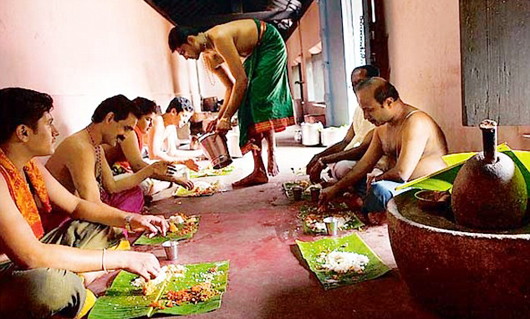
Udupi, Aug 26: What connects Bisi Bele Hulianna, Saaru, Modaka, Huggi, Majjige Palidya and Drakshi Gojju? These are some of the famed dishes of the Madhwa Brahmin community of Udupi, a coastal town in Karnataka where the Krishna temple acts as a pivot in people's lives.
brahmin

Laying out the geographical expanse and scientific logic to the regions Madhwa Brahmins vegetarian food habits, culinary expert Malati Srinivasan and arts and crafts connoisseur Geetha Rao showcase the hitherto unknown vegetarian recipes from Udupi in their book "The Udupi Kitchen."

The authors straddle the traditional and modern and list what was once easily cooked in Udupi households - spice powders, salads and chutneys, savoury snacks, desserts - and elaborate on several recipes which are all-time favourites like Bisi Bele Hulianna, Saaru, Masal Dose and Modaka.

While Bisi Bele Hulianna is a dish of spicy red gram, rice and vegetables, Saaru is spicy red gram soup, Huggi is rice and green gram with black pepper and cumin and Modaka is dumplings with coconut and jiggery filling.

Majjige Palidya is ash gourd with coconut and cumin in sour yoghurt and Drakshi Gojju is raisins in sweet, sour and spicy gravy.

Split into 12 sections, the Udupi Kitchen, published by Westland Ltd, celebrates vegetarian food with aplomb from a town where food is religion as well as a complete mouth-watering experience.

At the core of Udupi cuisine is the use of indigenous vegetables and fruits, cereals and pulses special to the Parashurama Kshetra and traditional Brahmins ate only vegetarian fare without onion and garlic.

According to the authors, Udupi cuisine has a vast variety and is not limited to tiffins or snacks.

"As I began working on this project, I realised how vast and varied our family’s repertoire of Udupi (Madhwa) cuisine was. I wrote down 175 recipes, but have used about a 100 of them in the book," says Srinivasan.

"Writing a cook book for both Indian and non-Indian readers required that a comprehensive multi-lingual glossary be compiled. It also meant using internationally accepted terminology: 'henchu' or 'tava' became griddle, bandle or 'kadhai' became wok, 'tappele' or 'bartan' became saucepan," says Rao.

She says for some kitchen tools like 'eelgemane' and 'ogarane chamcha', which had no "internationally understood" words, substitute words like curved knife blade and tempering-ladle had to be coined.

The story of Udupi cuisine is the story of how a temple-based, Brahmanical culinary tradition got modernised and became a global phenomenon. Food is religion in Udupi.

Fourteen varieties of food are cooked daily and offered to the deity at different times of the day. The food offered to god is 'naivediya', and the food eaten by human beings is 'prasada', food that is blessed.

In Udupi, meals are served on banana leaves in a particular order. Many recipes and foods have also proven health benefits. For example, dishes made from the inner banana stem prevent kidney stones, pepper rasam helps with the lactation of new mothers, jackfruit seeds have high protein content and so on.

The authors also say that the original of the masal dose or the famous masala dosa is attributed to Udupi.

Before it was invented, plain dosa was served with potato playa, without onions, in a separate cup. With changing food tastes, the Udupi chefs began to saute the mashed potatoes with onions and spices.

"As onions were considered taboo food for orthodox Brahmins, it is said that the doses were stuffed with onion-laced playa, instead of served in a separate cup, so that the onion could be 'hidden'," the authors say.

Comments

Usha moorthy
 - 
Wednesday, 8 Jun 2016

I'm extremely pleased that I now have a book to refer to for genuine udupi food!!! Thanks to the authors for painstakingly bringing together these wonderful recipes!!;

Add new comment

  • Coastaldigest.com reserves the right to delete or block any comments.
  • Coastaldigset.com is not responsible for its readers’ comments.
  • Comments that are abusive, incendiary or irrelevant are strictly prohibited.
  • Please use a genuine email ID and provide your name to avoid reject.
News Network
July 29,2020

Bengaluru Jul 29: There will be a centralised system in place in Karnataka to classify asymptomatic, symptomatic and mild symptomatic persons and recommend treatment based on the severity of the cases, said Medical Education Minister Dr K Sudhakar on Tuesday here.

"Various existing apps related to COVID-19 will be brought under one platform to get real-time information which will assist in strategising allocation of hospitals/beds to the needy. This will probably remove the delay in bed allocation and treatment which is being faced now. The patients will get all information in one phone call," Dr Sudhakar said.

Sudhakar spoke with a team of experts from the government and Infosys.

Referring to a company by name Step 1, which is providing such services in Delhi and Madhya Pradesh, the Minister said that a similar system will be implemented in the state as well.

"This company is having a team of doctors and nurses which is guiding the people whether they need hospital treatment or home isolation after they are tested positive for COVID-19. More than 70 per cent of the positive cases are being asymptomatic or mildly symptomatic and are advised to go for home isolation," the minister said.

"The load on the hospitals is reduced and severe cases can be administered proper treatment. Infosys co-ordinates with the government to provide technical support for this system," Dr Sudhakar added.

Earlier during the day, the minister held a video conference with the heads of private medical colleges to review COVID preparedness.
The government has already passed guidelines to allocate 50 per cent of hospital beds for COVID patients.

Comments

Add new comment

  • Coastaldigest.com reserves the right to delete or block any comments.
  • Coastaldigset.com is not responsible for its readers’ comments.
  • Comments that are abusive, incendiary or irrelevant are strictly prohibited.
  • Please use a genuine email ID and provide your name to avoid reject.
News Network
July 26,2020

Bengaluru, Jul 26: Today, one of the Co-founders of Infosys, SD Shibulal announced that over the last three days (22nd - 24th July) his family members have sold a portion of (representing approximately 0.20 per cent of the paid-up equity share capital) their holding in Infosys Ltd on the stock exchanges.

Proceeds from the partial stake monetization will be utilized for a combination of philanthropic and investment activities.

The sale was executed by Citigroup Global Markets India Private Limited as the Sole Broker.

The Founders, have served Infosys in various capacities, since its inception in 1981 until October 2014. Over the three decades, the Founders have nurtured the company transforming it into one of the professionally run companies in India with a global presence.

This press release is for information purposes only and is not an offer to sell, or a solicitation of an offer to buy, any of the shares described herein. The shares have not been and will not be registered under the US Securities Act of 1933, as amended (the "US Securities Act"), or in any state or other jurisdiction of the United States.

Securities may not be offered or sold in the United States absent registration or an applicable exemption from the registration requirements under the US Securities Act. 

There has not been and there will not be any public offering of the shares in the United States.

Comments

Add new comment

  • Coastaldigest.com reserves the right to delete or block any comments.
  • Coastaldigset.com is not responsible for its readers’ comments.
  • Comments that are abusive, incendiary or irrelevant are strictly prohibited.
  • Please use a genuine email ID and provide your name to avoid reject.
coastaldigest.com web desk
May 23,2020

The decision of the Indian government to ease the coronavirus-linked global travel restrictions imposed on those having OCI cards has given a big relief to many stranded overseas citizens of India across the world.

OCI card is issued to people of Indian origin globally which gives them almost all the privileges of an Indian national except for the right to vote, government service and buying agricultural land. The OCI card gives them a visa-free travel to India.

On Friday, the central government allowed certain categories of OCI card holders, who are stranded abroad, to come to the country. Earlier, according to the regulations issued by the Indian government in April, visas of foreign nationals and OCI cards were suspended as part of the new international travel restrictions following the COVID-19 pandemic.

This privilege of visa free travel to India was causing distress among a large number of people of Indian-origin and Indian citizens in countries like the US whose children were OCI card holders as they were born in this country.

Many Indian parents, several of whom lost their jobs as a result of the economic crisis due to coronavirus pandemic, but were not allowed to take the special evacuation flights of Air India from various US cities, took to social media and urged the Indian leaders to allow them to travel to India.

“This is a big relief for the OCI card holders. It was a humanitarian crisis in the making. I am pleased that the Indian Government listened to their voices,” said social activist Prem Bhandari, chairman of Jaipur Foot USA, who has been taking up the cause of the OCI card holders.

Dr Arathi Krishna, former deputy chairperson of NRI Forum of Karnataka government, who had been demanding this relaxation, many of the thousands of stranded OCI card holders in defferent parts of the world were in pursuading her to exert pressure on the authorities concerned for this much needed relaxation.

The restrictions on traveling of OCI card holders to India was issued by govt of India on March 13 in the wake of global outbreak of coronavirus pandemic. 

She said: "Many parents who are Indian nationals could not travel for emergency purpose to India after repatriation flights started due to their minor children being OCI card holders. Many children who were OCI card holders could not travel to India to perform last rites when there was death in their family due to these restrictions"

"I was constantly pressurising and bringing these issues to the attention of ministry officials in External Affairs and Home Affairs departments. I was following up with Mr Dammu Ravi who is heading the COVID task force  task firce in the ministry of overseas Indian affairs who took interest in solving this problem through his consistent efforts with MHA. Iam thankful to Fireign Secretary too for his efforts and concern and to MHA for making it easier now for OCI card holders to travel in repatriation flights with emergency reasons," she said.

Comments

Add new comment

  • Coastaldigest.com reserves the right to delete or block any comments.
  • Coastaldigset.com is not responsible for its readers’ comments.
  • Comments that are abusive, incendiary or irrelevant are strictly prohibited.
  • Please use a genuine email ID and provide your name to avoid reject.