


The secrets of Udupi's Madhwa Brahmin kitchen leaked!

[email protected] (News Network | KM Acharya)
August 26, 2015

Udupi, Aug 26: What connects Bisi Bele Hulianna, Saaru, Modaka, Huggi, Majjige Palidya and Drakshi Gojju? These are some of the famed dishes of the Madhwa Brahmin community of Udupi, a coastal town in Karnataka where the Krishna temple acts as a pivot in people's lives.
brahmin

Laying out the geographical expanse and scientific logic to the regions Madhwa Brahmins vegetarian food habits, culinary expert Malati Srinivasan and arts and crafts connoisseur Geetha Rao showcase the hitherto unknown vegetarian recipes from Udupi in their book "The Udupi Kitchen."

The authors straddle the traditional and modern and list what was once easily cooked in Udupi households - spice powders, salads and chutneys, savoury snacks, desserts - and elaborate on several recipes which are all-time favourites like Bisi Bele Hulianna, Saaru, Masal Dose and Modaka.

While Bisi Bele Hulianna is a dish of spicy red gram, rice and vegetables, Saaru is spicy red gram soup, Huggi is rice and green gram with black pepper and cumin and Modaka is dumplings with coconut and jiggery filling.

Majjige Palidya is ash gourd with coconut and cumin in sour yoghurt and Drakshi Gojju is raisins in sweet, sour and spicy gravy.

Split into 12 sections, the Udupi Kitchen, published by Westland Ltd, celebrates vegetarian food with aplomb from a town where food is religion as well as a complete mouth-watering experience.

At the core of Udupi cuisine is the use of indigenous vegetables and fruits, cereals and pulses special to the Parashurama Kshetra and traditional Brahmins ate only vegetarian fare without onion and garlic.

According to the authors, Udupi cuisine has a vast variety and is not limited to tiffins or snacks.

"As I began working on this project, I realised how vast and varied our family’s repertoire of Udupi (Madhwa) cuisine was. I wrote down 175 recipes, but have used about a 100 of them in the book," says Srinivasan.

"Writing a cook book for both Indian and non-Indian readers required that a comprehensive multi-lingual glossary be compiled. It also meant using internationally accepted terminology: 'henchu' or 'tava' became griddle, bandle or 'kadhai' became wok, 'tappele' or 'bartan' became saucepan," says Rao.

She says for some kitchen tools like 'eelgemane' and 'ogarane chamcha', which had no "internationally understood" words, substitute words like curved knife blade and tempering-ladle had to be coined.

The story of Udupi cuisine is the story of how a temple-based, Brahmanical culinary tradition got modernised and became a global phenomenon. Food is religion in Udupi.

Fourteen varieties of food are cooked daily and offered to the deity at different times of the day. The food offered to god is 'naivediya', and the food eaten by human beings is 'prasada', food that is blessed.

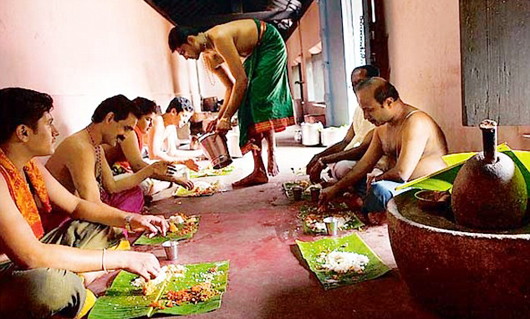
In Udupi, meals are served on banana leaves in a particular order. Many recipes and foods have also proven health benefits. For example, dishes made from the inner banana stem prevent kidney stones, pepper rasam helps with the lactation of new mothers, jackfruit seeds have high protein content and so on.

The authors also say that the original of the masal dose or the famous masala dosa is attributed to Udupi.

Before it was invented, plain dosa was served with potato playa, without onions, in a separate cup. With changing food tastes, the Udupi chefs began to saute the mashed potatoes with onions and spices.

"As onions were considered taboo food for orthodox Brahmins, it is said that the doses were stuffed with onion-laced playa, instead of served in a separate cup, so that the onion could be 'hidden'," the authors say.

Comments

Usha moorthy
 - 
Wednesday, 8 Jun 2016

I'm extremely pleased that I now have a book to refer to for genuine udupi food!!! Thanks to the authors for painstakingly bringing together these wonderful recipes!!;

Add new comment

  • Coastaldigest.com reserves the right to delete or block any comments.
  • Coastaldigset.com is not responsible for its readers’ comments.
  • Comments that are abusive, incendiary or irrelevant are strictly prohibited.
  • Please use a genuine email ID and provide your name to avoid reject.
News Network
March 5,2020

Mangaluru, Mar 5: As many as 29 police officers and personnel were examined by Udupi Deputy Commissioner G Jagadeesha, head of the magisterial enquiry into the police firing in the city in December 2019 which killed two anti- Citizenship (Amendment) Act (CAA) protesters.

A total of 176 police personnel have been directed to present their evidence before the magistrate for the enquiry.

ACPs K U Belliappa and Kodandarama presented his evidence on Wednesday, while ACP (central sub division) M Jagdish and ACP (traffic) M Manjunatha Shetty submitted their evidencein writing.

The next hearing is slated to be held on March 9 when statements of 41 officers including DCP (law and order) Arunangshu Giri will be recorded.

City police commissioner P S Harsha has been asked to submit his evidence on March 12, Jagadeesha said.

The enquiry report is to be submitted to the government on March 23.

Jagadeesha said he will seek an extension in the case of any delay in the recording of evidences.

Two people - Nausheen and Jaleel - were killed in the firing on December 19, 2019 during the protests here against the CAA.

The Karnataka government had decided to hold a CID probe and a magisterial enquiry into the incident.

Comments

Add new comment

  • Coastaldigest.com reserves the right to delete or block any comments.
  • Coastaldigset.com is not responsible for its readers’ comments.
  • Comments that are abusive, incendiary or irrelevant are strictly prohibited.
  • Please use a genuine email ID and provide your name to avoid reject.
News Network
February 4,2020

Bengaluru, Feb 4: Karnataka High Court on Monday reserved order on plea, seeking cancellation of bail granted to Nithyananda for skipping the trial and fleeing the country.

After hearing the arguments, the court has reserved the matter for further orders which will be pronounced on February 5.

The plea, which was filed in the high court on January 23, was heard by Justice John Michael Cunha.

The counsel for the complainant Lenin put forth arguments that the self-styled godman Swami Nithyananda had fled the country to escape the trial. "Nityananda has been claiming to be in India in his exemption petitions filed before the trial court but during that time he sought asylum in Ecuador and is having a second passport," said Lenin.

The prosecutor informed the court that they do not need his presence for the trial at this time.

Nithyananda, accused of rape and child abuse, has been absconding since November 2018.

In December 2019, the Ministry of External Affairs said that the passport of Nithyananda was cancelled and a fresh application of the same was denied as he did not get the requisite clearance from police and several criminal cases have been lodged against him.

Police in Ahmedabad had arrested two woman administrators of the ashram, allegedly owned by Nithyananda, and freed two boys who were held captive there.

Two of his disciples, Pranpriya and Priyatattva, were arrested on the basis of a complaint filed by one Janardhan Sharma who alleged that his daughter was held captive in Nithyananda's ashram.

The police took the two women to Nithyananda's ashram in Hathiajan for an investigation and seized laptops, mobile phones among other things.

Comments

Add new comment

  • Coastaldigest.com reserves the right to delete or block any comments.
  • Coastaldigset.com is not responsible for its readers’ comments.
  • Comments that are abusive, incendiary or irrelevant are strictly prohibited.
  • Please use a genuine email ID and provide your name to avoid reject.
News Network
February 5,2020

Tightening control over companies misleading advertisements of medicines and products, the Indian government could soon slap a fine of up to Rs10 lakh and up to two years' imprisonment. While repeat offender could be fined up to Rs50 and imprisonment up to five years.

The Ministry of Health and Family Welfare's new draft of the Drugs and Magic Remedies (Objectionable Advertisements) (Amendment) Bill, 2020, provides extremely stringent penalties compared to the current law.

Under the new Act, companies advertising medicines and products falsely claiming to make a person fairer, improve height and memory or cure issues like hair loss or greying and premature ageing, among several others, may attract more stringent fines and jail time.

The current Act, 1954, leaves scope for companies to create deceptive advertisements as first time offender can be jailed for six months while repeat offender can be up to one year in prison, reported The Indian Express.

Under the Bill, deceptive advertisements will cover digital advertising, notice, circular, label, wrapper, invoice, banner and poster, among others. The government also plans to expand the scope of the law under the proposed amendments to cover 24 more deceptive claims not included in the current law, like medicines that can cure AIDS, change the sex of a foetus, among others, reported Livemint.

Comments

Add new comment

  • Coastaldigest.com reserves the right to delete or block any comments.
  • Coastaldigset.com is not responsible for its readers’ comments.
  • Comments that are abusive, incendiary or irrelevant are strictly prohibited.
  • Please use a genuine email ID and provide your name to avoid reject.