


The secrets of Udupi's Madhwa Brahmin kitchen leaked!

[email protected] (News Network | KM Acharya)
August 26, 2015

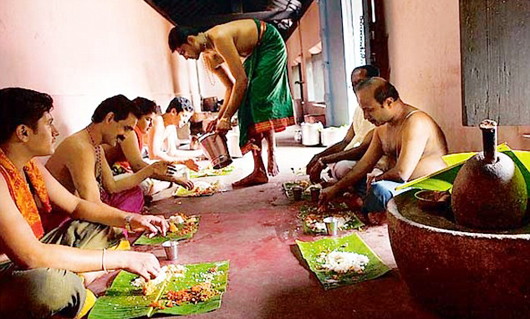
Udupi, Aug 26: What connects Bisi Bele Hulianna, Saaru, Modaka, Huggi, Majjige Palidya and Drakshi Gojju? These are some of the famed dishes of the Madhwa Brahmin community of Udupi, a coastal town in Karnataka where the Krishna temple acts as a pivot in people's lives.
brahmin

Laying out the geographical expanse and scientific logic to the regions Madhwa Brahmins vegetarian food habits, culinary expert Malati Srinivasan and arts and crafts connoisseur Geetha Rao showcase the hitherto unknown vegetarian recipes from Udupi in their book "The Udupi Kitchen."

The authors straddle the traditional and modern and list what was once easily cooked in Udupi households - spice powders, salads and chutneys, savoury snacks, desserts - and elaborate on several recipes which are all-time favourites like Bisi Bele Hulianna, Saaru, Masal Dose and Modaka.

While Bisi Bele Hulianna is a dish of spicy red gram, rice and vegetables, Saaru is spicy red gram soup, Huggi is rice and green gram with black pepper and cumin and Modaka is dumplings with coconut and jiggery filling.

Majjige Palidya is ash gourd with coconut and cumin in sour yoghurt and Drakshi Gojju is raisins in sweet, sour and spicy gravy.

Split into 12 sections, the Udupi Kitchen, published by Westland Ltd, celebrates vegetarian food with aplomb from a town where food is religion as well as a complete mouth-watering experience.

At the core of Udupi cuisine is the use of indigenous vegetables and fruits, cereals and pulses special to the Parashurama Kshetra and traditional Brahmins ate only vegetarian fare without onion and garlic.

According to the authors, Udupi cuisine has a vast variety and is not limited to tiffins or snacks.

"As I began working on this project, I realised how vast and varied our family’s repertoire of Udupi (Madhwa) cuisine was. I wrote down 175 recipes, but have used about a 100 of them in the book," says Srinivasan.

"Writing a cook book for both Indian and non-Indian readers required that a comprehensive multi-lingual glossary be compiled. It also meant using internationally accepted terminology: 'henchu' or 'tava' became griddle, bandle or 'kadhai' became wok, 'tappele' or 'bartan' became saucepan," says Rao.

She says for some kitchen tools like 'eelgemane' and 'ogarane chamcha', which had no "internationally understood" words, substitute words like curved knife blade and tempering-ladle had to be coined.

The story of Udupi cuisine is the story of how a temple-based, Brahmanical culinary tradition got modernised and became a global phenomenon. Food is religion in Udupi.

Fourteen varieties of food are cooked daily and offered to the deity at different times of the day. The food offered to god is 'naivediya', and the food eaten by human beings is 'prasada', food that is blessed.

In Udupi, meals are served on banana leaves in a particular order. Many recipes and foods have also proven health benefits. For example, dishes made from the inner banana stem prevent kidney stones, pepper rasam helps with the lactation of new mothers, jackfruit seeds have high protein content and so on.

The authors also say that the original of the masal dose or the famous masala dosa is attributed to Udupi.

Before it was invented, plain dosa was served with potato playa, without onions, in a separate cup. With changing food tastes, the Udupi chefs began to saute the mashed potatoes with onions and spices.

"As onions were considered taboo food for orthodox Brahmins, it is said that the doses were stuffed with onion-laced playa, instead of served in a separate cup, so that the onion could be 'hidden'," the authors say.

Comments

Usha moorthy
 - 
Wednesday, 8 Jun 2016

I'm extremely pleased that I now have a book to refer to for genuine udupi food!!! Thanks to the authors for painstakingly bringing together these wonderful recipes!!;

Add new comment

  • Coastaldigest.com reserves the right to delete or block any comments.
  • Coastaldigset.com is not responsible for its readers’ comments.
  • Comments that are abusive, incendiary or irrelevant are strictly prohibited.
  • Please use a genuine email ID and provide your name to avoid reject.
News Network
July 16,2020

Bengaluru, Jul 16: Amid difficulties being faced by COVID-19 patients in getting beds, the Karnataka government on Wednesday made bed allocation display board mandatory in all hospitals registered under Karnataka Private Medical Establishment (KPME).

"It is made mandatory that all hospitals registered under KPME in Karnataka State should display at the reception counter, a bed allocation display board," a notification issued by the state government read.

"It should display the name of the hospital, the total number of beds (as per of KPME registration) and the total number of beds allocated for COVID-19 patients referred by Bruhat Bengaluru Mahanagara Palike (BBMP)," it said.

The notification further stressed that the data must corroborate with the data of the central bed allocation system of BBMP. The display board should be arranged by July 16.

Non-compliance to the order issued by the state government will attract punishment under relevant sections of the Disaster Management Act 2005 and Indian Penal Code, the order read.

The state government on June 23 issued a notification making it mandatory to reserve 50 per cent of the beds in private hospitals to treat COVID-19 patients referred by public health authorities.

Comments

Add new comment

  • Coastaldigest.com reserves the right to delete or block any comments.
  • Coastaldigset.com is not responsible for its readers’ comments.
  • Comments that are abusive, incendiary or irrelevant are strictly prohibited.
  • Please use a genuine email ID and provide your name to avoid reject.
News Network
June 23,2020

Bengaluru, Jun 23: In an attempt to avoid exploitation of patients affected with coronavirus, the Karnataka government on Tuesday announced fixing charges that could be collected from patients by the private hospitals for treatment in the State.

There are now two sets of rates for patients--those who are referred by public health facilities and those who approach private hospitals directly.

According to the notification issued by State Chief Secretary TM Vijay Bhaskar on Tuesday, 50 per cent of the total beds in private hospitals having facilities to treat Covid-19 patients shall be reserved for the treatment of patients referred by public health authorities.

This will include the high-dependency unit and ICU (intensive care unit) beds both with and without ventilators. The hospitals may utilise the remaining Covid beds for admitting Covid-19 patients privately.

Comments

Add new comment

  • Coastaldigest.com reserves the right to delete or block any comments.
  • Coastaldigset.com is not responsible for its readers’ comments.
  • Comments that are abusive, incendiary or irrelevant are strictly prohibited.
  • Please use a genuine email ID and provide your name to avoid reject.
News Network
January 7,2020

Bengaluru, Jan 7: Slogans of ‘Inquilab Zindabad’ rent the air at Town Hall on Monday evening as thousands of students, social activists, lawyers, doctors and theatrepersons among others staged a protest to denounce Sunday’s attack on the students and faculty of New Delhi’s Jawaharlal Nehru University (JNU).

“This is unacceptable. As students living in hostels, we are now worried about our safety,” said Prakruthi Kishore, a student of National Law School of India University (NLSIU), Bengaluru.

Rishi Kumar, a student of Indian Institute of Science, pitched in. “JNU is an extremely protected university located in the national capital. It’s surprising that such an incident occurred amid tight security.”

Delhi police and the government need to wake up and take stringent action against the goons, Kumar said, adding: “Students can’t be treated like puppets. The government needs to act immediately.”

“The government is behaving shamelessly by sending goons to threaten students and professors of JNU,” said Alokanath Pandit, a lawyer.

With “Zor se bolo-azadi, tum din me maaro-azadi, hum raat me ayenge-azadi,” drowning the cacophony of traffic at the intersection, the sloganeering reached a crescendo around 6pm as the protesters raised their hands in a show of solidarity with the beleaguered JNU community.

Theatrepersons Prasanna and Arundathi Nag, farmer leader Kodihalli Chandrashekar and social activists Tara Krishnaswamy and Srinivas Alavilli were present at the protest venue. “It is not fair that educational institutions are now becoming the target. First, they hiked fees and now they are attacking students. What is the government doing,” Arundathi asked.

“JNU has always been an institution which has raised its voice against atrocities across the country as its students harbour no fear. This is an alarm bell for the country and the government to wake up. Students are the future and can’t be targeted,” she added.

Chandrashekar said Narendra Modi is unfit to be the Prime Minister as he doesn’t keep his word. “Modi said he will help farmers but has done nothing for them. He said he will provide employment to students but is now making them furious,” he said.

Comments

Add new comment

  • Coastaldigest.com reserves the right to delete or block any comments.
  • Coastaldigset.com is not responsible for its readers’ comments.
  • Comments that are abusive, incendiary or irrelevant are strictly prohibited.
  • Please use a genuine email ID and provide your name to avoid reject.