


The secrets of Udupi's Madhwa Brahmin kitchen leaked!

[email protected] (News Network | KM Acharya)
August 26, 2015

Udupi, Aug 26: What connects Bisi Bele Hulianna, Saaru, Modaka, Huggi, Majjige Palidya and Drakshi Gojju? These are some of the famed dishes of the Madhwa Brahmin community of Udupi, a coastal town in Karnataka where the Krishna temple acts as a pivot in people's lives.
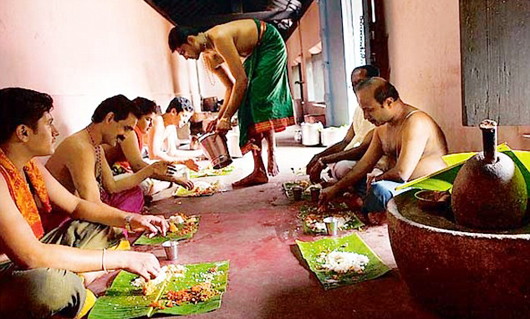
brahmin

Laying out the geographical expanse and scientific logic to the regions Madhwa Brahmins vegetarian food habits, culinary expert Malati Srinivasan and arts and crafts connoisseur Geetha Rao showcase the hitherto unknown vegetarian recipes from Udupi in their book "The Udupi Kitchen."

The authors straddle the traditional and modern and list what was once easily cooked in Udupi households - spice powders, salads and chutneys, savoury snacks, desserts - and elaborate on several recipes which are all-time favourites like Bisi Bele Hulianna, Saaru, Masal Dose and Modaka.

While Bisi Bele Hulianna is a dish of spicy red gram, rice and vegetables, Saaru is spicy red gram soup, Huggi is rice and green gram with black pepper and cumin and Modaka is dumplings with coconut and jiggery filling.

Majjige Palidya is ash gourd with coconut and cumin in sour yoghurt and Drakshi Gojju is raisins in sweet, sour and spicy gravy.

Split into 12 sections, the Udupi Kitchen, published by Westland Ltd, celebrates vegetarian food with aplomb from a town where food is religion as well as a complete mouth-watering experience.

At the core of Udupi cuisine is the use of indigenous vegetables and fruits, cereals and pulses special to the Parashurama Kshetra and traditional Brahmins ate only vegetarian fare without onion and garlic.

According to the authors, Udupi cuisine has a vast variety and is not limited to tiffins or snacks.

"As I began working on this project, I realised how vast and varied our family’s repertoire of Udupi (Madhwa) cuisine was. I wrote down 175 recipes, but have used about a 100 of them in the book," says Srinivasan.

"Writing a cook book for both Indian and non-Indian readers required that a comprehensive multi-lingual glossary be compiled. It also meant using internationally accepted terminology: 'henchu' or 'tava' became griddle, bandle or 'kadhai' became wok, 'tappele' or 'bartan' became saucepan," says Rao.

She says for some kitchen tools like 'eelgemane' and 'ogarane chamcha', which had no "internationally understood" words, substitute words like curved knife blade and tempering-ladle had to be coined.

The story of Udupi cuisine is the story of how a temple-based, Brahmanical culinary tradition got modernised and became a global phenomenon. Food is religion in Udupi.

Fourteen varieties of food are cooked daily and offered to the deity at different times of the day. The food offered to god is 'naivediya', and the food eaten by human beings is 'prasada', food that is blessed.

In Udupi, meals are served on banana leaves in a particular order. Many recipes and foods have also proven health benefits. For example, dishes made from the inner banana stem prevent kidney stones, pepper rasam helps with the lactation of new mothers, jackfruit seeds have high protein content and so on.

The authors also say that the original of the masal dose or the famous masala dosa is attributed to Udupi.

Before it was invented, plain dosa was served with potato playa, without onions, in a separate cup. With changing food tastes, the Udupi chefs began to saute the mashed potatoes with onions and spices.

"As onions were considered taboo food for orthodox Brahmins, it is said that the doses were stuffed with onion-laced playa, instead of served in a separate cup, so that the onion could be 'hidden'," the authors say.

Comments

Usha moorthy
 - 
Wednesday, 8 Jun 2016

I'm extremely pleased that I now have a book to refer to for genuine udupi food!!! Thanks to the authors for painstakingly bringing together these wonderful recipes!!;

Add new comment

  • Coastaldigest.com reserves the right to delete or block any comments.
  • Coastaldigset.com is not responsible for its readers’ comments.
  • Comments that are abusive, incendiary or irrelevant are strictly prohibited.
  • Please use a genuine email ID and provide your name to avoid reject.
News Network
February 6,2020

Thiruvananthapuram, Feb 6: The Kerala government on Wednesday said three foreign nationals were among the 2,528 people under observation in the state for the novel coronavirus infection and no new cases have been reported.

At least 93 people with minor symptoms of the virus have been lodged in isolation wards of various hospitals, state Health Minister KK Shailaja told reporters in Thiruvananthapuram.

India's three positive cases for the virus has been from the state's three districts of Thrissur, Alappuzha and Kasaragod.

All the three are students of China's Wuhan university, the epicentre of the virus.

"No new cases of coronavirus has been detected in the state today. At least 2,435 are under observation at home while 93 are in isolation wards at various hospital across the state," Mr Shailaja said.

The minister also said two foreigners have been quarantined in Ernakulam district and one foreign national at Thiruvananthapuram.

"The foreigner in Thiruvananthapuram has been kept at general hospital but not because he was showing symptoms but for observation as he travelled from China," an official said.

The health status of the three patients, who had tested positive for the virus, "remains satisfactory", the minister said.

After three cases were reported, the Left Democratic Front (LDF) government had declared the epidemic as a "state calamity" on Monday.

The health department has issued advisories to the education, tourism and the animal husbandry departments on taking precautions.

"The students, teachers, other staff members residing with families of Wuhan/China returnees who are already in home isolation should not attend classes...," an advisory issued to the education department read.

Rajan Khobragade, Principal Secretary (Health), said the health department has directed the District collectors to hold a meeting with the religious leaders of the district to create awareness during prayer meetings.

"We have directed district collectors to meet religious leaders and talk to them about the seriousness of the situation and create awareness among them and their followers on how to contain the spread of virus," the minister said.

Mr Shailaja also said the department got messages from some Kerala students studying in China, who returned to the state after the virus outbreak, that their Universities had asked them to return and attend classes.

"We have got some messages from the students that they were being recalled by the universities in China. We discussed the matter and it was decided that the centre will contact such universities and convey the message that it was not possible to send the students back to China until the epidemic was under control," the minister said.

Mr Shailaja also said even though there were no positive cases for the second consecutive day on Wednesday, the state needs to remain vigilant and reiterated the 28 days quarantine period for those returning from China.

Of the 2,528 people under observation, the maximum number is from Malappuram (383), followed by Ernakulam (333), Kozhikode (306) and Thrissur (241).

Comments

Add new comment

  • Coastaldigest.com reserves the right to delete or block any comments.
  • Coastaldigset.com is not responsible for its readers’ comments.
  • Comments that are abusive, incendiary or irrelevant are strictly prohibited.
  • Please use a genuine email ID and provide your name to avoid reject.
News Network
January 30,2020

Bengaluru, Jan 30: A kidnap case in Bengaluru has proved that crime-based series on TV channels can inspire youth to commit crimes. 21-year-old Chirag R Mehta, who kidnapped a schoolboy and got arrested within an hour after demanding Rs 5 lakh ransom, has told police that he thought of abducting the boy after watching Crime Patrol, a popular Hindi crime anthology series created by Subramanian S. lyer for Sony TV. The kidnapped schoolboy was rescued by the police and reunited with his parents. Son of a gift shop owner from Basavanagudi area in Bengaluru, Chirag has reportedly told police that decided to make some quick money to spend on cricket betting and gambling after learning kidnap tricks from the ‘Crime Patrol’. According to police, Chirag reached a private school around 3pm on Tuesday on a Bounce rental bike and zeroed in on a fourth standard student who was walking out of school. He told the boy he was his father's friend and that he required help to search for a relative who had gone missing. The boy believed Chirag and rode pillion on the bike. Chirag then engaged the boy in conversation and learnt about his father's business and got his mobile phone number. He then made a call to the boy's father, demanded Rs 5 lakh and warned him against approaching cops. However, the boy's father alerted Cottonpet police and special teams were formed to crack the case. While Cottonpet inspector Venkatesh TC's squad verified CCTV footage in and around the school, Chamarajpet inspector BG Kumaraswamy's team started tracking the suspect's mobile phone movements. An hour later, the suspect's location was traced to a hotel on the Lavelle Road-St Mark's Road stretch. Police rushed there, rescued the boy and arrested Chirag.

Comments

Add new comment

  • Coastaldigest.com reserves the right to delete or block any comments.
  • Coastaldigset.com is not responsible for its readers’ comments.
  • Comments that are abusive, incendiary or irrelevant are strictly prohibited.
  • Please use a genuine email ID and provide your name to avoid reject.
News Network
July 17,2020

Bengaluru, Jul 17: The Karnataka State Board of AUQAF has ordered that management committees at Muslim Khabarastans, shall not refuse burial to Muslims died due to COVID-19.

"...in exercise the powers conferred under Waqf Act 1995, it is hereby ordered that management Committees/Muthawallies/Administrators responsible for the management of Muslim Khabarastans in the state of Karnataka irrespective of registered or unregistered in the Waqf, shall not refuse the burial of Muslims died due to COVID-19 pandemic," read an order from the Karnataka State Board of AUQAF on Thursday.

"They shall co-operate with all the Nodal Officers designated for this purpose regarding the decent burial. Non co-operation or refusal on the part of the management will be construed as an insult committed to the deceased. Any violation of the above order will attract the punitive provision of Indian Penal Code and removal from the management as per the provisions of the Waqf Act 1995," the order read.

It further said that the Waqf Officers, District Wakf Advisory Committees of the state, shall ensure the adherence of this order, and circulate the same to all the Khabarastan managements, registered or unregistered in the state.

"No further deliberation in this regard is solicited except compliance of the order in letter and spirit. Any dereliction in this regard will be viewed seriously," it read.

Giving a background on the issue of burial of COVID-19 deceased, the order read, "It is observed that, number of deaths are being occurred in various Districts of Karnataka, due to COVID-19 pandemic and it is reported that, some of the management committees of Khabarastan, are not cooperating to bury the dead bodies of COVID-19."

"A decent burial is a right of the dead person" as per the law of the land and the Islamic jurisprudence. It is needless to emphasize the importance of burial of Muslim dead bodies in Shariah. The dead body of a Muslim is treated with the utmost respect by the Ummah, joining in the funeral (Tadfeen), participating in the Namaz-e-Janaza and the burial are considered as Farz-e-Kifaya in Muslim law. According to the tradition of Islam, the person who participates in the funeral is entitled to Mountain sized reward (Sawaab)," the order read.

As per the order, the board, in its earlier circular had also cautioned the management of Waqf institutions and Khabarastan which were reluctant to allow the decent burial in the Khabarastan would be punished under the provisions of Indian Penal Code and the punitive provisions of the Waqf Act 1995 as well.

"The District Magistrates and the Superintendent of Police in the districts have been requested to prosecute the erring management committees who are responsible for non co-operation in this regard. Hence, the following order," it added.

Comments

Add new comment

  • Coastaldigest.com reserves the right to delete or block any comments.
  • Coastaldigset.com is not responsible for its readers’ comments.
  • Comments that are abusive, incendiary or irrelevant are strictly prohibited.
  • Please use a genuine email ID and provide your name to avoid reject.