


The secrets of Udupi's Madhwa Brahmin kitchen leaked!

[email protected] (News Network | KM Acharya)
August 26, 2015

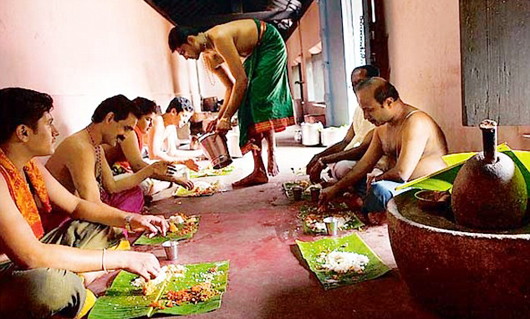
Udupi, Aug 26: What connects Bisi Bele Hulianna, Saaru, Modaka, Huggi, Majjige Palidya and Drakshi Gojju? These are some of the famed dishes of the Madhwa Brahmin community of Udupi, a coastal town in Karnataka where the Krishna temple acts as a pivot in people's lives.
brahmin

Laying out the geographical expanse and scientific logic to the regions Madhwa Brahmins vegetarian food habits, culinary expert Malati Srinivasan and arts and crafts connoisseur Geetha Rao showcase the hitherto unknown vegetarian recipes from Udupi in their book "The Udupi Kitchen."

The authors straddle the traditional and modern and list what was once easily cooked in Udupi households - spice powders, salads and chutneys, savoury snacks, desserts - and elaborate on several recipes which are all-time favourites like Bisi Bele Hulianna, Saaru, Masal Dose and Modaka.

While Bisi Bele Hulianna is a dish of spicy red gram, rice and vegetables, Saaru is spicy red gram soup, Huggi is rice and green gram with black pepper and cumin and Modaka is dumplings with coconut and jiggery filling.

Majjige Palidya is ash gourd with coconut and cumin in sour yoghurt and Drakshi Gojju is raisins in sweet, sour and spicy gravy.

Split into 12 sections, the Udupi Kitchen, published by Westland Ltd, celebrates vegetarian food with aplomb from a town where food is religion as well as a complete mouth-watering experience.

At the core of Udupi cuisine is the use of indigenous vegetables and fruits, cereals and pulses special to the Parashurama Kshetra and traditional Brahmins ate only vegetarian fare without onion and garlic.

According to the authors, Udupi cuisine has a vast variety and is not limited to tiffins or snacks.

"As I began working on this project, I realised how vast and varied our family’s repertoire of Udupi (Madhwa) cuisine was. I wrote down 175 recipes, but have used about a 100 of them in the book," says Srinivasan.

"Writing a cook book for both Indian and non-Indian readers required that a comprehensive multi-lingual glossary be compiled. It also meant using internationally accepted terminology: 'henchu' or 'tava' became griddle, bandle or 'kadhai' became wok, 'tappele' or 'bartan' became saucepan," says Rao.

She says for some kitchen tools like 'eelgemane' and 'ogarane chamcha', which had no "internationally understood" words, substitute words like curved knife blade and tempering-ladle had to be coined.

The story of Udupi cuisine is the story of how a temple-based, Brahmanical culinary tradition got modernised and became a global phenomenon. Food is religion in Udupi.

Fourteen varieties of food are cooked daily and offered to the deity at different times of the day. The food offered to god is 'naivediya', and the food eaten by human beings is 'prasada', food that is blessed.

In Udupi, meals are served on banana leaves in a particular order. Many recipes and foods have also proven health benefits. For example, dishes made from the inner banana stem prevent kidney stones, pepper rasam helps with the lactation of new mothers, jackfruit seeds have high protein content and so on.

The authors also say that the original of the masal dose or the famous masala dosa is attributed to Udupi.

Before it was invented, plain dosa was served with potato playa, without onions, in a separate cup. With changing food tastes, the Udupi chefs began to saute the mashed potatoes with onions and spices.

"As onions were considered taboo food for orthodox Brahmins, it is said that the doses were stuffed with onion-laced playa, instead of served in a separate cup, so that the onion could be 'hidden'," the authors say.

Comments

Usha moorthy
 - 
Wednesday, 8 Jun 2016

I'm extremely pleased that I now have a book to refer to for genuine udupi food!!! Thanks to the authors for painstakingly bringing together these wonderful recipes!!;

Add new comment

  • Coastaldigest.com reserves the right to delete or block any comments.
  • Coastaldigset.com is not responsible for its readers’ comments.
  • Comments that are abusive, incendiary or irrelevant are strictly prohibited.
  • Please use a genuine email ID and provide your name to avoid reject.
News Network
March 19,2020

Bengaluru, Mar 19: Karnataka High Court on Wednesday rejected the plea by Congress leader Digvijay Singh seeking directions to the police to allow him to meet rebel Madhya Pradesh Congress MLAs who are lodged in Bengaluru.

Earlier in the day, Singh said at a press conference, "I have filed a plea in the Karnataka High Court, seeking permission to meet Madhya Pradesh Congress MLAs who are putting up at Bengaluru. I have decided to be on fast and shall take a call on that after the decision of the Supreme Court and the High Court," Singh said at a press conference here earlier.

Singh said, "The BJP is busy in toppling duly-elected governments. We had successfully thwarted their plans to destabilise the MP government but we were let down by Jyotiraditya Scindia who had a very successful career in Congress."

"We never expected that he would ditch us and join hands with the BJP," he added.

The Congress leader also said that the BJP government had become insecure since the Kamal Nath-led government started tightening the laws on mining.

"Chief Minister Kamal Nath drafted a new mining policy for the sand under which the mines were allotted through auction. All this was unpalatable to the BJP and from Day 1 they started offering money to our Congress legislators," he said.

"In BJP, the Atal Bihari Vajpayee's kind of leadership no longer exists. The leadership which controls the BJP now includes people who have joined hands to do all kinds of unscrupulous things which has led to a stage in India where the banks are collapsing, non-performing assets and unemployment are growing," he added.

Earlier today, he was put under preventive arrest after he sat on a dharna near Ramada Hotel here allegedly for not being allowed to meet the 21 rebel Congress MLAs lodged in the hotel.

Comments

Add new comment

  • Coastaldigest.com reserves the right to delete or block any comments.
  • Coastaldigset.com is not responsible for its readers’ comments.
  • Comments that are abusive, incendiary or irrelevant are strictly prohibited.
  • Please use a genuine email ID and provide your name to avoid reject.
News Network
May 5,2020

Dubai, May 5: Tickets on repatriation flights from UAE to India, which start on May 7, could be costlier than regular airfare, and adding to the financial woes of those flying back. Nearly 200,000 Indians in the UAE have registered on the website seeking to return home.

“A one-way repatriation ticket to Delhi will cost approximately Dh1,400-Dh1,650 - this would earlier have cost between Dh600-Dh700 [during these months],” said Jamal Abdulnazar, CEO of Cozmo Travel. “A one-way repatriation flight ticket to Kerala would cost approximately Dh1,900-Dh2,300.”

This can be quite a burden, as a majority of those taking these flights have either lost their jobs or are sending back their families because of uncertainty on the work front. To now have to pay airfare that is nearly on par with those during peak summer months is quite a blow.

Sources said that officials in Indian diplomatic missions have already initiated calls to some expats, telling them about likely ticket fares and enquiring about their willingness to travel.

Although many believed repatriation would be government-sponsored, Indian authorities have clarified that customers would have to pay for the tickets themselves. Those who thought they were entitled to free repatriation might back out of travel plans for now.

Fact of life

But aviation and travel industry sources say higher rates cannot be escaped since social distancing norms have to be strictly enforced at all times. That would limit the number of passengers on each of these flights.

“One airline can carry only limited passengers - therefore, multiple airlines are likely to get the approval to operate repatriation flights,” said Abdulnazar. “Also, airports will have to maintain safe distance for passengers to queue up at immigration and security counters.

“Therefore, it is recommended that multiple carriers fly into multiple Indian airports for repatriation to be expedited.”

The Indian authorities, so far, have not taken the easy decision to get its private domestic airlines into the rescue act. Gulf News tried speaking to the leading players, but they declined to provide any official statements. So far, only Air India, the national airline, has been commissioned to operate the flights.

Air India finds itself in the driver's seat when it comes to operating India's repatriation flights. To date, there is no confirmation India's private airlines will be allowed to join in.

UAE carriers ready to help out

UAE’s Emirates airline, Etihad, flydubai and Air Arabia are likely to also operate repatriation flights to India after Air India implements the first phase of services.

“We are fully supporting governments and authorities across the flydubai network with their repatriation efforts, helping them to make arrangements for their citizens to return home,” said a flydubai spokesperson.

“We will announce repatriation flights as and when they are confirmed, recognising this is an evolving situation whilst the flight restrictions remain in place.”

An AirArabia spokesperson said the airline is ready to operate repatriation flights when the government tells them to.

Travel agencies likely to benefit

Apart from operating non-scheduled commercial flights, the Indian government is also deploying naval ships to bring expat Indians back. Sources claim the ships are to ferry passengers who cannot afford the repatriation airfares.

Even then, considering the sheer numbers who will want to get on the flights, travel agencies are likely to see a surge in bookings since airline websites alone may not cope with the demand set off in such a short span.

Learn from Gulf governments

In instances when they carried out their own repatriation flights, some GCC governments paid the ticket fares to fly in their citizens. Those citizens who did not have the ready funds could approach their diplomatic mission and aid would be given on a case-to-case basis.

Should Indians wait for normal services to resume?

Industry sources say that those Indians wanting to fly back and cannot afford the repatriation flights should wait for full services to resume once the COVID-19 pandemic settles.

But can those who lost their jobs or seen steep salary cuts stay on without adding to their costs? And is there any guarantee that when flight services resume, ticket rates would be lower than on the repatriation trips.

As such, normal travel is expected to pick up only after the repatriation exercise to several countries is completed. UAE-based travel agencies are not seeing any bookings for summer, which is traditionally the peak holiday season.

“Majority want to stay put unless full confidence is restored,” said Abdulnazar. “I expect full normalcy to be restored not until March 2021.

“People have also taken a hit to their income. Without disposable income, you will curtail your travel.”

What constitutes normalcy?

Airfares are expected to remain high, given the need to keep the middle seats empty to practise safe distance onboard.

“We expect holiday travel to resume by October or November - but, the travel sentiment will not go back to pre-COVID-19 levels anytime soon,” said Manvendra Roy, Vice-President – Commercial at holidayme, an online travel agency. “The need to keep the middle seat vacant will add 30-40 per cent pricing pressure per seat from an airline perspective.

“This will make holidays more expensive.”

As for business travel, it will take some time to recover. Corporate staff are now used to getting work done via conference calls. “Companies will also curtail their travel expenditure since their income has taken a hit,” said Abdulnazar.

Comments

Add new comment

  • Coastaldigest.com reserves the right to delete or block any comments.
  • Coastaldigset.com is not responsible for its readers’ comments.
  • Comments that are abusive, incendiary or irrelevant are strictly prohibited.
  • Please use a genuine email ID and provide your name to avoid reject.
News Network
June 12,2020

Hubli, Jun 12: An inspector of Hubli Rural police station on Friday was suspended for delaying the submission of a charge sheet in the matter relating to sedition charges against three Kashmiri students for making a video with pro-Pakistan slogan.

A second Joint Magistrate First Class (JMFC) court in February sent the three students, identified as Basit Ashik Sophi (19), Talib Majid (19) and Amir Mohiuddin (23), to police custody till February 28.

The Kashmiri students are under judicial custody since February 17 following their arrest for raising pro-Pakistan slogans and posting a video of the same on social media on the night of February 16.

Comments

Add new comment

  • Coastaldigest.com reserves the right to delete or block any comments.
  • Coastaldigset.com is not responsible for its readers’ comments.
  • Comments that are abusive, incendiary or irrelevant are strictly prohibited.
  • Please use a genuine email ID and provide your name to avoid reject.