


The secrets of Udupi's Madhwa Brahmin kitchen leaked!

[email protected] (News Network | KM Acharya)
August 26, 2015

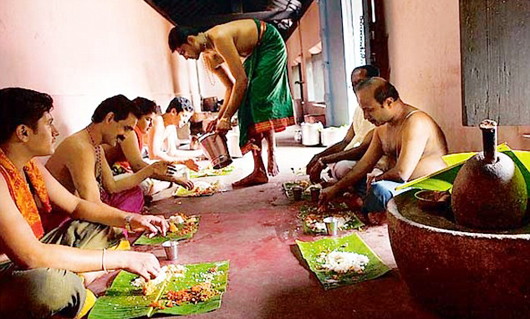
Udupi, Aug 26: What connects Bisi Bele Hulianna, Saaru, Modaka, Huggi, Majjige Palidya and Drakshi Gojju? These are some of the famed dishes of the Madhwa Brahmin community of Udupi, a coastal town in Karnataka where the Krishna temple acts as a pivot in people's lives.
brahmin

Laying out the geographical expanse and scientific logic to the regions Madhwa Brahmins vegetarian food habits, culinary expert Malati Srinivasan and arts and crafts connoisseur Geetha Rao showcase the hitherto unknown vegetarian recipes from Udupi in their book "The Udupi Kitchen."

The authors straddle the traditional and modern and list what was once easily cooked in Udupi households - spice powders, salads and chutneys, savoury snacks, desserts - and elaborate on several recipes which are all-time favourites like Bisi Bele Hulianna, Saaru, Masal Dose and Modaka.

While Bisi Bele Hulianna is a dish of spicy red gram, rice and vegetables, Saaru is spicy red gram soup, Huggi is rice and green gram with black pepper and cumin and Modaka is dumplings with coconut and jiggery filling.

Majjige Palidya is ash gourd with coconut and cumin in sour yoghurt and Drakshi Gojju is raisins in sweet, sour and spicy gravy.

Split into 12 sections, the Udupi Kitchen, published by Westland Ltd, celebrates vegetarian food with aplomb from a town where food is religion as well as a complete mouth-watering experience.

At the core of Udupi cuisine is the use of indigenous vegetables and fruits, cereals and pulses special to the Parashurama Kshetra and traditional Brahmins ate only vegetarian fare without onion and garlic.

According to the authors, Udupi cuisine has a vast variety and is not limited to tiffins or snacks.

"As I began working on this project, I realised how vast and varied our family’s repertoire of Udupi (Madhwa) cuisine was. I wrote down 175 recipes, but have used about a 100 of them in the book," says Srinivasan.

"Writing a cook book for both Indian and non-Indian readers required that a comprehensive multi-lingual glossary be compiled. It also meant using internationally accepted terminology: 'henchu' or 'tava' became griddle, bandle or 'kadhai' became wok, 'tappele' or 'bartan' became saucepan," says Rao.

She says for some kitchen tools like 'eelgemane' and 'ogarane chamcha', which had no "internationally understood" words, substitute words like curved knife blade and tempering-ladle had to be coined.

The story of Udupi cuisine is the story of how a temple-based, Brahmanical culinary tradition got modernised and became a global phenomenon. Food is religion in Udupi.

Fourteen varieties of food are cooked daily and offered to the deity at different times of the day. The food offered to god is 'naivediya', and the food eaten by human beings is 'prasada', food that is blessed.

In Udupi, meals are served on banana leaves in a particular order. Many recipes and foods have also proven health benefits. For example, dishes made from the inner banana stem prevent kidney stones, pepper rasam helps with the lactation of new mothers, jackfruit seeds have high protein content and so on.

The authors also say that the original of the masal dose or the famous masala dosa is attributed to Udupi.

Before it was invented, plain dosa was served with potato playa, without onions, in a separate cup. With changing food tastes, the Udupi chefs began to saute the mashed potatoes with onions and spices.

"As onions were considered taboo food for orthodox Brahmins, it is said that the doses were stuffed with onion-laced playa, instead of served in a separate cup, so that the onion could be 'hidden'," the authors say.

Comments

Usha moorthy
 - 
Wednesday, 8 Jun 2016

I'm extremely pleased that I now have a book to refer to for genuine udupi food!!! Thanks to the authors for painstakingly bringing together these wonderful recipes!!;

Add new comment

  • Coastaldigest.com reserves the right to delete or block any comments.
  • Coastaldigset.com is not responsible for its readers’ comments.
  • Comments that are abusive, incendiary or irrelevant are strictly prohibited.
  • Please use a genuine email ID and provide your name to avoid reject.
News Network
June 2,2020

Kasaragod, Jun 2: Kumbala police on Tuesday arrested 20 persons on charges of misbehaving and obstructing a medical team who were on official duty for Covid-19.

Police sources said the incident occurred at Kumbala beach near here on Monday evening when a group of locals misbehaved and obstructed an eight-member medical team, comprising of doctors and health workers, from carrying out a survey to asertain whether there has been a community spread of Covid-19 in that locality.

The health team was on a mission to gather data of people who had interacted with expatriates after they had returned to hometown recently.

Comments

Add new comment

  • Coastaldigest.com reserves the right to delete or block any comments.
  • Coastaldigset.com is not responsible for its readers’ comments.
  • Comments that are abusive, incendiary or irrelevant are strictly prohibited.
  • Please use a genuine email ID and provide your name to avoid reject.
News Network
June 8,2020

Bengaluru, Jun 8: Facing a shortage of labour, some top builders in the city have initiated efforts to bring back the migrant workers, who have returned to their native places following the COVID-19 lockdown, and are holding parleys with Railway authorities for operation of special trains to ferry them.

After the lockdown was announced, many construction projects came to a halt and accordingly the labourers were rendered jobless. These migrant workers preferred to go back to their home state as they were not paid when the projects were stopped and were caught in the big financial mess. Many of these migrants even chose to cover thousands of kilometres by foot when even trains, buses or any motor vehicles were not operating.

Keeping their woes in view, the Centre decided to run the Shramik Special trains to ferry them to their native places. But, after they were gone, the builders found themselves in a lurch. An executive of a builder told PTI "Yes, our builder and a few others are in talks with the Railways to run the special train to bring back the labourers." She said nothing has been materialised as of now.

According to her, the builders took the contact numbers of the workers when they left the city to their home states and are now contacting them one by one. The South Western Railway has so far sent 3.11 lakh migrant workers in 216 Shramik Special trains starting from May 3 to June 6.

Comments

Add new comment

  • Coastaldigest.com reserves the right to delete or block any comments.
  • Coastaldigset.com is not responsible for its readers’ comments.
  • Comments that are abusive, incendiary or irrelevant are strictly prohibited.
  • Please use a genuine email ID and provide your name to avoid reject.
DHNS
January 2,2020

Jan 2: A year after 12,000 acres of forests in Bandipur went up in smoke, the Karnataka Forest Department is gearing up for the summer even as the Forest Survey of India (FSI) has cautioned that 22.78 lakh acres (9,222 sq km) or about 20% of the green cover spread across three districts in the central part of the state is fire-prone.

The FSI studied forest fire incidents across the country between 2004-05 and 2017 before coming up with state-specific inputs.

According to the 13-year observation, Karnataka has 7,352 “fire points” or areas measuring 5 km X 5 km with frequent fire incidents.

Though the number is lower compared to states like Maharashtra, Madhya Pradesh and Odisha with over 20,000 points, the sheer spread of the fire-prone area itself is a challenge for the Karnataka Forest Department.

According to data, about three lakh acres (1,199.9 sq km) of forest area is very highly fire prone with 26 to 52 fire incidents in 13 years. This is followed by 7.6 lakh acres (3,067 sq km) of “highly fire prone” areas with an average of one to two incidents every year.

Almost all of the “red alert” areas are concentrated in Uttara Kannada, Chikkmagaluru, Shivamogga and Chamarajanagar districts. As temperature rises at the end of January, so does the risk of forest fires, requiring officials to be on vigil till the end of summer.

After an investigation into the Bandipur blaze revealed that faulty fire lines and poor supervision were the reason for the spread of the fire, the department has come up with a multi-pronged approach to prevent similar incidents this year.

“After the Bandipur incident, we have created a fire cell and a standard operating procedure (SOP) which everyone has to follow. Firstly, a fire management plan is prepared and approved by a competent authority.

The SOP has well defined firelines which have to be executed by December-end and burning must be completed by January 15,”  Principal Chief Conservator of Forests (Head of Forest Force) Punati Sridhar told DH.

He said that to ensure its strict implementation, GPS readings of firelines are to be submitted for random verification.

“All the required equipment from fire jackets to shoes, gloves, backpack sprayers and tractors mounted with 2,000-5,000 litre tanks with high pressure pumps will be deployed at vantage points,” he said.

In addition, the department’s fire cell works in collaboration with the Karnataka State Remote Sensing Applications Centre (KSRSAC) to give fire alerts within half and hour of an area catching fire and detected by satellites.

“Earlier, the gap used to be four hours by when the fire would have spread beyond control. Now, with reduced time gap, it would be easier to control fire early,” he added.

Comments

Add new comment

  • Coastaldigest.com reserves the right to delete or block any comments.
  • Coastaldigset.com is not responsible for its readers’ comments.
  • Comments that are abusive, incendiary or irrelevant are strictly prohibited.
  • Please use a genuine email ID and provide your name to avoid reject.