


The secrets of Udupi's Madhwa Brahmin kitchen leaked!

[email protected] (News Network | KM Acharya)
August 26, 2015

Udupi, Aug 26: What connects Bisi Bele Hulianna, Saaru, Modaka, Huggi, Majjige Palidya and Drakshi Gojju? These are some of the famed dishes of the Madhwa Brahmin community of Udupi, a coastal town in Karnataka where the Krishna temple acts as a pivot in people's lives.
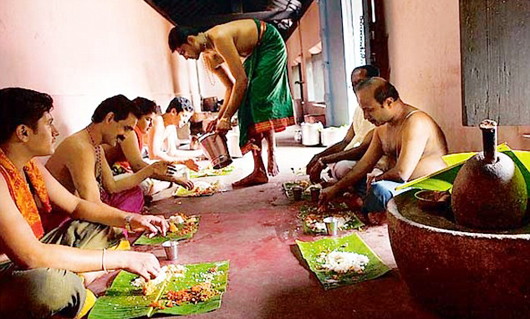
brahmin

Laying out the geographical expanse and scientific logic to the regions Madhwa Brahmins vegetarian food habits, culinary expert Malati Srinivasan and arts and crafts connoisseur Geetha Rao showcase the hitherto unknown vegetarian recipes from Udupi in their book "The Udupi Kitchen."

The authors straddle the traditional and modern and list what was once easily cooked in Udupi households - spice powders, salads and chutneys, savoury snacks, desserts - and elaborate on several recipes which are all-time favourites like Bisi Bele Hulianna, Saaru, Masal Dose and Modaka.

While Bisi Bele Hulianna is a dish of spicy red gram, rice and vegetables, Saaru is spicy red gram soup, Huggi is rice and green gram with black pepper and cumin and Modaka is dumplings with coconut and jiggery filling.

Majjige Palidya is ash gourd with coconut and cumin in sour yoghurt and Drakshi Gojju is raisins in sweet, sour and spicy gravy.

Split into 12 sections, the Udupi Kitchen, published by Westland Ltd, celebrates vegetarian food with aplomb from a town where food is religion as well as a complete mouth-watering experience.

At the core of Udupi cuisine is the use of indigenous vegetables and fruits, cereals and pulses special to the Parashurama Kshetra and traditional Brahmins ate only vegetarian fare without onion and garlic.

According to the authors, Udupi cuisine has a vast variety and is not limited to tiffins or snacks.

"As I began working on this project, I realised how vast and varied our family’s repertoire of Udupi (Madhwa) cuisine was. I wrote down 175 recipes, but have used about a 100 of them in the book," says Srinivasan.

"Writing a cook book for both Indian and non-Indian readers required that a comprehensive multi-lingual glossary be compiled. It also meant using internationally accepted terminology: 'henchu' or 'tava' became griddle, bandle or 'kadhai' became wok, 'tappele' or 'bartan' became saucepan," says Rao.

She says for some kitchen tools like 'eelgemane' and 'ogarane chamcha', which had no "internationally understood" words, substitute words like curved knife blade and tempering-ladle had to be coined.

The story of Udupi cuisine is the story of how a temple-based, Brahmanical culinary tradition got modernised and became a global phenomenon. Food is religion in Udupi.

Fourteen varieties of food are cooked daily and offered to the deity at different times of the day. The food offered to god is 'naivediya', and the food eaten by human beings is 'prasada', food that is blessed.

In Udupi, meals are served on banana leaves in a particular order. Many recipes and foods have also proven health benefits. For example, dishes made from the inner banana stem prevent kidney stones, pepper rasam helps with the lactation of new mothers, jackfruit seeds have high protein content and so on.

The authors also say that the original of the masal dose or the famous masala dosa is attributed to Udupi.

Before it was invented, plain dosa was served with potato playa, without onions, in a separate cup. With changing food tastes, the Udupi chefs began to saute the mashed potatoes with onions and spices.

"As onions were considered taboo food for orthodox Brahmins, it is said that the doses were stuffed with onion-laced playa, instead of served in a separate cup, so that the onion could be 'hidden'," the authors say.

Comments

Usha moorthy
 - 
Wednesday, 8 Jun 2016

I'm extremely pleased that I now have a book to refer to for genuine udupi food!!! Thanks to the authors for painstakingly bringing together these wonderful recipes!!;

Add new comment

  • Coastaldigest.com reserves the right to delete or block any comments.
  • Coastaldigset.com is not responsible for its readers’ comments.
  • Comments that are abusive, incendiary or irrelevant are strictly prohibited.
  • Please use a genuine email ID and provide your name to avoid reject.
News Network
January 25,2020

Mangaluru, Jan 25: Orange vendor Harekala Hajabba, popularly known as 'Akshara Santha' (the saint of alphabets), who went on to build a school at Newpadpu village on the city’s outskirts in 1999 is among this year’s Padma Shri awardees.

When Hajabba received the call on being nominated for the award, he was standing in a queue to buy rations.

As he is not fluent in Hindi, Hajabba handed over the phone to an auto driver, who conveyed the news that the Padma Shri award will be conferred on him.

The unlettered achiever set up a primary school from his meagre savings of Rs 150 per day,  selling oranges in Mangaluru. 

“The first time I felt bad for being an illiterate was when a foreigner enquired about the price of oranges in English. I did not know what he meant. So, I decided to start a school in my village,” Hajabba had said during a felicitation programme.

When Hajabba decided to start a school, he did not get any support. He started the school with 28 children.

The school today has been upgraded to a composite high school and is catering to the educational needs of hundreds of children in and around Newpadpu.

He ran from pillar to post in the Zilla Panchayat to make his dream come true. All cash awards he had received went into building the school. The United Christians Association, moved by the sight of his dilapidated house, built a 760-square-foot house costing Rs 15 lakh for him. 

Hajabba’s life was prescribed for the syllabus of three universities - Davangere, Kuvempu and Mangalore. His success story is also included in a Tulu textbook.

He won the Karnataka Rajyotsava award in 2013, Real Heroes award from TV channel CNN-IBN.

Hajabba, when contacted, said he could not believe his ears when told about the award.

New dreams

The frail vendor, in his 60s, humbly declared that he could achieve all this because of the support of all. Hajabba now dreams of upgrading the school into a full-fledged PU college.

Comments

Meethal Kasaragod
 - 
Sunday, 26 Jan 2020

A big Salute to him!

Great effort,

fairman
 - 
Sunday, 26 Jan 2020

Where there is will, there is way

May God help him.

Add new comment

  • Coastaldigest.com reserves the right to delete or block any comments.
  • Coastaldigset.com is not responsible for its readers’ comments.
  • Comments that are abusive, incendiary or irrelevant are strictly prohibited.
  • Please use a genuine email ID and provide your name to avoid reject.
coastaldigest.com news network
February 3,2020

A motley group of as many as 150 birders ‘walked the chirp’ in search of their feathered friends in and around the countryside of Manipal. The occasion was the 10th Edition of Manipal Bird Day organised by Manipal Birders Group on Sunday, February 2nd, 2020.

The day began ‘Bird Walk’ from Hotel Sheela Sagar (Opposite MIT campus) at 6:30 a.m. The birders divided themselves in smaller groups of 10-12 members and followed 13 different trails which took them through different terrains like hills, plains, paddy fields and wetlands. The idea was to sight as many birds as possible and record their presence in the region.

When the walk ended at about 10:00 a.m., the different groups have recorded a total of 125 species of birds, which was a bit lesser than the sighting of the yester years. “The 10th edition this year has seen a very good growth of interest among people. At the same time a decline has been seen in the bird species sighted compared to previous years,” said one of the organisers. Some of the rare birds sighted were Indian Pitta, Oriental Turtle Dove, Fork-Tailed Drongo Cuckoo, Orange Breasted Green Pigeon, Eurasian Marsh Harrier and Malabar Pied Hornbill.

The bird walk was followed with an interaction session at KMC Food Court and MAHE Vice Chancellor Dr. H. Vinod Bhat presided over the function. He felicitated six people who actively participated recently in a rescue mission of abandoned birds in Manipal.

A program then continued with a talk on ‘Ethical Photography’ by Dhruvam Desai, final year student of MIT, Manipal. This was followed by ‘Backyard Birding’ with Shubha Bhat from IISc Bangalore. She spoke on different ways to feed the birds with water using different materials for bird baths. “I have recorded 120 species of birds from bird baths in my garden,” she said. She encouraged the participants to have bird baths in their gardens or flats which will help quench the thirst of these little winged wonders during summer.

The participants involved themselves actively in the interaction sessions. The event was accompanied with an art exhibition titled ‘Feathered Jewels’ by Aditya Bhat. He presented around 18 paintings all from his memory of birding encounters.

Participation in Manipal Bird Day was open to all and entry was free.

MANIPAL BIRD DAY

Manipal Bird Day is an annual event dedicated to celebrating birds in Manipal. This day long event brings together a large number of birders from Manipal, Udupi, Mangalore, Mysore, Bangalore, Davangere and other places. Around 150-200 people gather and are split into different teams. They visit the assigned regions and count as many birds as possible. This non competitive event focuses on spreading awareness regarding the diverse avifauna around us. Turn out for this event has been increasing from 3 people to 200 in last 10 years. This is the 10th edition of Manipal Bird Day.

MANIPAL BIRDERS CLUB

Manipal Birders Club started as a Facebook group after the release of the first edition of “A Birders Handbook to Manipal” to share information about the latest sightings. It is now a formal group of over 500 like-minded members that meets at least once a week to go on bird walks. It is now a large birders community and a medium to organize events, bird walks and discussions about birds and sightings.

The next step would be to involve a higher number of local and young birders who will dictate the change in environment around the town in the coming years. With the co operation of Zoology and natural sciences students and other nature enthusiasts and faculty of different colleges weekly birding sessions have been conducted to involve and encourage more and more people to bird and get connected to the nature and to try to understand the changes happening around us, the media release issued by the group said.


Comments

Add new comment

  • Coastaldigest.com reserves the right to delete or block any comments.
  • Coastaldigset.com is not responsible for its readers’ comments.
  • Comments that are abusive, incendiary or irrelevant are strictly prohibited.
  • Please use a genuine email ID and provide your name to avoid reject.
News Network
May 2,2020

Mangaluru, May 2:  Karnataka Pradesh Congress Committee Spokesperson P V Mohan on Saturday urged the district administration to find the source of coronavirus in Dakshina Kannada (DK) district.

He asked the district administration to ascertain from where a woman from Bantwal's Kasba contracted virus on April 19.

''We do not want to convert Dakshina Kannada into Nanjangud,'' Mr Mohan said referring to the mysterious case of Patient 52 from Nanjangud who has been identified as the main source of virus to the rest of the positive individuals in Nanjangud.

Comments

Add new comment

  • Coastaldigest.com reserves the right to delete or block any comments.
  • Coastaldigset.com is not responsible for its readers’ comments.
  • Comments that are abusive, incendiary or irrelevant are strictly prohibited.
  • Please use a genuine email ID and provide your name to avoid reject.