


The secrets of Udupi's Madhwa Brahmin kitchen leaked!

[email protected] (News Network | KM Acharya)
August 26, 2015

Udupi, Aug 26: What connects Bisi Bele Hulianna, Saaru, Modaka, Huggi, Majjige Palidya and Drakshi Gojju? These are some of the famed dishes of the Madhwa Brahmin community of Udupi, a coastal town in Karnataka where the Krishna temple acts as a pivot in people's lives.
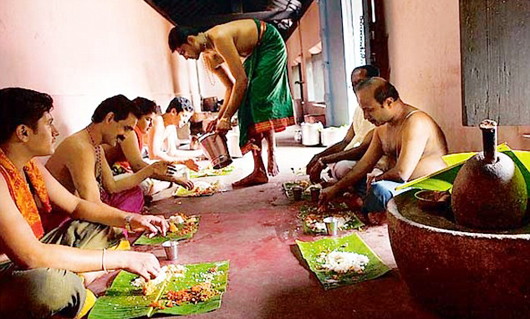
brahmin

Laying out the geographical expanse and scientific logic to the regions Madhwa Brahmins vegetarian food habits, culinary expert Malati Srinivasan and arts and crafts connoisseur Geetha Rao showcase the hitherto unknown vegetarian recipes from Udupi in their book "The Udupi Kitchen."

The authors straddle the traditional and modern and list what was once easily cooked in Udupi households - spice powders, salads and chutneys, savoury snacks, desserts - and elaborate on several recipes which are all-time favourites like Bisi Bele Hulianna, Saaru, Masal Dose and Modaka.

While Bisi Bele Hulianna is a dish of spicy red gram, rice and vegetables, Saaru is spicy red gram soup, Huggi is rice and green gram with black pepper and cumin and Modaka is dumplings with coconut and jiggery filling.

Majjige Palidya is ash gourd with coconut and cumin in sour yoghurt and Drakshi Gojju is raisins in sweet, sour and spicy gravy.

Split into 12 sections, the Udupi Kitchen, published by Westland Ltd, celebrates vegetarian food with aplomb from a town where food is religion as well as a complete mouth-watering experience.

At the core of Udupi cuisine is the use of indigenous vegetables and fruits, cereals and pulses special to the Parashurama Kshetra and traditional Brahmins ate only vegetarian fare without onion and garlic.

According to the authors, Udupi cuisine has a vast variety and is not limited to tiffins or snacks.

"As I began working on this project, I realised how vast and varied our family’s repertoire of Udupi (Madhwa) cuisine was. I wrote down 175 recipes, but have used about a 100 of them in the book," says Srinivasan.

"Writing a cook book for both Indian and non-Indian readers required that a comprehensive multi-lingual glossary be compiled. It also meant using internationally accepted terminology: 'henchu' or 'tava' became griddle, bandle or 'kadhai' became wok, 'tappele' or 'bartan' became saucepan," says Rao.

She says for some kitchen tools like 'eelgemane' and 'ogarane chamcha', which had no "internationally understood" words, substitute words like curved knife blade and tempering-ladle had to be coined.

The story of Udupi cuisine is the story of how a temple-based, Brahmanical culinary tradition got modernised and became a global phenomenon. Food is religion in Udupi.

Fourteen varieties of food are cooked daily and offered to the deity at different times of the day. The food offered to god is 'naivediya', and the food eaten by human beings is 'prasada', food that is blessed.

In Udupi, meals are served on banana leaves in a particular order. Many recipes and foods have also proven health benefits. For example, dishes made from the inner banana stem prevent kidney stones, pepper rasam helps with the lactation of new mothers, jackfruit seeds have high protein content and so on.

The authors also say that the original of the masal dose or the famous masala dosa is attributed to Udupi.

Before it was invented, plain dosa was served with potato playa, without onions, in a separate cup. With changing food tastes, the Udupi chefs began to saute the mashed potatoes with onions and spices.

"As onions were considered taboo food for orthodox Brahmins, it is said that the doses were stuffed with onion-laced playa, instead of served in a separate cup, so that the onion could be 'hidden'," the authors say.

Comments

Usha moorthy
 - 
Wednesday, 8 Jun 2016

I'm extremely pleased that I now have a book to refer to for genuine udupi food!!! Thanks to the authors for painstakingly bringing together these wonderful recipes!!;

Add new comment

  • Coastaldigest.com reserves the right to delete or block any comments.
  • Coastaldigset.com is not responsible for its readers’ comments.
  • Comments that are abusive, incendiary or irrelevant are strictly prohibited.
  • Please use a genuine email ID and provide your name to avoid reject.
News Network
July 19,2020

Bengaluru, Jul 19: The Karnataka Deputy Chief Minister C N Ashwathnarayan on Saturday inspected the country's first modular Intensive Care Unit (ICU) containers.

A notice from the Chief Minister's Office (CMO) said that the new mobile modular container ICUs, which will be used in the fight against the ongoing COVID-19 pandemic, have been created by Rinac India Limited, known for setting up sanitised operation theatres and clean rooms in hospitals.

On a pilot basis, the Deputy CM, who is also in charge of setting up COVID-care centres, said that 10 modular container ICUs will be deployed at the KC General Hospital in Malleshwaram. Each of the containers will have five beds.

Deputy CM Ashwathnarayan also said, "These mobile ICUs donated by Rinac will be useful, particularly in times of a crisis like COVID 19 or any natural calamity."

"The entry of health officials will be through an airlock, and entry of patients will be through a different door. There will be two doors for patients and can be increased if need. ICUs are fitted with cameras to monitor online from a centralized monitoring station, thereby limiting the exposure of the health personnel," the CMO informed.

The CMO further added, "the advantages of this new system are that the prefabricated modules of 5 can be shifted to any location by trailers and it is easy to deploy multiple containers to create a common facility. They are easy to clean and the airtight functionality ensures that no moisture or heat ingression happens, hence, it is easy to air-condition or ventilate."

Comments

Add new comment

  • Coastaldigest.com reserves the right to delete or block any comments.
  • Coastaldigset.com is not responsible for its readers’ comments.
  • Comments that are abusive, incendiary or irrelevant are strictly prohibited.
  • Please use a genuine email ID and provide your name to avoid reject.
coastaldigest.com news network
June 24,2020

Riyadh, June 24: Thousands of expatriates who managed to return to their home countries from Saudi Arabia during covid-19 lockdown are now in a dilemma as the Kingdom has clarified that it will not allow their re-entry till the end of the corona crisis. 

The Directorate General of Passports (Jawazat) announced on Tuesday that the mechanism to resume extension of the exit and re-entry visas for expatriates who are outside the Kingdom will be announced only after the end of the pandemic crisis.

The Jawazat stated this on its Twitter account while responding to queries from a number of expatriates who are currently outside the Kingdom and whose exit and re-entry visas have expired.

They inquired about the possibility of returning to the Kingdom after the resumption of international flight service. 

The Jawazat reiterated that the return of expatriates who left Saudi Arabia will be only after the end of the pandemic and in accordance with the process to obtain a valid re-entry visa.

The directorate said that in the event of any new decisions or instructions in this regard, they will be announced through the official channels.

It is noteworthy that the Jawazat had previously confirmed that its electronic services are continuing through the Absher and Muqeem online portals of the Ministry of Interior and that the service for messages and requests is still available and continuing through Absher for all the beneficiaries of its services.

Comments

Add new comment

  • Coastaldigest.com reserves the right to delete or block any comments.
  • Coastaldigset.com is not responsible for its readers’ comments.
  • Comments that are abusive, incendiary or irrelevant are strictly prohibited.
  • Please use a genuine email ID and provide your name to avoid reject.
coastaldigest.com news network
July 18,2020

Mangaluru, July 18: The Dakshina Kannada district administration is likely to earmark a common burial ground in the wake of growing resistance from residents of various localities in Mangaluru against burial of Covid-19 victims in their vicinity.

Recently, following protests by residents on Bolar, the body of a Covid-19 victim remained in the ambulance for hours together. The residents refused to allow the victim to be laid to rest at a burial ground attached to a mosque. The victim, who had been a resident of Idya in Surathkal, was subsequently laid to rest after DC’s intervention.

In a bid to avoid such instances in the future, the district administration has identified a burial ground on the outskirts of Mangaluru. 

Former minister and incumbent Mangaluru MLA UT Khader said that he had discussed the problem at length with the officials of the Dakshina Kannada district administration, and had suggested they look for a relatively isolated space on the outskirts of Mangaluru city in order to avoid confrontation with the public.

“A parcel of land at Badaga Yekkuru, some 20km from the city has been identified as being suitable for the burial ground, but the district administration is yet to take a final decision,” Khader said.

Comments

Add new comment

  • Coastaldigest.com reserves the right to delete or block any comments.
  • Coastaldigset.com is not responsible for its readers’ comments.
  • Comments that are abusive, incendiary or irrelevant are strictly prohibited.
  • Please use a genuine email ID and provide your name to avoid reject.