


The secrets of Udupi's Madhwa Brahmin kitchen leaked!

[email protected] (News Network | KM Acharya)
August 26, 2015

Udupi, Aug 26: What connects Bisi Bele Hulianna, Saaru, Modaka, Huggi, Majjige Palidya and Drakshi Gojju? These are some of the famed dishes of the Madhwa Brahmin community of Udupi, a coastal town in Karnataka where the Krishna temple acts as a pivot in people's lives.
brahmin

Laying out the geographical expanse and scientific logic to the regions Madhwa Brahmins vegetarian food habits, culinary expert Malati Srinivasan and arts and crafts connoisseur Geetha Rao showcase the hitherto unknown vegetarian recipes from Udupi in their book "The Udupi Kitchen."

The authors straddle the traditional and modern and list what was once easily cooked in Udupi households - spice powders, salads and chutneys, savoury snacks, desserts - and elaborate on several recipes which are all-time favourites like Bisi Bele Hulianna, Saaru, Masal Dose and Modaka.

While Bisi Bele Hulianna is a dish of spicy red gram, rice and vegetables, Saaru is spicy red gram soup, Huggi is rice and green gram with black pepper and cumin and Modaka is dumplings with coconut and jiggery filling.

Majjige Palidya is ash gourd with coconut and cumin in sour yoghurt and Drakshi Gojju is raisins in sweet, sour and spicy gravy.

Split into 12 sections, the Udupi Kitchen, published by Westland Ltd, celebrates vegetarian food with aplomb from a town where food is religion as well as a complete mouth-watering experience.

At the core of Udupi cuisine is the use of indigenous vegetables and fruits, cereals and pulses special to the Parashurama Kshetra and traditional Brahmins ate only vegetarian fare without onion and garlic.

According to the authors, Udupi cuisine has a vast variety and is not limited to tiffins or snacks.

"As I began working on this project, I realised how vast and varied our family’s repertoire of Udupi (Madhwa) cuisine was. I wrote down 175 recipes, but have used about a 100 of them in the book," says Srinivasan.

"Writing a cook book for both Indian and non-Indian readers required that a comprehensive multi-lingual glossary be compiled. It also meant using internationally accepted terminology: 'henchu' or 'tava' became griddle, bandle or 'kadhai' became wok, 'tappele' or 'bartan' became saucepan," says Rao.

She says for some kitchen tools like 'eelgemane' and 'ogarane chamcha', which had no "internationally understood" words, substitute words like curved knife blade and tempering-ladle had to be coined.

The story of Udupi cuisine is the story of how a temple-based, Brahmanical culinary tradition got modernised and became a global phenomenon. Food is religion in Udupi.

Fourteen varieties of food are cooked daily and offered to the deity at different times of the day. The food offered to god is 'naivediya', and the food eaten by human beings is 'prasada', food that is blessed.

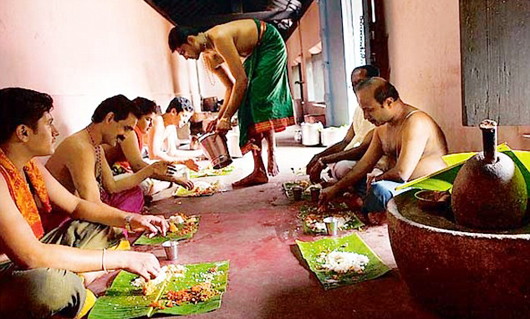
In Udupi, meals are served on banana leaves in a particular order. Many recipes and foods have also proven health benefits. For example, dishes made from the inner banana stem prevent kidney stones, pepper rasam helps with the lactation of new mothers, jackfruit seeds have high protein content and so on.

The authors also say that the original of the masal dose or the famous masala dosa is attributed to Udupi.

Before it was invented, plain dosa was served with potato playa, without onions, in a separate cup. With changing food tastes, the Udupi chefs began to saute the mashed potatoes with onions and spices.

"As onions were considered taboo food for orthodox Brahmins, it is said that the doses were stuffed with onion-laced playa, instead of served in a separate cup, so that the onion could be 'hidden'," the authors say.

Comments

Usha moorthy
 - 
Wednesday, 8 Jun 2016

I'm extremely pleased that I now have a book to refer to for genuine udupi food!!! Thanks to the authors for painstakingly bringing together these wonderful recipes!!;

Add new comment

  • Coastaldigest.com reserves the right to delete or block any comments.
  • Coastaldigset.com is not responsible for its readers’ comments.
  • Comments that are abusive, incendiary or irrelevant are strictly prohibited.
  • Please use a genuine email ID and provide your name to avoid reject.
News Network
March 13,2020

Mysuru, Mar 13: A state-of-the-art viral research laboratory in the city has been identified as one of the testing laboratories for the detection of COVID-19, official sources said here on Friday.

The samples of suspected cases could be sent to the lab for analysis and it would take about three hours to get the results.

The Viral Research and Diagnostic Laboratory (VRDL), which was set up from Central grants and functions at the Microbiology Department of K.R. Hospital, has been authorised to carry out the tests. This lab in Mysuru is among the 52-plus laboratories in the country.

Though the VRDL is equipped to carry out the tests, the sole authority of confirming the virus lies with the Indian Council of Medical Research (ICMR)-National Institute of Virology (NIV) in Pune. VRDL is also the sole agency for collection and transportation of suspected samples of COVID-19 to NIV.

VRDL, which is part of the Mysore Medical College and Research Institute, functions on the advice of NIV.

According to the guidelines issued by ICMR, the results of the tests done here have to be shared with NIV the same day and the labs are not supposed to disclose the results since the NIV is the only authority to declare positive cases. Also, confirmation from the NIV should be awaited in case the samples test negative for COVID-19. The ICMR, in the guidelines made available on its website, has advised clinicians at labs to isolate the patient tested positive for COVID-19 in the identified facility and follow bio-safety precautions.

VRDL is a part of a network of labs established by the Department of Health Research, Government of India. The rise in the number of viral outbreaks and the resultant mortality had been cited as key reasons for the launch of network of such hi-tech labs in the country.

The NIV and the National Centre for Disease Control, Delhi, are the top laboratories for the network, while the National Institute of Epidemiology, Chennai, is the supervising authority for the data generated by the network of labs, sources added.

Comments

Add new comment

  • Coastaldigest.com reserves the right to delete or block any comments.
  • Coastaldigset.com is not responsible for its readers’ comments.
  • Comments that are abusive, incendiary or irrelevant are strictly prohibited.
  • Please use a genuine email ID and provide your name to avoid reject.
News Network
June 20,2020

Bengaluru, Jun 20: Continuing with the easing of restrictions under 'Unlock 1.0', the Karnataka government on Saturday authorised local bodies to fix timing for opening of public parks other than those in the containment zones between 5 am to 9 pm.

It has also mandated adhering to all the national directives issued to contain the spread of COVID-19 and the guidelines issued by the state government in this connection.

Noting that the government has been relaxing conditions under unlock 1.0, Principal Secretary Revenue N Manjunath Prasad, who is also the member secretary of the state disaster management authority in an order said, local bodies have been asked to set the timing between 5 am to 9 pm to open all parks that come under them and the government.

It said this would be applicable to only those parks that come outside the containment zones. Earlier in May, while relaxing the lockdown norms, the government had set 7 am to 9 am and from 5 pm to 7 pm for the opening of parks.

Comments

Add new comment

  • Coastaldigest.com reserves the right to delete or block any comments.
  • Coastaldigset.com is not responsible for its readers’ comments.
  • Comments that are abusive, incendiary or irrelevant are strictly prohibited.
  • Please use a genuine email ID and provide your name to avoid reject.
News Network
July 11,2020

Bengaluru, Jul 11: Karnataka Animal Husbandry Minister Prabhu Chauhan on Saturday said an ambulance service is being rolled out by the state government in a bid to maintain livestock's health in the state.

"An ambulance service is currently being rolled out by the Department of Animal Husbandry in order to maintain livestock health, livestock farmers in the state," said Prabhu Chauhan.

"A well-equipped ambulance is being provided in 16 districts of the state," he added.

The ambulance that is being introduced has special veterinary facilities including an emergency unit, lab facility, scanning pharmaceutical, and medical equipment, he said.

Chauhan further said that a 'war room' is being prepared to allow veterinarians and livestock farmers to pursue veterinary care in a timely manner.

"For the first time, a 'war room' is being prepared by the Department of Animal Husbandry in Karnataka to allow veterinarians and livestock farmers to pursue veterinary care in a timely manner. The facility will be available 24 hours a day," he added.

Moreover, Karnataka is planning to ban cow slaughter as well by bringing the Prevention of Cow Slaughter and Preservation Bill, 2012.

"Many states have passed the Anti-Cow Slaughter Bill. We are preparing to implement it in Karnataka as well. The state government will soon implement a ban on cow slaughter, sale, and consumption of beef on the lines of many other states," added Chauhan.

Comments

Add new comment

  • Coastaldigest.com reserves the right to delete or block any comments.
  • Coastaldigset.com is not responsible for its readers’ comments.
  • Comments that are abusive, incendiary or irrelevant are strictly prohibited.
  • Please use a genuine email ID and provide your name to avoid reject.