Section 144 clamped in Mangaluru; social media under scanner

[email protected] (CD Network)
November 13, 2016

Mangaluru, Nov 13: In the wake of recent untoward incidents in parts of Mangaluru taluk, the police has clamped prohibitory order Section 144 of the Criminal Procedure Code (CrPC) in the limits of city commissionerate.

1commisCity police chief M Chandra Sekhar told media persons that the prohibitory orders that came into force at 2 p.m. on Sunday (Nov 13) will be there till 10 p.m. on Nov 16 throughout the commissionerate.

In fact Dakshina Kannada district administration had clamed prohibitory orders for four days from November 9 to 12 in order to maintain peace during Tipu Jayanti.

However, the city police chief had extended the ban orders under the limits of Ullal and Konate police stations in the wake of stabbing incidents.

Mr Chandra Sekhar, said that he had to expand the orders to the entire commissionerate to thwart the attempt of trouble mongers to disrupt the peace.

“There will be no permission for any public gathering or protest meets during the ban period,” he said adding that the police are keeping an eye on those who distribute pamphlets or share provocative posts on social media.

The top cop clarified that the prohibitory orders will not apply for wedding ceremonies and those who stand in queues in front of banks.

Comments

indian
 - 
Sunday, 13 Nov 2016

its novemnber not december

Add new comment

  • Coastaldigest.com reserves the right to delete or block any comments.
  • Coastaldigset.com is not responsible for its readers’ comments.
  • Comments that are abusive, incendiary or irrelevant are strictly prohibited.
  • Please use a genuine email ID and provide your name to avoid reject.
coastaldigest.com news network
August 5,2020

Mangaluru, Aug 5: Normal life was thrown out of gear as heavy rain and gusty winds lashed large parts of coastal and malnad districts of Karnataka in last 48 hours. Widespread power outages due to tree fall and minor landslides were reported in last 24 hours.

Meanwhile, Indian Meteorological Department has sounded a red alert for Uttara Kannada, Udupi and Dakshina Kannada districts 8:30am of August 5.

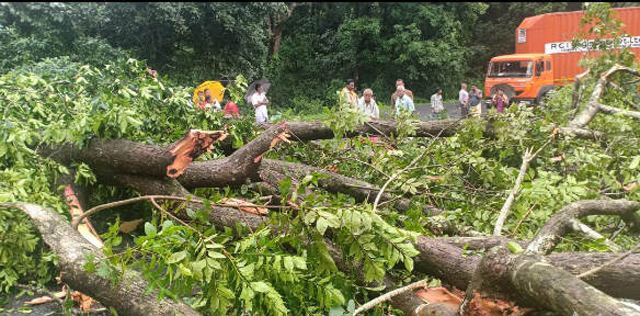
In Mangaluru city there were several tree falls disrupting power supply in key areas of the city. Four electricity poles were damaged after a tree fell on Boloor Jarandaya road due to rain and heavy winds. In Neermarga too, there were a couple of tree falls in the morning cutting off power supply, which was not restored till this report was sent.

Mescom bore the brunt of the rains in Udupi and Dakshina Kannada District and at the last count as many as 148 electric poles, 23 transformers and 65 kilometer conductor wires were damaged due to poles being damaged in tree fall and landslides.

Traffic was affected on Charmadi Ghat on the Mangaluru-Chikkamagaluru route due to a tree fall on the second hair pin bend. 

On Monday, landslides near Kottigehara, Chikkamagaluru District, left traffic badly affected. Though normalcy has been restored on the route after blocking the road for restoration till Tuesday morning, locals fear more landslides due to continuous downpour.

Kodagu district too received heavy rainfall in past 24 hours which resulted in water logging in low-lying areas.

In the Coast, Uttara Kannada received the highest amount of rainfall at 91mm, followed by Udupi at 75 and DK at 73mm. The highest Rainfall of 241 mm was recorded at Castlerock, Supa Taluk in Uttara Kannada District.

KSNMDC bulletin stated that widespread moderate to heavy rains associated with strong surface winds at times and isolated very heavy to extreme heavy rains was likely over Udupi, Dakshina Kannada and Uttara Kannada districts It also stated that wind speeds ranging between 50kmph to 60 kmph was forecast along the coast of Karnataka from Mangaluru to Karwar, warning fishermen not to venture into the sea.

Comments

Add new comment

  • Coastaldigest.com reserves the right to delete or block any comments.
  • Coastaldigset.com is not responsible for its readers’ comments.
  • Comments that are abusive, incendiary or irrelevant are strictly prohibited.
  • Please use a genuine email ID and provide your name to avoid reject.
News Network
July 8,2020

Bengaluru, Jul 8: Karnataka has drafted 1,246 government employees into the crucial task of contact tracing to fight the coronavirus pandemic, and they have been warned of action if they refuse to work.

These are Group A, B and C employees from various departments who have been asked to report to senior IAS officer V Manjula, who heads a task force on Covid-19 contact tracing.

In an order, Chief Secretary TM Vijay Bhaskar on Tuesday said additional human resources were required to strengthen contact tracing, which is “a very important part” of controlling the spread of Covid-19.

Comments

Add new comment

  • Coastaldigest.com reserves the right to delete or block any comments.
  • Coastaldigset.com is not responsible for its readers’ comments.
  • Comments that are abusive, incendiary or irrelevant are strictly prohibited.
  • Please use a genuine email ID and provide your name to avoid reject.
Agencies
July 5,2020

The deadly coronavirus that entered India while there was still nip in the air has beaten rising mercury, humid conditions, unique Indian genome and has entered monsoon season with more potency as fresh cases are only breaking all records in the country.

India recorded a single-day spike of record 24,850 new coronavirus cases on Sunday, taking its total tally to 6.73 lakh corona-positive cases.

Top Indian microbiologists were hopeful in March that after the 21-day lockdown, as summer approaches, the rise in temperature would play an important role in preventing the drastic spread of COVID-19 virus in India.

Several virologists hinted that by June this year, the impact of COVID-19 would be less than what it appeared in March-April.

The claims have fallen flat as the virus is mutating fast, becoming more potent than ever.

According to experts, the novel coronavirus is a new virus whose seasonality and response to hot humid weather was never fully understood.

"The theory was based on the fact that high temperatures can kill the virus as in sterilisation techniques used in healthcare. But these are controlled environment conditions. There are many other factors besides temperature, humidity which influence the transmission rate among humans," Dr Anu Gupta, Head, Microbiologist and Infection Control, Fortis Escorts Heart Institute, told IANS.

There is no built-up immunity to COVID-19 in humans.

"Also, asymptomatic people might be passing it to many others unknowingly. New viruses tend not to follow the seasonal trend in their first year," Gupta emphasized.

Globally, as several countries are now experiencing hot weather, the World Health Organization (WHO) reported a record hike in the number of coronavirus cases, with the total rising by 2,12,326 in 24 hours in the highest single-day increase since COVID-19 broke out.

So far over 11 million people worldwide have tested positive for the disease which has led to over 5,25,000 deaths, according to data from Johns Hopkins University. The US remained the worst-hit country with over 28 lakh cases, followed by Brazil with 15.8 lakh.

According to Sandeep Nayar, Senior Consultant and HOD, Respiratory Medicine, Allergy & Sleep Disorders, BLK Super Speciality Hospital in New Delhi, whether temperature plays a role in COVID-19 infection is highly debated.

One school of thought said in the tropical regions of South Asia, the virus might not thrive longer.

"On the other hand, another school of thought has found that novel Coronavirus can survive in a hot and humid environment and tropical climate does not make a difference to the virus. According to them, this is what distinguishes the novel coronavirus from other common viruses, which usually wane in hot weather," stressed Nayar.

Not much has been studied in the past and no definite treatment or vaccine is available to date.

"Every day, new properties and manifestation of the disease come up. As of now, the only way to prevent this monster is by taking appropriate precautions. Hand hygiene, social distancing, cough etiquette and face masks definitely reduce spread of COVID-19 infection," Nayar told IANS.

Not just top Indian health experts, even Indian-American scientists had this theory in mind that sunshine and summer may ebb the spread of the coronavirus.

Ravi Godse, Director of Discharge Planning, UPMC Shadyside Pennsylvania in the US told IANS in April: "In the summer, the humidity can go up as well, meaning more water drops in the air. If the air is saturated with water and somebody sneezes virus droplets into such air, it is likely that the droplets will fall to the ground quicker, making them less infectious. So the short answer is yes, summer/sunshine could be bettera.

According to Dr Puneet Khanna, Head of Respiratory Medicine and Pulmonology, Manipal Hospital, Delhi, COVID-19 death rates are not too different in tropical countries but since the disease affected them late it was yet to show its peak in these areas.

"The virus can survive well in hot and humid countries and this is proven now," he stressed.

Comments

Add new comment

  • Coastaldigest.com reserves the right to delete or block any comments.
  • Coastaldigset.com is not responsible for its readers’ comments.
  • Comments that are abusive, incendiary or irrelevant are strictly prohibited.
  • Please use a genuine email ID and provide your name to avoid reject.