Secularism of Cong, Left is euphemism for hating Hindutva, says BJP

June 26, 2016

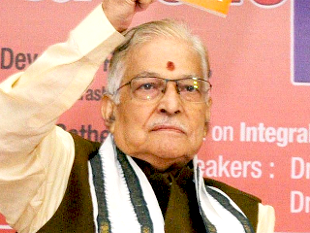
Bengaluru, Jun 26: Former Union Minister and senior BJP leader Murali Manohar Joshi has alleged that secularism as practiced by Congress and Left parties was "nothing but an euphemism for hating Hindutva".

secularism"Secularism being practiced by Congress and Leftists is nothing but an euphemism for hating Hindutva. People of India have seen through this devious game of Congress as well as the Leftists and realised they were taken for a ride," he said.

The people had rightly dumped them "at the dustbin of history", he said addressing a public meeting organised by the party unit of the Bangalore Urban district here.

The meeting was held in remembrance of the 63rd martyrdom of Jan Sangh founder Shyama Prasad Mukherjee.

Joshi, who was a minister in Vajpayee government, stressed the need for a thorough debate on issues of nationalism and secularism. He said that pseudo-secularism has thrived at the cost of genuine, positive secularism for the last several decades.

He alleged that the concept and definition of nationalism had also been twisted and distorted as secularism to suit the needs of pseudo-secular and communal forces.

Joshi said the Jan Sangh founder's martyrdom was on the issue of what constitutes nationalism and what represents secularism.

"This needs to be further debated to bring in clarity and settle the issue of secularism once and for all," he said.

Comments

Well Wisher
 - 
Sunday, 26 Jun 2016

He is a big enemy of democracy always omit poison during his central cabinet minister post tried a lot to spoil INDIAN education field.

Totally a deshdrophi or Terrorist.

Jai Hind

Add new comment

  • Coastaldigest.com reserves the right to delete or block any comments.
  • Coastaldigset.com is not responsible for its readers’ comments.
  • Comments that are abusive, incendiary or irrelevant are strictly prohibited.
  • Please use a genuine email ID and provide your name to avoid reject.
News Network
June 9,2020

Thiruvananthapuram, Jun 9: Malls, restaurants and places of worship opened in Kerala on Tuesday morning after over two-and half months of Coronavirus induced lockdown. There were very few visitors in the malls and restaurants in the early hours and people preferred takeaways in eateries.

Various temples, including the famous Lord Krishna temple at Guruvayoor, a few churches and mosques opened in the state for the devotees. The Guruvayur shrine opened at 9.30 am and around 150 people, who had booked through virtual queue system, offered prayers.

Devotees wearing masks were seen standing adhering to the social distance norm. A faithful at the guruvayur temple said he had booked for darshan on Sunday and was happy to be offering worship after a long gap. "This is a realisation of a dream", he said.

In the state capital while the famed Lord Padmanabha swamy, Pazhavanangadi Ganapathy and Attukal Bhagavathy temples remained shut, the SreekanteshwaraShiva shrine and Lord Hanuman temple near the state assembly were among those which opened for darshan. The names, age and other details of the worshippers are also being collected by the temple authorities before letting people in. Another devotee said it was very painful not to go to the temple and expressed happiness over reopening of the shrines.

The virtual queue booking for devotees to offer worship at the hill shrine of Lord Ayyappa temple at Sabarimala would commence from Wednesday. Devotees from other states have to produce a Covid-19 negative certificate while booking,sources in the Travancore Devaswom Board (TDB), administers the temple, said.

The Ayyappa shrine would open from June 14 to 28 for the five day monthly pooja and temple festival and only 10 people would be allowed inside the shrine at a time, sources said.

Most of the over 1,200 temples under the TDB, have opened while those under the Nair Service Society (NSS), an organisation of the Nair community and few other shrines were shut. The state government, which had come under attack from the BJP and Hindu Aikya vedi for opening the temples in a "hasty manner" has maintained that the decision was taken in line with the Centre's Unlock-1 guidelines and said those opposing the move had earlier wanted devotees to be allowed into the shrines.

As per the centre's Standard Operating Procedures, social distancing should be followed in all the places of worship and devotees should wear face mask are among other precautions in view of the COVID-19 pandemic.

Those above 65 and children below 10 years would not be allowed in places of worship, distribution of food, refreshments and offertory blessings (prasadams), sandalwood paste or ashes should be avoided. Thermal scanners to check body temperatures, sanitiisers, arrangements for washing hands, were all provided in the temples and other places of worship which opened this morning, In churches in the state capital, Kochi and Kozhikode, allowedthe faithful inside after disinfecting the place.

The orthodox church synod is being held on Tuesday which will take a decision on whether or not to open their places of worship. Few mosques were also open in some places.

Comments

Add new comment

  • Coastaldigest.com reserves the right to delete or block any comments.
  • Coastaldigset.com is not responsible for its readers’ comments.
  • Comments that are abusive, incendiary or irrelevant are strictly prohibited.
  • Please use a genuine email ID and provide your name to avoid reject.
News Network
February 28,2020

Bengaluru, Feb 28: The Liquefied Petroleum Gas penetration in Karnataka is 'absolutely 100 per cent' due to the Prime Minister Ujjwala Yojana, Indian Oil Corporation Karnataka Executive Director D L Pramodh said here on Friday.

In 2014, LPG penetration in the State was only 68 per cent, but after the PMUY, massive number of gas connections were given in the last five years, he said, adding, "It is absolutely 100 per cent today."

"There are 1.6 crore LPG connections out of which around 31.5 lakh -- or around 20 per cent -- come under the PMUY. The 100 per cent LPG penetration in the state will help women in rural areas to make their kitchens smokeless. Against the national average of 2.88 cylinders per family per PMUY annually, the figure is Karnataka 3.4 cylinders in Karnataka," Pramodh told reporters.

On the initiative of blending ethanol with petrol, he said it's 8.6 per cent in Karnataka, the highest comparedto other states, where it's five per cent to 5.5 per cent. The state aims to increase it to 10 per cent. By March 31, the IOC would commission the Rs 10 crore Vapour Recovery System at the Devanagonthi terminal on the city outskirts which would ensure that vapour does not go out in the air when tankers are being filled with fuel. "This is an important measure taken tominimise pollution", he said.

Pramodh also said the IOC has started mobile fuel dispensers, delivering fuels at the doorsteps.

Regarding the IOC's preparedness for Electric Vehicle charging stations, Pramodh said the Ministry of Power has given the company a target to set up 500 charging stations across India in the first phase. The IOC has already signed MoUs with NTPC, Power Grid Corporation Limited, Hyundai Motors, Tech Mahindra and Tata Power in this regard.

In Karnataka, 58 sites have been identified for setting up charging and battery swapping stations.

"Total electric vehicle charging facilities planned by IOC in Karnataka by March 31 is 34, out of which 26 will be EVcharging sites and eight battery swapping stations," Pramodh said.

Comments

Add new comment

  • Coastaldigest.com reserves the right to delete or block any comments.
  • Coastaldigset.com is not responsible for its readers’ comments.
  • Comments that are abusive, incendiary or irrelevant are strictly prohibited.
  • Please use a genuine email ID and provide your name to avoid reject.
Media Release
February 14,2020

Veteran journalist P. Sainath has said that the nation is in a crisis. And this crisis is not limited to just the rural area. It has become a national crisis at various areas such as agriculture, education, economy, job creation etc.

He was delivering the endowment lecture on the topic ‘Indian democracy at the post-liberalization and post-truth era’ at Media Manthan 2020 organized by the PG department of journalism and mass communication at St Aloysius College (Autonomous). 

Mr Sainath said that the many policies adopted in the 90s led to India becoming unusually unequal. Referring to the speech Ambedkar had made at the Constituent Assembly while handing over the draft of the Constitution, Mr Sainath said, “Ambedkar had warned about the weakness of Indian democracy that liberty without equality allows the supremacy of a few over the multitude. Liberty, equality and fraternity must be kept together as we cannot have one without the other.” 

Mr Sainath stated that the agrarian crisis was no longer about the loss of productivity, employment or about farmer suicide; it was a societal, civilizational crisis. Commenting on the lopsided policies such as cow-slaughter ban, he explained how cow slaughter ban had adversely affected many industries due to their interdependency. While Muslims who slaughtered cows were rendered helpless, the cattle traders who were mostly OBCs lost their earnings as the cattle prices crashed. An important industry like Kolhapur sandals industry in Maharashtra went bankrupt as a result of the cow slaughter ban in Maharashtra. He said the policymakers had no idea how the rural industries were interconnected. Demonetisation too devastated the rural economy as 98 percent of rural transactions happen through cash. 

Mr Sainath also spoke about the crisis of inequality which affects the Dalits and the Adivasis far more than anyone else as 90 percent of the rural households take home less than Rs 10,000/- per month. “Women are yet another group whose labour is never counted in the gross domestic product. Women and girls globally do unpaid work which amounts to about 12.5 billion working hours per year. Monetarily speaking, this is worth 10.8 trillion dollars,” Mr Sainath added. 

Speaking about the crisis of jobs Mr Sainath said that major companies were laying off employees just to create more profits for the investors and the adoption of artificial intelligence in the industry would further destroy millions of jobs.

Rector of St Aloysius College Institutions Fr Dionysius Vaz SJ, Principal Dr (Fr) Praveen Martis SJ, HOD of Journalism and Mass Communication department Dr (Fr) Melwyn Pinto SJ were present.

‘Veerappan and Vijay Mallya’s business models are interesting!’

Addressing the gathering during his endowment lecture on Friday, Mr Sainath made an interesting comment on the so called ‘revenue model’. “Whenever I visit IIMs and IITs for lectures on my PARI project, the students there ask me what my revenue model for my project is. I tell them that I do not have a revenue model. In fact, journalism does not begin with a revenue model. Gandhiji, Ambedkar, Bhagat Singh were all great journalists. But they did not have a revenue model,” Mr Sainath said.

On a lighter note, he said that the best revenue model that he liked was that of forest brigand Veerappan and liquor baron Vijay Mallya. “Veerappan ruled the forest for forty years and from the top ministers to the villagers he could dictate terms and liver royally. Similarly, Mallya’s revenue model was to steal the banks and run away abroad and live like a king,” Mr Sainath added.

Journalism is not and can never be a business. It is a calling, he opined. While newspaper can be a business, television can be a business, journalism per se cannot be reduced to a business. “Unfortunately today, journalists are recruited on a contract basis and they have no bargaining power; and there are no unions to fight for their cause. Hence, they are at the mercy of the corporate media houses for their survival and are made to write stories that cannot be called journalism,” Mr Sainath said.

Answering a question as to the pressures he faced as a journalist, he said that external pressures from the government or others could be very well handled. It is the internal pressures from once own media house that journalists find it difficult to manage.


 

Comments

Add new comment

  • Coastaldigest.com reserves the right to delete or block any comments.
  • Coastaldigset.com is not responsible for its readers’ comments.
  • Comments that are abusive, incendiary or irrelevant are strictly prohibited.
  • Please use a genuine email ID and provide your name to avoid reject.