


Secularism of Cong, Left is euphemism for hating Hindutva, says BJP

June 26, 2016

Bengaluru, Jun 26: Former Union Minister and senior BJP leader Murali Manohar Joshi has alleged that secularism as practiced by Congress and Left parties was "nothing but an euphemism for hating Hindutva".
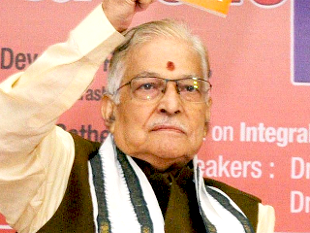
secularism"Secularism being practiced by Congress and Leftists is nothing but an euphemism for hating Hindutva. People of India have seen through this devious game of Congress as well as the Leftists and realised they were taken for a ride," he said.

The people had rightly dumped them "at the dustbin of history", he said addressing a public meeting organised by the party unit of the Bangalore Urban district here.

The meeting was held in remembrance of the 63rd martyrdom of Jan Sangh founder Shyama Prasad Mukherjee.

Joshi, who was a minister in Vajpayee government, stressed the need for a thorough debate on issues of nationalism and secularism. He said that pseudo-secularism has thrived at the cost of genuine, positive secularism for the last several decades.

He alleged that the concept and definition of nationalism had also been twisted and distorted as secularism to suit the needs of pseudo-secular and communal forces.

Joshi said the Jan Sangh founder's martyrdom was on the issue of what constitutes nationalism and what represents secularism.

"This needs to be further debated to bring in clarity and settle the issue of secularism once and for all," he said.

Comments

Well Wisher
 - 
Sunday, 26 Jun 2016

He is a big enemy of democracy always omit poison during his central cabinet minister post tried a lot to spoil INDIAN education field.

Totally a deshdrophi or Terrorist.

Jai Hind

Add new comment

  • Coastaldigest.com reserves the right to delete or block any comments.
  • Coastaldigset.com is not responsible for its readers’ comments.
  • Comments that are abusive, incendiary or irrelevant are strictly prohibited.
  • Please use a genuine email ID and provide your name to avoid reject.
News Network
May 10,2020

May 10: Azaan is an integral part of the faith, not the gadget, says veteran writer-lyricist Javed Akhtar, asking that the Islamic call to prayer on loudspeakers should be stopped as it causes "discomfort" to others.

In a tweet on Saturday, Akhtar wondered why the practice was 'halaal' (allowed) when it was, for nearly half a century in the country, considered 'haraam' or forbidden.

"In India for almost 50 years Azaan on the loud speak was Haraam. Then it became Halaal and so halaal that there is no end to it, but there should be an end to it. Azaan is fine but loud speaker does cause of discomfort for others. I hope that atleast this time they will do it themselves (sic)," Akhtar tweeted.

When a user asked his opinion on loudspeakers being used in temples, the 75-year-old writer said everyday use of speakers is a cause of concern.

"Whether it's a temple or a mosque, if you're using loudspeakers during a festival, it's fine. But it shouldn't be used everyday in either temples or mosques.

"For more than thousand years Azaan was given without the loud speaker. Azaan is the integral part of your faith, not this gadget," he replied.

Earlier in March, Akhtar had supported the demand to shut mosques amid the coronavirus outbreak in the country, saying even Kaaba and Medina have been closed due to the pandemic.

He had also appealed to the Muslim community to offer prayers from home in the holy month of Ramzan, which began on April 24.

"I request all the Muslim brothers that now that Ramzan is coming, please say your prayers but make sure that this doesn't cause problems to anyone else. The prayers that you do in the mosque, you can do that at home. According to you, the house, the ground, this all has been made by Him. Then you can do your prayers anywhere," he had said.

Comments

Add new comment

  • Coastaldigest.com reserves the right to delete or block any comments.
  • Coastaldigset.com is not responsible for its readers’ comments.
  • Comments that are abusive, incendiary or irrelevant are strictly prohibited.
  • Please use a genuine email ID and provide your name to avoid reject.
News Network
May 3,2020

Mangaluru,  May 3: An unidentified vehicle mowed down a 62-year-old security guard near Guruvayanakere, Belthangady taluk, on Saturday.

The deceased Lingappa Moolya was returning to his home in Guruvayanakere on a two-wheeler when the hit-and-run case took place. Police said he was hit by a truck. A guard at an ATM, Moolya was also an active member of the local Kulala Association.

A case was registered at Belthangady police station.

Comments

Add new comment

  • Coastaldigest.com reserves the right to delete or block any comments.
  • Coastaldigset.com is not responsible for its readers’ comments.
  • Comments that are abusive, incendiary or irrelevant are strictly prohibited.
  • Please use a genuine email ID and provide your name to avoid reject.
News Network
February 28,2020

Bengaluru, Feb 28: Historian S. Shettar, 85, breathed his last early on February 28 in Bengaluru. He was suffering from respiratory problems and was hospitalised for over a week.

Shettar was known for his multi-disciplinary work, encompassing linguistics, epigraphy, anthropology, the study of religions and art history. He had extensively worked on the Jain practice of ritual death in Karnataka and Asoka edicts. He had studied and compiled early edicts in Kannada and worked extensively on the growth of Kannada language down the ages.

Born in 1935 at Hampasagara, Ballari district, he went on to study at Cambridge University and started his career as a Professor of History at Karnatak University, Dharwad, his alma mater. He later headed the National Museum Institute of the History of Art, Conservation and Museology in 1978 and Indian Council for Historical Research in 1996. He was also a visiting professor at the National Institute of Advanced Studies, Bengaluru.

He was a bilingual historian who wrote in English for most of his career, but started writing in Kannada in later years. In the last two decades, he developed a keen interest in linguistics and wrote multiple books on classical Kannada and Prakrit. His 2007 book “Shangam Tamilagam” is considered a seminal work in the study of the early period of Dravidian languages. It won him Bhasha Samman from Central Sahitya Akademi. He later wrote two works on Halegannada, classical Kannada. His most recent work was “Prakrita Jagadvalaya” in 2018.

Comments

Add new comment

  • Coastaldigest.com reserves the right to delete or block any comments.
  • Coastaldigset.com is not responsible for its readers’ comments.
  • Comments that are abusive, incendiary or irrelevant are strictly prohibited.
  • Please use a genuine email ID and provide your name to avoid reject.