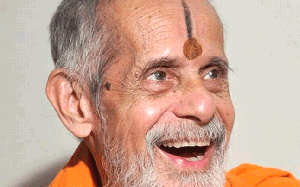
Seer defends iftar party in temple, says 'didn't hurt sentiments'

DHNS
June 27, 2017

Udupi, Jun 27: Vishweshateertha Swami of Pejawar Mutt on Monday defended the iftar party organised for members of the Muslim community at the Krishna Mutt here on Saturday.seer

The pontiff’s defence comes in the backdrop of Sri Rama Sene founder Pramod Muthalik’s criticism of the event being held in the Mutt.

The seer said he had done nothing wrong to hurt the religious sentiments of the Hindus, instead he had upheld the ethos of the Hindu religion of tolerance and harmony.

He was speaking to reporters after a 40-minute closed door meeting with Muthalik. The seer said he had been striving to bridge the gap between the communities and had never failed to raise his voice when injustice was meted out to Hindus. The Muslim community had been cooperative during the paryaya, he said.

He said Muthalik’s claim that he had hurt the sentiments of Hindus held no water as he had received accolades from all sections of the society.

The pontiff denied the charge that members of the Muslim community were allowed to perform namaz (holy prayer) on the premises of the Mutt. The namaz, before breaking the fast, was facilitated at the ‘bhojana shala’ (dining hall), which is away from the Mutt.

Regarding the other apprehension over beef consumption, the seer said it is not only Muslims who consume beef, there are also some Hindus who eat beef. Just because they consume beef, people cannot be stopped from entering the temple. They can be advised or requested not to consume beef, the seer said.

“My predecessor had visited Haji Abdullah’s house for the pre-paryaya ritual and accepted offerings in 1904. Even Madhwacharya had harmonious relations with Muslims and was felicitated by the community people.”

Comments

Aslam Sheikh
 - 
Wednesday, 28 Jun 2017

Basically I am from Udupi and most of my hindu friends who do regular visit to Sri Krishna temple are beef eaters!!!

Fairman
 - 
Wednesday, 28 Jun 2017

If beef eating is really a sin or crime, then the issue should be brought into global level where most of the beef consumption is outside the India. But scientific evidence is must to prove it.

Man made culture of food habit should not be considered as rule of God.
India consumes beef less than 5% of whole world.
Why don't go to US & Europe, 80% are consumed here.
Australia and New Zealand also consume and export big qty. of beef

God give wisdom to know and follow the right path.

Add new comment

  • Coastaldigest.com reserves the right to delete or block any comments.
  • Coastaldigset.com is not responsible for its readers’ comments.
  • Comments that are abusive, incendiary or irrelevant are strictly prohibited.
  • Please use a genuine email ID and provide your name to avoid reject.
News Network
May 24,2020

Bengaluru, May 24: A couple got married in Bengaluru today, even as Karnataka government has announced a complete lockdown on Sundays, as part of the fourth phase of COVID-19 shutdown till the end of this month.

The marriage ceremony on this Sunday was possible thanks to a clarification given by the state government for marriages, which has been already scheduled for May 24 and May 31 to be exempted from the Sunday complete lockdown.

At today's wedding, the rituals were performed with compliance of all guidelines including ensuring social distancing and capping the number of guests at 50.

Satish, the groom said, "Government has allowed weddings with up to 50 people in attendance but we decided to invite only 25 people to the ceremony".

Meanwhile, in the Honnali Honnali area of Davanagere, BJP MLA MP Renukacharya distributed masks to three newly-wed couples.

As per an earlier advisory issued by the State government more than 50 guests, no air conditioning, and the consumption of liquor and paan are among the guidelines to be followed for holding weddings in the state. Also, people aged above 65 and below 10 as well as pregnant women have been barred from participating in the event.

According to the advisory, sanitisers should be provided at the entry and other appropriate places at the venue. Also, thermal screening of all persons shall be conducted at the entry of the venue. The scanner should be held 3-15 cms away from a person's forehead.

Apart from this, the venue shall be "clean and hygienic," and a "nodal person shall be identified for overseeing the arrangements and coordination at the venue." Also, a list of attendees with contact details has to be maintained and all guests should have downloaded Aarogya Setu app.

Comments

Add new comment

  • Coastaldigest.com reserves the right to delete or block any comments.
  • Coastaldigset.com is not responsible for its readers’ comments.
  • Comments that are abusive, incendiary or irrelevant are strictly prohibited.
  • Please use a genuine email ID and provide your name to avoid reject.
Ram Puniyani
January 14,2020

In the beginning of January 2020 two very disturbing events were reported from Pakistan. One was the attack on Nankana Sahib, the holy shrine where Sant Guru Nanak was born. While one report said that the place has been desecrated, the other stated that it was a fight between two Muslim groups. Prime Minister of Pakistan Imran Khan condemned the incident and the main accused Imran Chisti was arrested. The matter related to abduction and conversion of a Sikh girl Jagjit Kaur, daughter of Pathi (One who reads Holy Guru Granth Sahib in Gurudwara) of the Gurudwara. In another incident one Sikh youth Ravinder Singh, who was out on shopping for his marriage, was shot dead in Peshawar.

While these condemnable attacks took place on the Sikh minority in Pakistan, BJP was quick enough to jump to state that it is events like this which justify the Citizenship Amendment Act (CAA). Incidentally CAA is the Act which is discriminatory and relates to citizenship with Religion, which is not as per the norms of Indian constitution. There are constant debates and propaganda that population of Hindus has come down drastically in Pakistan and Bangla Desh. Amit Shah, the Home minister stated that in Pakistan the population of Hindus has come down from 23% at the time of partition to 3.7% at present. And in Bangla Desh it has come down from 22% to present 8%.

While not denying the fact that the religious minorities are getting a rough deal in both these countries, the figures which are presented are totally off the mark. These figures don’t take into consideration the painful migrations, which took place at the time of partition and formation of Bangla Desh later. Pakistan census figures tell a different tale. Their first census was held in 1951. As per this census the overall percentage of Non Muslim in Pakistan (East and West together) was 14.2%, of this in West Pakistan (Now Pakistan) it was 3.44 and in Eat Pakistan it was 23.2. In the census held in Pakistan 1998 it became 3.72%. As far as Bangla Desh is concerned the share of Non Muslims has gone down from 23.2 (1951) to 9.6% in 2011.

The largest minority of Pakistan is Ahmadis, (https://minorityrights.org/country/pakistan/) who are close to 4 Million and are not recognised as Muslims in Pakistan. In Bangla Desh the major migrations of Hindus from Bangla Desh took place in the backdrop of Pakistan army’s atrocities in the then East Pakistan.

As far as UN data on refugees in India it went up by 17% between 2016-2019 and largest numbers were from Tibet and Sri Lanka.  (https://www.un.org/en/development/desa/population/migration/publication…)

The state of minorities is in a way the index of strength of democracy. Most South Asian Countries have not been able to sustain democratic values properly. In Pakistan, the Republic began with Jinnah’s classic speech where secularism was to be central credo of Pakistan. This 11th August speech was in a way what the state policy should be, as per which people of all faiths are free to practice their religion. Soon enough the logic of ‘Two Nation theory” and formation of Pakistan, a separate state for Muslim took over. Army stepped in and dictatorship was to reign there intermittently. Democratic elements were suppressed and the worst came when Zia Ul Haq Islamized the state in collusion with Maulanas. The army was already a strong presence in Pakistan. The popular formulation for Pakistan was that it is ruled by three A’s, Army, America and Allah (Mullah).

Bangla Desh had a different trajectory. Its very formation was a nail in the coffin of ‘two nation theory’; that religion can be the basis of a state. Bangla Desh did begin as a secular republic but communal forces and secular forces kept struggling for their dominance and in 1988 it also became Islamic republic. At another level Myanmar, in the grip of military dictatorship, with democratic elements trying to retain their presence is also seeing a hard battle. Democracy or not, the army and Sanghas (Buddhist Sang has) are strong, in Myanmar as well. The most visible result is persecution of Rohingya Muslims.

Similar phenomenon is dominating in Sri Lanka also where Budhhist Sanghas and army have strong say in the political affairs, irrespective of which Government is ruling. Muslim and Christian minorities are a big victim there, while Tamils (Hindus, Christians etc.) suffered the biggest damage as ethnic and religious minorities. India had the best prospect of democracy, pluralism and secularism flourishing here. The secular constitution, the outcome of India’s freedom struggle, the leadership of Gandhi and Nehru did ensure the rooting of democracy and secularism in a strong way.

India so far had best democratic credentials amongst all the south Asian countries. Despite that though the population of minorities rose mainly due to poverty and illiteracy, their overall marginalisation was order of the day, it went on worsening with the rise of communal forces, with communal forces resorting to identity issues, and indulging in propaganda against minorities.

While other South Asian countries should had followed India to focus more on infrastructure and political culture of liberalism, today India is following the footsteps of Pakistan. The retrograde march of India is most visible in the issues which have dominated the political space during last few years. Issues like Ram Temple, Ghar Wapasi, Love Jihad, Beef-Cow are now finding their peak in CAA.

India’s reversal towards a polity with religion’s identity dominating the political scene was nicely presented by the late Pakistani poetess Fahmida Riaz in her poem, Tum bhi Hum Jaise Nikle (You also turned out to be like us). While trying to resist communal forces has been an arduous task, it is becoming more difficult by the day. This phenomenon has been variously called, Fundamentalism, Communalism or religious nationalism among others. Surely it has nothing to do with the religion as practiced by the great Saint and Sufi traditions of India; it resorts mainly to political mobilization by using religion as a tool.


Comments

Ashi
 - 
Tuesday, 14 Jan 2020

If Malaysia implement similar NRC/CAA, India and China are the loser.

Add new comment

  • Coastaldigest.com reserves the right to delete or block any comments.
  • Coastaldigset.com is not responsible for its readers’ comments.
  • Comments that are abusive, incendiary or irrelevant are strictly prohibited.
  • Please use a genuine email ID and provide your name to avoid reject.
Agencies
June 13,2020

New Delhi, Jun 13: Loss of smell or taste has been added to the list of COVID-19 symptoms, according to the revised clinical management protocols released by the Union Health Ministry on Saturday.

The ministry said that coronavirus-infected patients reporting to various COVID-19 treatment facilities have been reporting symptoms like fever, cough, fatigue, shortness of breath, expectoration, myalgia, rhinorrhea, sore throat and diarrhea.

They have also complained of loss of smell (anosmia) or loss of taste (ageusia) preceding the onset of respiratory symptoms.

Older people and immune-suppressed patients in particular may present with atypical symptoms such as fatigue, reduced alertness, reduced mobility, diarrhoea, loss of appetite, delirium, and absence of fever, the ministry said.

Children might not have reported fever or cough as frequently as adults.

The US's national public health institute, the Centers for Disease Control and Prevention (CDC), had in early May incorporated "a new loss of taste or smell" in the list of COVID-19 symptoms.

According to the data from Integrated Health Information Platform and Integrated Disease Surveillance Programme, portal case investigation forms for COVID 19 (n=15,366), the details on the signs and symptoms reported are (as on June 11), fever (27 per cent), cough (21 pc), sore throat (10 pc), breathlessness (8 pc), Weakness (7 pc), running nose (3pc ) and others 24 pc.

According to the health ministry, people infected by the novel coronavirus are the main source of infection.

Direct person-to-person transmission occurs through close contact, mainly through respiratory droplets that are released when the infected person coughs, sneezes, or talks.

These droplets may also land on surfaces, where the virus remains viable. Infection can also occur if a person touches an infected surface and then touches his or her eyes, nose, or mouth.

The median incubation period is 5.1 days (range 2–14 days). The precise interval during which an individual with COVID-19 is infectious is uncertain.

As per the current evidence, the period of infectivity starts 2 days prior to onset of symptoms and lasts up to 8 days.

The extent and role played by pre-clinical/ asymptomatic infections in transmission still remain under investigation.

Comments

Add new comment

  • Coastaldigest.com reserves the right to delete or block any comments.
  • Coastaldigset.com is not responsible for its readers’ comments.
  • Comments that are abusive, incendiary or irrelevant are strictly prohibited.
  • Please use a genuine email ID and provide your name to avoid reject.