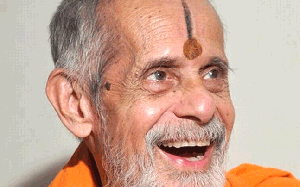
Seer defends iftar party in temple, says 'didn't hurt sentiments'

DHNS
June 27, 2017

Udupi, Jun 27: Vishweshateertha Swami of Pejawar Mutt on Monday defended the iftar party organised for members of the Muslim community at the Krishna Mutt here on Saturday.seer

The pontiff’s defence comes in the backdrop of Sri Rama Sene founder Pramod Muthalik’s criticism of the event being held in the Mutt.

The seer said he had done nothing wrong to hurt the religious sentiments of the Hindus, instead he had upheld the ethos of the Hindu religion of tolerance and harmony.

He was speaking to reporters after a 40-minute closed door meeting with Muthalik. The seer said he had been striving to bridge the gap between the communities and had never failed to raise his voice when injustice was meted out to Hindus. The Muslim community had been cooperative during the paryaya, he said.

He said Muthalik’s claim that he had hurt the sentiments of Hindus held no water as he had received accolades from all sections of the society.

The pontiff denied the charge that members of the Muslim community were allowed to perform namaz (holy prayer) on the premises of the Mutt. The namaz, before breaking the fast, was facilitated at the ‘bhojana shala’ (dining hall), which is away from the Mutt.

Regarding the other apprehension over beef consumption, the seer said it is not only Muslims who consume beef, there are also some Hindus who eat beef. Just because they consume beef, people cannot be stopped from entering the temple. They can be advised or requested not to consume beef, the seer said.

“My predecessor had visited Haji Abdullah’s house for the pre-paryaya ritual and accepted offerings in 1904. Even Madhwacharya had harmonious relations with Muslims and was felicitated by the community people.”

Comments

Aslam Sheikh
 - 
Wednesday, 28 Jun 2017

Basically I am from Udupi and most of my hindu friends who do regular visit to Sri Krishna temple are beef eaters!!!

Fairman
 - 
Wednesday, 28 Jun 2017

If beef eating is really a sin or crime, then the issue should be brought into global level where most of the beef consumption is outside the India. But scientific evidence is must to prove it.

Man made culture of food habit should not be considered as rule of God.
India consumes beef less than 5% of whole world.
Why don't go to US & Europe, 80% are consumed here.
Australia and New Zealand also consume and export big qty. of beef

God give wisdom to know and follow the right path.

Add new comment

  • Coastaldigest.com reserves the right to delete or block any comments.
  • Coastaldigset.com is not responsible for its readers’ comments.
  • Comments that are abusive, incendiary or irrelevant are strictly prohibited.
  • Please use a genuine email ID and provide your name to avoid reject.
News Network
March 25,2020

Bengaluru, Mar 25: In what is suspected to be the second COVID-19 death in Karnataka, a 70-year-old woman from Gouribidanuru, who was under house quarantine for the last one week has died at Rajiv Gandhi Hospital for Chest Diseases.

The woman, who had recently returned from the Mecca pilgrimage developed fever on Tuesday afternoon. She was rushed to hospital, where she died on Wednesday morning.

Health and Family Welfare officials said that the throat swab sample of the woman had been sent to the laboratory for testing and the result was expected to come by afternoon.

Since last week, at least three cases of COVID-19 positive had been reported in Gouribidanuru in Chikkaballpura district, about 80 kms from Bengaluru.

Most of the suspects and confirmed cases had returned from Makkah pilgrimage. Even the deceased woman was one of them and had been advised house quarantine.

On Tuesday morning, she developed fever and was shifted to Gouribidanur hospital and later to Chikkaballapura hospital. By evening, she was moved to Rajiv Gandhi hospital, where she died on Wednesday morning.

The Chikkaballapura district administration has proclaimed prohibitory orders in the locality. They have also taken the woman's family members for testing.

Comments

Add new comment

  • Coastaldigest.com reserves the right to delete or block any comments.
  • Coastaldigset.com is not responsible for its readers’ comments.
  • Comments that are abusive, incendiary or irrelevant are strictly prohibited.
  • Please use a genuine email ID and provide your name to avoid reject.
Agencies
February 20,2020

India ranked 77th on a sustainability index that takes into account per capita carbon emissions and ability of children in a nation to live healthy lives and secures 131st spot on a flourishing ranking that measures the best chance at survival and well-being for children, according to a UN-backed report.

The report was released on Wednesday by a commission of over 40 child and adolescent health experts from around the world. It was commissioned by the World Health Organization (WHO), UN Children's Fund (UNICEF) and The Lancet medical journal.

In the report assessing the capacity of 180 countries to ensure that their youngsters can survive and thrive, India ranks 77th on the Sustainability Index and 131 on the Flourishing Index, it said.

Flourishing is the geometric mean of Surviving and Thriving. For Surviving, the authors selected maternal survival, survival in children younger than 5 years old, suicide, access to maternal and child health services, basic hygiene and sanitation, and lack of extreme poverty.

For Thriving, the domains were educational achievement, growth and nutrition, reproductive freedom, and protection from violence.

Under the Sustainability Index, the authors noted that promoting today's national conditions for children to survive and thrive must not come at the cost of eroding future global conditions for children's ability to flourish.

The Sustainability Index ranks countries on excess carbon emissions compared with the 2030 target. This provides a convenient and available proxy for a country's contribution to sustainability in future.

The report noted that under realistic assumptions about possible trajectories towards sustainable greenhouse gas emissions, models predict that global carbon emissions need to be reduced from 39·7 giga­ tonnes to 22·8 gigatonnes per year by 2030 to maintain even a 66 per cent chance of keeping global warming below 1·5°C.

It said that the world's survival depended on children being able to flourish, but no country is doing enough to give them a sustainable future.

"No country in the world is currently providing the conditions we need to support every child to grow up and have a healthy future," said Anthony Costello, Professor of Global Health and Sustainability at University College London, one of the lead authors of the report.

"Especially, they're under immediate threat from climate change and from commercial marketing, which has grown hugely in the last decade," said Costello – former WHO Director of Mother, Child and Adolescent health.

Norway leads the table for survival, health, education and nutrition rates - followed by South Korea and the Netherlands. Central African Republic, Chad and Somalia come at the bottom.

However, when taking into account per capita CO2 emissions, these top countries trail behind, with Norway 156th, the Republic of Korea 166th and the Netherlands 160th.

Each of the three emits 210 per cent more CO2 per capita than their 2030 target, the data shows, while the US, Australia, and Saudi Arabia are among the 10 worst emitters. The lowest emitters are Burundi, Chad and Somalia.

According to the report, the only countries on track to beat CO2 emission per capita targets by 2030, while also performing fairly – within the top 70 – on child flourishing measures are: Albania, Armenia, Grenada, Jordan, Moldova, Sri Lanka, Tunisia, Uruguay and Vietnam.

"More than 2 billion people live in countries where development is hampered by humanitarian crises, conflicts, and natural disasters, problems increasingly linked with climate change," said Minister Awa Coll-Seck from Senegal, Co-Chair of the commission.

The report also highlights the distinct threat posed to children from harmful marketing.

Evidence suggests that children in some countries see as many as 30,000 advertisements on television alone in a single year, while youth exposure to vaping (e-cigarettes) advertisements increased by more than 250 per cent in the US over two years, reaching more than 24 million young people.

Studies in Australia, Canada, Mexico, New Zealand and the US – among many others – have shown that self-regulation has not hampered commercial ability to advertise to children.

Children's exposure to commercial marketing of junk food and sugary beverages is associated with purchase of unhealthy foods and overweight and obesity, linking predatory marketing to the alarming rise in childhood obesity, it said.

The number of obese children and adolescents increased from 11 million in 1975 to 124 million in 2016 – an 11-fold increase, with dire individual and societal costs, the report said.

To protect children, the authors call for a new global movement driven by and for children.

Specific recommendations include stopping CO2 emissions with the utmost urgency, to ensure children have a future on this planet; placing children and adolescents at the centre of global efforts to achieve sustainable development, the report said.

New policies and investment in all sectors to work towards child health and rights; incorporating children's voices into policy decisions and tightening national regulation of harmful commercial marketing, supported by a new Optional Protocol to the UN Convention on the Rights of the Child, it said.


Comments

Add new comment

  • Coastaldigest.com reserves the right to delete or block any comments.
  • Coastaldigset.com is not responsible for its readers’ comments.
  • Comments that are abusive, incendiary or irrelevant are strictly prohibited.
  • Please use a genuine email ID and provide your name to avoid reject.
News Network
May 19,2020

Bengaluru, May 19: Containment zones in Karnataka will be much smaller in size under the latest lockdown norms. However, rules and loopholes will be tightened and action against violators will be stringent in order to check the spread of the disease.

Revised guidelines issued by the Centre to the state, reveal containment zones are delineated based on mapping of cases and contacts. Intensive action will be carried out in these areas with the aim of breaking the chain of transmission. Therefore, the area of a containment zone should be appropriately defined by the district administration/local urban bodies with technical inputs at local level.

The health department is considering shrinking the size of containment zones from the existing 100 metres to open up more space for economic activities. Medical education minister K Sudhakar, also a member of the Covid taskforce, said additional chief secretary (health department) Javed Akthar will issue a new definition of a containment zone after the Covid-19 taskforce holds its next meeting.

“We are planning to further shrink it and restrict containment zones to an apartment complex, independent house or even a lane where the Covid-19 patient resides,” Sudhakar said. He went on to say bigger containment zones will impede businesses and normal activities in the vicinity, something which the government wants to avoid.

The minister said Karnataka will also do away with colour-coding districts. “With restrictions being relaxed for almost all activities, it does not make sense to pursue with colour codes. It is either containment zone or outside containment zone,” he said.

In rural areas, the minister said containment zones will be identified by the taluk heads. Government sources say it is difficult to restrict activities to certain areas or smaller location in rural areas as farmers and people will have to travel to the outskirts of their villages for their livelihood.

An official said, a containment operation (large outbreak or cluster) is deemed successful when no case is reported in 28 days from the containment zone.

Comments

Add new comment

  • Coastaldigest.com reserves the right to delete or block any comments.
  • Coastaldigset.com is not responsible for its readers’ comments.
  • Comments that are abusive, incendiary or irrelevant are strictly prohibited.
  • Please use a genuine email ID and provide your name to avoid reject.