


Seer defends iftar party in temple, says 'didn't hurt sentiments'

DHNS
June 27, 2017

Udupi, Jun 27: Vishweshateertha Swami of Pejawar Mutt on Monday defended the iftar party organised for members of the Muslim community at the Krishna Mutt here on Saturday.seer
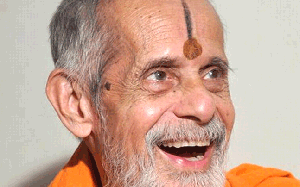
The pontiff’s defence comes in the backdrop of Sri Rama Sene founder Pramod Muthalik’s criticism of the event being held in the Mutt.

The seer said he had done nothing wrong to hurt the religious sentiments of the Hindus, instead he had upheld the ethos of the Hindu religion of tolerance and harmony.

He was speaking to reporters after a 40-minute closed door meeting with Muthalik. The seer said he had been striving to bridge the gap between the communities and had never failed to raise his voice when injustice was meted out to Hindus. The Muslim community had been cooperative during the paryaya, he said.

He said Muthalik’s claim that he had hurt the sentiments of Hindus held no water as he had received accolades from all sections of the society.

The pontiff denied the charge that members of the Muslim community were allowed to perform namaz (holy prayer) on the premises of the Mutt. The namaz, before breaking the fast, was facilitated at the ‘bhojana shala’ (dining hall), which is away from the Mutt.

Regarding the other apprehension over beef consumption, the seer said it is not only Muslims who consume beef, there are also some Hindus who eat beef. Just because they consume beef, people cannot be stopped from entering the temple. They can be advised or requested not to consume beef, the seer said.

“My predecessor had visited Haji Abdullah’s house for the pre-paryaya ritual and accepted offerings in 1904. Even Madhwacharya had harmonious relations with Muslims and was felicitated by the community people.”

Comments

Aslam Sheikh
 - 
Wednesday, 28 Jun 2017

Basically I am from Udupi and most of my hindu friends who do regular visit to Sri Krishna temple are beef eaters!!!

Fairman
 - 
Wednesday, 28 Jun 2017

If beef eating is really a sin or crime, then the issue should be brought into global level where most of the beef consumption is outside the India. But scientific evidence is must to prove it.

Man made culture of food habit should not be considered as rule of God.
India consumes beef less than 5% of whole world.
Why don't go to US & Europe, 80% are consumed here.
Australia and New Zealand also consume and export big qty. of beef

God give wisdom to know and follow the right path.

Add new comment

  • Coastaldigest.com reserves the right to delete or block any comments.
  • Coastaldigset.com is not responsible for its readers’ comments.
  • Comments that are abusive, incendiary or irrelevant are strictly prohibited.
  • Please use a genuine email ID and provide your name to avoid reject.
coastaldigest.com news network
February 23,2020

Mangalore University has been participating in the campus bird count a sub-event of ‘Great backyard bird count’ (GBBC) organized by Bird Count India for the past 5 years. This year, CBC was held from 14th to 17th February of 2020 across various campuses in India.

This year the four days event was successfully ended up with the sightings of 103 species of birds from various locations across the campus spread on 300 acres. In this Black Drongo, Black Kite, Brahminy Kite, Common Iora, Green Wabler, Purple-rumed Sunbird, Red-whiskered Bulbul, White-cheeked Barbet, Jungle Babbler and Plum headed parakeets were the common birds, and also observed House Crow with nest and nestlings, Indian Robin nest with eggs, Bronzed Drongo constructing the nest and Shikra mating and carrying nesting materials.  Whereas Yellow-billed Babbler is rare in the campus, Ashy Drongo, Barn Swallow, Booted Eagle, Grey Wagtail, Indian Pitta etc. were migratory birds, Grey-headed Bulbul (Near Threatened bird), Rufous Babbler and Grey-headed Bulbul were Western Ghats Endemics  and Brown Wood Owl, Barn Owl, Spotted Owlet, Nightjars (Savanna, Indian and Jerdon’s) and Sri Lanka Frogmouth were nocturnal birds. Blue-eared Kingfisher Grey-bellied Cuckoo which was very rare and new additions to avian list of the campus.

In the first year (2016) of Mangalore University’s CBC recorded 77 species, in 2017 recorded 95 species, in 2018 recorded 110 species and in 2019 recorded 107 species of birds. However some of the common species like Rose ringed parakeets, Blue tailed bee-eater, Nilgiri Flowerpecker and Indian roller etc., sighted last year were not seen this year. But with 2 new additions from this CBC, the checklist of Mangalore University Campus has been updated with a total of 141 species.

This event was coordinated by Vivek Hasyagar from the Department of Applied Zoology and Maxim Rodrigues from the Department of Marine Geology. Survey trails were led by more than 60 students and research scholars from various Departments of Mangalore University includes Applied Zoology, Biosciences, Microbiology, Botany, Physics, Chemistry and Material Science.  In addition, some enthusiastic participants from St. Aloysius College had involved in identifying the birds around the campus.

Quote:

Wild/planned fire affects negatively on the existing ecologically sensitive areas in and around the campus especially in lateritic grasslands. Because many insectivorous birds are dependent on these lateritic grassland habitats for their food and breeding grounds for many ground dwelling birds like Yellow wattled lapwing, Red wattled lapwing, Indian Robin and Barred buttonquails. Conserving these habitats will be helpful in protecting these birds.

Quotes from the participants: “The Campus Bird Count 2020 at Mangalore University was an experience of its own kind. Observing birds in their natural habitat gave me new perspective of viewing them not only as another living being, but as equals, or even of higher intelligence. The Campus Bird Count is an important step towards documenting bird life year after year, and creating awareness amongst youngsters, so that proper conservation steps can be taken to protect them from human interference”.

-Jyotsna Dessai ( 1 M.Sc Zoology)

Comments

Add new comment

  • Coastaldigest.com reserves the right to delete or block any comments.
  • Coastaldigset.com is not responsible for its readers’ comments.
  • Comments that are abusive, incendiary or irrelevant are strictly prohibited.
  • Please use a genuine email ID and provide your name to avoid reject.
News Network
April 21,2020

Wayanad, Apr 21: Panic gripped residents of Mananthavady and Mepaddi regions of the district after several cats in the region were found dead.

A group of people approached authorities after which the Animal Husbandry Department tested samples from the carcasses and found that the cat deaths were caused by Feline Parvovirus, which does not transmit to humans.

Speaking to ANI, Dr D Ramachandran, Chief Veterinary Officer, Wayanad said that Feline Parvovirus affects cats and vaccines are available to protect cats and keep the virus at bay.

"There were incidents of cat deaths in Mananthavady and Meppadi region of Wayanad district creating panic among the local residents. The officials of the Animal Husbandry department visited the spots for epidemiological investigations. The samples were collected and sent to the State Institute of Animal Diseases, which confirmed that the deaths were due to Feline Parvovirus. There is no need to worry as this virus does not spread to humans," he said.

A cat owner in Meppadi said that within a span of two-three days, over 13 cats had died in the region.

"We are afraid of these sudden cat deaths amidst coronavirus outbreak. We have informed the Health Department and Animal Husbandry department. Officials came here and collected the samples," she said.

Comments

Add new comment

  • Coastaldigest.com reserves the right to delete or block any comments.
  • Coastaldigset.com is not responsible for its readers’ comments.
  • Comments that are abusive, incendiary or irrelevant are strictly prohibited.
  • Please use a genuine email ID and provide your name to avoid reject.
News Network
July 17,2020

Bengaluru, Jul 17: The Karnataka State Board of AUQAF has ordered that management committees at Muslim Khabarastans, shall not refuse burial to Muslims died due to COVID-19.

"...in exercise the powers conferred under Waqf Act 1995, it is hereby ordered that management Committees/Muthawallies/Administrators responsible for the management of Muslim Khabarastans in the state of Karnataka irrespective of registered or unregistered in the Waqf, shall not refuse the burial of Muslims died due to COVID-19 pandemic," read an order from the Karnataka State Board of AUQAF on Thursday.

"They shall co-operate with all the Nodal Officers designated for this purpose regarding the decent burial. Non co-operation or refusal on the part of the management will be construed as an insult committed to the deceased. Any violation of the above order will attract the punitive provision of Indian Penal Code and removal from the management as per the provisions of the Waqf Act 1995," the order read.

It further said that the Waqf Officers, District Wakf Advisory Committees of the state, shall ensure the adherence of this order, and circulate the same to all the Khabarastan managements, registered or unregistered in the state.

"No further deliberation in this regard is solicited except compliance of the order in letter and spirit. Any dereliction in this regard will be viewed seriously," it read.

Giving a background on the issue of burial of COVID-19 deceased, the order read, "It is observed that, number of deaths are being occurred in various Districts of Karnataka, due to COVID-19 pandemic and it is reported that, some of the management committees of Khabarastan, are not cooperating to bury the dead bodies of COVID-19."

"A decent burial is a right of the dead person" as per the law of the land and the Islamic jurisprudence. It is needless to emphasize the importance of burial of Muslim dead bodies in Shariah. The dead body of a Muslim is treated with the utmost respect by the Ummah, joining in the funeral (Tadfeen), participating in the Namaz-e-Janaza and the burial are considered as Farz-e-Kifaya in Muslim law. According to the tradition of Islam, the person who participates in the funeral is entitled to Mountain sized reward (Sawaab)," the order read.

As per the order, the board, in its earlier circular had also cautioned the management of Waqf institutions and Khabarastan which were reluctant to allow the decent burial in the Khabarastan would be punished under the provisions of Indian Penal Code and the punitive provisions of the Waqf Act 1995 as well.

"The District Magistrates and the Superintendent of Police in the districts have been requested to prosecute the erring management committees who are responsible for non co-operation in this regard. Hence, the following order," it added.

Comments

Add new comment

  • Coastaldigest.com reserves the right to delete or block any comments.
  • Coastaldigset.com is not responsible for its readers’ comments.
  • Comments that are abusive, incendiary or irrelevant are strictly prohibited.
  • Please use a genuine email ID and provide your name to avoid reject.