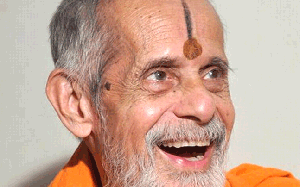
Seer defends iftar party in temple, says 'didn't hurt sentiments'

DHNS
June 27, 2017

Udupi, Jun 27: Vishweshateertha Swami of Pejawar Mutt on Monday defended the iftar party organised for members of the Muslim community at the Krishna Mutt here on Saturday.seer

The pontiff’s defence comes in the backdrop of Sri Rama Sene founder Pramod Muthalik’s criticism of the event being held in the Mutt.

The seer said he had done nothing wrong to hurt the religious sentiments of the Hindus, instead he had upheld the ethos of the Hindu religion of tolerance and harmony.

He was speaking to reporters after a 40-minute closed door meeting with Muthalik. The seer said he had been striving to bridge the gap between the communities and had never failed to raise his voice when injustice was meted out to Hindus. The Muslim community had been cooperative during the paryaya, he said.

He said Muthalik’s claim that he had hurt the sentiments of Hindus held no water as he had received accolades from all sections of the society.

The pontiff denied the charge that members of the Muslim community were allowed to perform namaz (holy prayer) on the premises of the Mutt. The namaz, before breaking the fast, was facilitated at the ‘bhojana shala’ (dining hall), which is away from the Mutt.

Regarding the other apprehension over beef consumption, the seer said it is not only Muslims who consume beef, there are also some Hindus who eat beef. Just because they consume beef, people cannot be stopped from entering the temple. They can be advised or requested not to consume beef, the seer said.

“My predecessor had visited Haji Abdullah’s house for the pre-paryaya ritual and accepted offerings in 1904. Even Madhwacharya had harmonious relations with Muslims and was felicitated by the community people.”

Comments

Aslam Sheikh
 - 
Wednesday, 28 Jun 2017

Basically I am from Udupi and most of my hindu friends who do regular visit to Sri Krishna temple are beef eaters!!!

Fairman
 - 
Wednesday, 28 Jun 2017

If beef eating is really a sin or crime, then the issue should be brought into global level where most of the beef consumption is outside the India. But scientific evidence is must to prove it.

Man made culture of food habit should not be considered as rule of God.
India consumes beef less than 5% of whole world.
Why don't go to US & Europe, 80% are consumed here.
Australia and New Zealand also consume and export big qty. of beef

God give wisdom to know and follow the right path.

Add new comment

  • Coastaldigest.com reserves the right to delete or block any comments.
  • Coastaldigset.com is not responsible for its readers’ comments.
  • Comments that are abusive, incendiary or irrelevant are strictly prohibited.
  • Please use a genuine email ID and provide your name to avoid reject.
Media Release
February 14,2020

Veteran journalist P. Sainath has said that the nation is in a crisis. And this crisis is not limited to just the rural area. It has become a national crisis at various areas such as agriculture, education, economy, job creation etc.

He was delivering the endowment lecture on the topic ‘Indian democracy at the post-liberalization and post-truth era’ at Media Manthan 2020 organized by the PG department of journalism and mass communication at St Aloysius College (Autonomous). 

Mr Sainath said that the many policies adopted in the 90s led to India becoming unusually unequal. Referring to the speech Ambedkar had made at the Constituent Assembly while handing over the draft of the Constitution, Mr Sainath said, “Ambedkar had warned about the weakness of Indian democracy that liberty without equality allows the supremacy of a few over the multitude. Liberty, equality and fraternity must be kept together as we cannot have one without the other.” 

Mr Sainath stated that the agrarian crisis was no longer about the loss of productivity, employment or about farmer suicide; it was a societal, civilizational crisis. Commenting on the lopsided policies such as cow-slaughter ban, he explained how cow slaughter ban had adversely affected many industries due to their interdependency. While Muslims who slaughtered cows were rendered helpless, the cattle traders who were mostly OBCs lost their earnings as the cattle prices crashed. An important industry like Kolhapur sandals industry in Maharashtra went bankrupt as a result of the cow slaughter ban in Maharashtra. He said the policymakers had no idea how the rural industries were interconnected. Demonetisation too devastated the rural economy as 98 percent of rural transactions happen through cash. 

Mr Sainath also spoke about the crisis of inequality which affects the Dalits and the Adivasis far more than anyone else as 90 percent of the rural households take home less than Rs 10,000/- per month. “Women are yet another group whose labour is never counted in the gross domestic product. Women and girls globally do unpaid work which amounts to about 12.5 billion working hours per year. Monetarily speaking, this is worth 10.8 trillion dollars,” Mr Sainath added. 

Speaking about the crisis of jobs Mr Sainath said that major companies were laying off employees just to create more profits for the investors and the adoption of artificial intelligence in the industry would further destroy millions of jobs.

Rector of St Aloysius College Institutions Fr Dionysius Vaz SJ, Principal Dr (Fr) Praveen Martis SJ, HOD of Journalism and Mass Communication department Dr (Fr) Melwyn Pinto SJ were present.

‘Veerappan and Vijay Mallya’s business models are interesting!’

Addressing the gathering during his endowment lecture on Friday, Mr Sainath made an interesting comment on the so called ‘revenue model’. “Whenever I visit IIMs and IITs for lectures on my PARI project, the students there ask me what my revenue model for my project is. I tell them that I do not have a revenue model. In fact, journalism does not begin with a revenue model. Gandhiji, Ambedkar, Bhagat Singh were all great journalists. But they did not have a revenue model,” Mr Sainath said.

On a lighter note, he said that the best revenue model that he liked was that of forest brigand Veerappan and liquor baron Vijay Mallya. “Veerappan ruled the forest for forty years and from the top ministers to the villagers he could dictate terms and liver royally. Similarly, Mallya’s revenue model was to steal the banks and run away abroad and live like a king,” Mr Sainath added.

Journalism is not and can never be a business. It is a calling, he opined. While newspaper can be a business, television can be a business, journalism per se cannot be reduced to a business. “Unfortunately today, journalists are recruited on a contract basis and they have no bargaining power; and there are no unions to fight for their cause. Hence, they are at the mercy of the corporate media houses for their survival and are made to write stories that cannot be called journalism,” Mr Sainath said.

Answering a question as to the pressures he faced as a journalist, he said that external pressures from the government or others could be very well handled. It is the internal pressures from once own media house that journalists find it difficult to manage.


 

Comments

Add new comment

  • Coastaldigest.com reserves the right to delete or block any comments.
  • Coastaldigset.com is not responsible for its readers’ comments.
  • Comments that are abusive, incendiary or irrelevant are strictly prohibited.
  • Please use a genuine email ID and provide your name to avoid reject.
coastaldigest.com news network
February 5,2020

Udupi, Feb 5: A school boy died after being bitten by a venomous snake while he was returning home from a playground at Perdoor village in Udupi district.

The victim has been identified as Abhinav (9), son of Raju Shetty and Gita Shetty couple from the same village. 

Abhinav had returned from school yesterday evening as usually. He then went out to play. At around 7 p.m. while he was walking towards home, a snake bit him sources said. 

He was immediately taken to KMC Hospital in Manipal, where doctors pronounced him brought dead. 

A case of unnatural death has been registered in the jurisdictional police station.

Comments

Add new comment

  • Coastaldigest.com reserves the right to delete or block any comments.
  • Coastaldigset.com is not responsible for its readers’ comments.
  • Comments that are abusive, incendiary or irrelevant are strictly prohibited.
  • Please use a genuine email ID and provide your name to avoid reject.
coastaldigest.com news network
June 12,2020

Mangaluru, June 12: Juma prayers were held in dozens of mosques across coastal district of Dakshina Kannada including the city of Mangaluru for the first time in nearly three months upholding all the safety norms including physical distancing. 

For the first time in the recent history of Mangaluru, juma prayers were stalled in all the mosques for 11 consecutive weeks as part of nationwide coronavirus lockdown. 

While many mosques were reopened for the congregational prayers in the region on June 8 (Monday) after receiving approval from the government, many others are yet to be opened as Muslim religious leaders are taking additional precautionary measures to prevent the spread of covid-19 apart from following all the guidelines issued by the government.

“Around 400 people participated in the Juma prayer at Zeenat Bakhsh Juma Masjid. All the safety guidelines were followed. Sadaqatul Nadwi delivered the sermon and led the prayers,” S M Rasheed Haji, executive member of the mosque committee told coastaldigest.com.

“As per the guidelines, devotees performed Wudu (ablution) at their homes and also carried their own musalla (prayer mat) to the mosque,” said a Jalaluddin, a cleric who offered Juma prayers in Ullal.  

The guidelines issued by the government to the mosques also include disinfecting the premises at regular intervals, maintaining physical distance, wearing masks and finishing prayers in “minimum permissible time”.

Comments

Add new comment

  • Coastaldigest.com reserves the right to delete or block any comments.
  • Coastaldigset.com is not responsible for its readers’ comments.
  • Comments that are abusive, incendiary or irrelevant are strictly prohibited.
  • Please use a genuine email ID and provide your name to avoid reject.