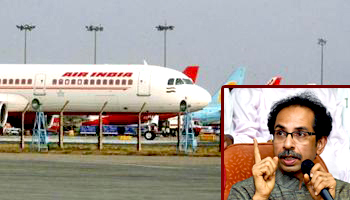
Sena hits out at BJP on Air India privatisation decision

Agencies
June 30, 2017

Mumbai, Jun 30: NDA ally Shiv Sena today came down heavily on the Centre over its decision to privatise national carrier Air India, saying had such a decision been taken by the previous Congress-led UPA government, the BJP would not have spared it.airindia

It also asked the finance minister to spell out the reasons which made the 'Maharaja' (the Air India's characteristic logo) a "beggar."

The Sena's taunt comes two days after Finance Minister Arun Jaitley said the Cabinet has given "in-principle" approval for the disinvestment of Air India.

The Civil Aviation Ministry is charting out the disinvestment of the debt-laden carrier.

"Had this decision been taken by the previous government, the BJP would have exposed the Congress in public. The BJP would have asked how can a government that cannot run an airline, run the nation," the Sena said in an editorial in party mouthpiece 'Saamana'.

"But the BJP today has indulged in the sale of the national carrier," it noted.

The Sena also sought to know from Jaitley the reasons for Air India's downfall and losses in the last few years, and those responsible for it.

The airline earlier had a local market share of about 35 per cent which has gone down to a mere 16 per cent. This happened as many routes were sold off to private companies by the Civil Aviation Ministry, the Sena claimed.

"This is corruption. If done during the Congress regime, the Modi dispensation had a chance to undo the damage. Why did they not do it?" it asked.

"Today the airline is being sold off as it has a debt of Rs 50,000 crore. Tomorrow the government will say they are unable to provide for the security cost of Kashmir valley and will thus auction it. They cannot be trusted," the Sena claimed.

Surviving on taxpayers' money, Air India has been in the red for long and various proposals, including government think tank Niti Aayog's suggestion for complete privatisation, have been made.

The airline has a debt of more than Rs 52,000 crore and is surviving on a Rs 30,000-crore bailout package extended by the previous UPA government in 2012.

Comments

Yaseen Baig
 - 
Friday, 30 Jun 2017

This government is selling one by one, now what is left!

Add new comment

  • Coastaldigest.com reserves the right to delete or block any comments.
  • Coastaldigset.com is not responsible for its readers’ comments.
  • Comments that are abusive, incendiary or irrelevant are strictly prohibited.
  • Please use a genuine email ID and provide your name to avoid reject.
Agencies
May 27,2020

Lucknow, May 27: Uttar Pradesh chief minister Yogi Adityanath has taken a U-turn, two days after he declared that permission would be needed if other states employ workers from UP.

The issue sparked a major controversy and an official spokesman has now said that the government would not include this clause of 'prior permission' in the bye-laws of the Migration Commission.

The government spokesman also said it was working on modalities to set up the commission to provide jobs and social security to migrant workers returning to the state. It has named the migration commission as the "Shramik Kalyan Aayog (Workers welfare commission).

About 26 lakh migrants have already returned to the state and an exercise to map their skills is being carried out to help them get jobs.

Yogi Adityanath has discussed the modalities for setting up the commission and told his officers to complete the skill mapping exercise in 15 days.

A senior official of Team 11, said, "The chief minister discussed the modalities for setting up the commission, as well. There will be no provision requiring other states to seek UP government's prior permission for employing our manpower. The commission is being set up to provide jobs and social security to the workers. We will also link the migrants to the government schemes to provide them houses and loans etc."

Yogi Adityanath said a letter should be sent to all state governments to find out about migrant workers wanting to come back to Uttar Pradesh.

Earlier, the chief minister, while speaking at a webinar on Sunday, had said, "The migration commission will work in the interest of migrant workers. If any other state wants UP's manpower, they cannot take them just like that, but will have to seek permission of the UP government. The way our migrant workers were ill-treated in other states, the UP government will take their insurance, social security in its hands now. The state government will stand by them wherever they work, whether in Uttar Pradesh, other states or other countries."

The statement had sparked a row with some political leaders and parties questioning the move.

Former Congress president Rahul Gandhi sharply criticized Adityanath's stand, saying the workers were not the chief minister's personal property.

"It is very unfortunate that the chief minister of Uttar Pradesh views India in such a way. These people are not his personal property. They are not the personal property of Uttar Pradesh. These people are Indian citizens and they have the right to decide what they want to do and they have the right to live the life they want to live," he had said.

Maharashtra Navnirman Sena chief Raj Thackeray had also taken on Adityanath and said that if UP insists on "permission" before other states can employ workers from there, "then any migrant entering Maharashtra would need to take permissions from us, from the Maharashtra state, our police force too."

Meanwhile, the government spokesman said, "The chief minister is deeply moved by the condition of migrants. They have been treated badly by other states. So, when the chief minister spoke about the need for seeking UP government's permission, he did so as a guardian for workers. It's only his concern for the migrants that came out as a political statement."

Comments

Add new comment

  • Coastaldigest.com reserves the right to delete or block any comments.
  • Coastaldigset.com is not responsible for its readers’ comments.
  • Comments that are abusive, incendiary or irrelevant are strictly prohibited.
  • Please use a genuine email ID and provide your name to avoid reject.
News Network
April 12,2020

Hyderabad, Apr 12: Indicating that prolonged lockdown to contain coronavirus spread may lead to job cuts in the Indian IT industry, NASSCOM former president R Chandrashekhar has said that the work-from-home culture may become a positive development in the long run as it opens up newer avenues and save investments by IT firms.

The former bureaucrat also said startups which are surviving on funds infused by venture capitalists may face tougher situations if the present scenario deteriorates.

"The larger companies may not be actually cutting jobs for two reasons. One is that they do not want to lose their employees and they have money to pay. Many of them ( big companies), even if they do shed some jobs it might be at the most people who are on temporary or intern type and all. But they would not want regular and permanent employees to go. So as long as they have sufficient flexibility in their books, they would continue," said NASSCOM former president.

"But beyond a point that it goes on, for let us say, two months or three months, then even for them, they will feel the pressure. They may not just keep on providing subsidies to the employees. So the key question will be how long that goes on," Chandrasekhar said.

He also said the work-from-home systems being adopted by several firms across the globe, including India, may have a negative impact on the industry in the short-term, but in the long run it would change the work culture which hitherto was not experienced by many of the IT firms in India.

 On impact of the prolonged lockdown on startups, he said it would be a big challenge for the budding enterprises as the investments they get are based on their ideas and future revenues and the present situation under which peoples movement is curbed may shackle their progress.

 "Where will they (startups) get money to pay salaries to their employees. Venture capital investors would not pay the money or invest their money to pay salaries because they are not in the charity business."

If the employees are not paid and if they leave and it is difficult for the startup againto come up. So the whole investment plan goes for a toss, he said.

Former chairman of NASSCOM, B V R Mohan Reddy said a clear picture as to what is going to happen has not yet emerged as the situation with all respects is still evolving. Reddy said there will be a demand shrinkage for the IT industry as the entire world is under stress. "There is no economy in this world that is going to do well in this situation.

So, therefore, there will be a demand shrinkage, he said, indicating tougher times of the industry ahead.

Comments

Add new comment

  • Coastaldigest.com reserves the right to delete or block any comments.
  • Coastaldigset.com is not responsible for its readers’ comments.
  • Comments that are abusive, incendiary or irrelevant are strictly prohibited.
  • Please use a genuine email ID and provide your name to avoid reject.
News Network
January 23,2020

Mumbai, Jan 23: Rashmi Sahijwala never expected to start working at the age of 59, let alone join India’s gig economy—now she is part of an army of housewives turning their homes into “cloud kitchens” to feed time-starved millennials.

Asia’s third-largest economy is battling a slowdown so sharp it is creating a drag on global growth, the International Monetary Fund said Monday, but there are some bright spots.

The gig economy, aided by cheap mobile data and abundant labour, has flourished in India, opening up new markets across the vast nation.

Although Indian women have long battled for access to education and employment opportunities, the biggest hurdle for many is convincing conservative families to let them leave home.

But new apps like Curryful, Homefoodi, and Nanighar are tapping the skills of housewives to slice, dice and prepare meals for hungry urbanites from the comfort of their homes.

The so-called cloud kitchens—restaurants that have no physical presence and a delivery-only model—are rising in popularity as there is a boom in food delivery apps such as Swiggy and Zomato.

“We want to be the Uber of home-cooked food,” said Ben Mathew, who launched Curryful in 2018, convinced that housewives were a huge untapped resource.

His company—which employs five people for the app’s daily operations—works with 52 women and three men, and the 31-year-old web entrepreneur hopes to get one million female chefs on-board by 2022.

“We usually train them in processes of sanitisation, cooking, prep time and packaging... and then launch them on the platform,” Mathew told news agency.

One of the first housewives to join Curryful in November 2018 shortly after its launch, Sahijwala was initially apprehensive, despite having four decades of experience in the kitchen.

But backed by her children, including her son who gave her regular feedback about her proposed dishes, she took the plunge.

Since then, she’s undergone a crash course in how to run a business, from creating weekly menus to buying supplies from wholesale markets to cut costs.

The learning curve was steep and Sahijwala switched from cooking everything from scratch to preparing curries and batters for breads in advance to save time and limit leftovers.

She even bought a massive freezer to store fruits and vegetables despite her husband’s reservations about the cost.

“I told him that I am a professional now,” she told news agency.

‘Internet restaurants’

Kallol Banerjee, co-founder of Rebel Foods which runs 301 cloud kitchens backing up 2,200 “internet restaurants”, was among the first entrepreneurs to embrace the concept in 2012.

“We could do more brands from one kitchen and cater to different customer requirements at multiple price points,” Banerjee told AFP.

The chefs buy the ingredients, supply the cookware and pay the utility bills.

The apps—which make their money through charging commission, such as more than 18 percent per order for Curryful—offer training and supply the chefs with containers and bags to pack the food in.

Curryful chef Chand Vyas, 55, spent years trying to set up a lunch delivery business but finally gave up after failing to compete with dabbawalas, Mumbai’s famously efficient food porters.

Today Vyas works seven hours a day, five days a week in her kitchen, serving up a bevy of Indian vegetarian staples, from street food favourites to lentils and rice according to the app’s weekly set menus.

“I don’t understand marketing or how to run a business but I know how to cook. So, the current partnership helps me focus on just that while Curryful takes care of the rest,” Vyas told AFP.

She pockets up to $150 (Rs 10,000 approx) a month after accounting for the commissions and costs, but hopes to earn more as the orders increase.

In contrast, a chef at a bricks-and-mortar restaurant takes home a monthly wage of between $300 (Rs 20,000 approx) and $1,000 (Rs 70,000) approx for working six days a week.

With India’s cloud kitchen sector expected to reach $1.05 billion by 2023, according to data platform Inc42, other companies are also keen to get a slice of the action.

Swiggy, for example, has invested 2.5 billion rupees ($35.3 million) in opening 1,000 cloud kitchens across the nation.

Back in her Mumbai kitchen, Sahijwala is elated to have embarked on a career at an age when her contemporaries are eyeing retirement.

Over the past year, she has seen her profit grow to $200 (Rs 15,000 approx) a month, but more importantly, she said, “My passion has finally found an outlet.

“I am just glad life has given me this chance.”

Comments

Add new comment

  • Coastaldigest.com reserves the right to delete or block any comments.
  • Coastaldigset.com is not responsible for its readers’ comments.
  • Comments that are abusive, incendiary or irrelevant are strictly prohibited.
  • Please use a genuine email ID and provide your name to avoid reject.