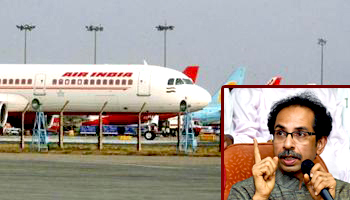
Sena hits out at BJP on Air India privatisation decision

Agencies
June 30, 2017

Mumbai, Jun 30: NDA ally Shiv Sena today came down heavily on the Centre over its decision to privatise national carrier Air India, saying had such a decision been taken by the previous Congress-led UPA government, the BJP would not have spared it.airindia

It also asked the finance minister to spell out the reasons which made the 'Maharaja' (the Air India's characteristic logo) a "beggar."

The Sena's taunt comes two days after Finance Minister Arun Jaitley said the Cabinet has given "in-principle" approval for the disinvestment of Air India.

The Civil Aviation Ministry is charting out the disinvestment of the debt-laden carrier.

"Had this decision been taken by the previous government, the BJP would have exposed the Congress in public. The BJP would have asked how can a government that cannot run an airline, run the nation," the Sena said in an editorial in party mouthpiece 'Saamana'.

"But the BJP today has indulged in the sale of the national carrier," it noted.

The Sena also sought to know from Jaitley the reasons for Air India's downfall and losses in the last few years, and those responsible for it.

The airline earlier had a local market share of about 35 per cent which has gone down to a mere 16 per cent. This happened as many routes were sold off to private companies by the Civil Aviation Ministry, the Sena claimed.

"This is corruption. If done during the Congress regime, the Modi dispensation had a chance to undo the damage. Why did they not do it?" it asked.

"Today the airline is being sold off as it has a debt of Rs 50,000 crore. Tomorrow the government will say they are unable to provide for the security cost of Kashmir valley and will thus auction it. They cannot be trusted," the Sena claimed.

Surviving on taxpayers' money, Air India has been in the red for long and various proposals, including government think tank Niti Aayog's suggestion for complete privatisation, have been made.

The airline has a debt of more than Rs 52,000 crore and is surviving on a Rs 30,000-crore bailout package extended by the previous UPA government in 2012.

Comments

Yaseen Baig
 - 
Friday, 30 Jun 2017

This government is selling one by one, now what is left!

Add new comment

  • Coastaldigest.com reserves the right to delete or block any comments.
  • Coastaldigset.com is not responsible for its readers’ comments.
  • Comments that are abusive, incendiary or irrelevant are strictly prohibited.
  • Please use a genuine email ID and provide your name to avoid reject.
News Network
April 5,2020

New Delhi, Apr 5: Joining efforts to fight COVID-19, the Defence Research and Development Organisation (DRDO) has designed a full-body disinfection chamber and a special face protection mask for healthcare professionals, officials said.

The special chamber called 'PSE' has been designed by Vehicle Research Development Establishment (VRDE), Ahmednagar, a DRDO Laboratory.

The walk through enclosure is designed for personnel decontamination, one person at a time. It is a portable system equipped with sanitiser and soap dispenser, officials said.

The decontamination is started using a foot pedal at the entry. On entering the chamber, electrically-operated pump creates a disinfectant mist of hypo sodium chloride for disinfecting, the DRDO said in a statement.

The mist spray is calibrated for an operation of 25 seconds and stops automatically indicating completion of operation. As per procedure, personnel undergoing disinfection will need to keep their eyes closed while inside the chamber, it said.

The system consists of roof mounted and bottom tanks with a total of 700 litres capacity. Approximately 650 personnel can pass through the chamber for disinfection until the refill is required, the DRDO said.

The system has see-through glass panels on side walls for monitoring purpose and is fitted with lights for illumination during night-time operations, it added.

This system can be used for disinfection of personnel at the areas of controlled ingress and egress such as entry and exit to hospitals, malls, office buildings and critical installations, officials said.

Also, Research Centre Imarat (RCI), Hyderabad, and Terminal Ballistics Research Laboratory (TBRL), Chandigarh, have developed face protection mask for healthcare professionals handling COVID-19 patients, the DRDO added.

Its light weight construction makes it convenient for comfortable wear for long duration. This design uses commonly available A4 size Over-Head Projection (OHP) film for face protection, it said.

One thousand face shields are being produced daily in TBRL and provided to Postgraduate Institute of Medical Education and Research (PGIMER), Chandigarh, it said.

Similarly, 100 are produced at RCI and these have been handed over to Employees' State Insurance Corporation (ESIC), Hyderabad. A demand of 10,000 shields has been received from PGIMER and ESIC hospitals based on successful user trials, the DRDO added.

Comments

Add new comment

  • Coastaldigest.com reserves the right to delete or block any comments.
  • Coastaldigset.com is not responsible for its readers’ comments.
  • Comments that are abusive, incendiary or irrelevant are strictly prohibited.
  • Please use a genuine email ID and provide your name to avoid reject.
News Network
January 1,2020

Jan 1: The ban on the practice of instant triple talaq, making it a penal offence and the increase in the strength of Supreme Court judges were two of the major achievements of the law ministry in 2019.

In July, Parliament gave its nod to The Muslim Women (Protection of Rights on Marriage) Bill, 2019. The new law makes talaq-e-biddat or any other similar form of talaq having the effect of instantaneous and irrevocable divorce pronounced by a Muslim husband void and illegal.

It makes it illegal to pronounce talaq three times in spoken, written or through SMS or WhatsApp or any other electronic chat in one sitting.

According to the new law, any Muslim who pronounces the illegal form of talaq upon his wife shall be punished with imprisonment for a term which may extend to three years, and shall also be liable to fine.

During the year, four new judges were appointed to the Supreme Court in September, taking its strength to 34, the highest-ever.

However, vacancies in high courts and lower courts are on the rise and convincing state governments and the 25 high courts to come on board to create an all-India judicial service to recruit judges for the subordinate courts tops the agenda of the Law Ministry in 2020.

Besides creating a consensus on setting up the All-India Judicial Services, the ministry will also have to focus on filling up vacancies in the high court. On an average, the vacancies stood at 400 throughout this year.

With more than 5,000 positions of judicial officers in district and subordinate courts lying vacant, the Law Ministry has pitched for setting up all-India judicial services.

The sanctioned strength of the judicial officers in district and subordinate courts was 22,644. The number of judicial officers in position and vacant posts is 17,509 and 5,135, respectively.

The government has proposed that while states and high courts can recruit judicial officers, the Union Public Service Commission (UPSC) can hold pan-India entrance tests.

The ministry has made it clear that such services would not encroach on the powers of the states.

As of now, the selection and appointment of judges in subordinate courts is the responsibility of the high courts and state governments concerned.

The Narendra Modi government has given a fresh push to the long-pending proposal to set up the new service to have a separate cadre for the lower judiciary in the country.

But there is a divergence of opinion among state governments and respective high courts on the constitution of the All India Judicial Service (AIJS).

One of the problems cited is that since several states have used powers under Code of Criminal Procedure (CrPC) and Code of Civil Procedure (CPC) to declare that the local language would be used in lower courts even for writing orders, a person say selected from Tamil Nadu may find it difficult to hold proceedings in states like Uttar Pradesh and Bihar.

The other point of opposition is that an all India service may hamper the career progression of state judicial services officers.

Another key issue the ministry has to handle in 2020 is vacancies in the 25 high courts.

Throughout 2019, on an average, the high courts faced a shortage of 400 judges.

According to Law Ministry data, as on September 1, the high courts had 414 vacant positions as compared to the sanctioned strength of 1,079 judges. The figure was 409 in August and 403 in July, as per the data.

A three-member Supreme Court collegium recommends the names of candidates for appointment as high court judges. In case of appointments to the Supreme Court, the collegium consists of five top judges of the top court.

High court collegiums shortlist candidates for their respective high courts and send the names to the law ministry.

The ministry, along with background check reports by the Intelligence Bureau, forwards it to the Supreme Court collegium for a final call.

The government has maintained that appointment of judges in the high courts is a "continuous collaborative process" between the Executive and the Judiciary, as it requires consultation and approval from various Constitutional authorities.

Vacancies keep arising on account of retirement, resignation or elevation of judges and increase in judges' strength. In June last year, the vacancy position stood at 399, while it was 396 in May.

In April, 399 posts of judges were vacant, while the figure was 394 in March. The vacancy position in February stood at 400 and in January, it was 392, according to the data collated by the Department of Justice.

Over 43 lakh cases are pending in the 25 high courts.

Another priority would be the finalisation of the memorandum of the procedure to guide the appointment and transfer of the Supreme Court and high court judges. The issue had now been pending for over two years now with the SC collegium and the government failing to reach a consensus.

Successive governments have also been working on making India a hub of international arbitration. It has taken several steps to change laws dealing with commercial disputes.


Comments

Add new comment

  • Coastaldigest.com reserves the right to delete or block any comments.
  • Coastaldigset.com is not responsible for its readers’ comments.
  • Comments that are abusive, incendiary or irrelevant are strictly prohibited.
  • Please use a genuine email ID and provide your name to avoid reject.
News Network
May 21,2020

New Delhi, May 21: As many as 5,609 new COVID-19 cases were reported in India in the last 24 hours, taking the total number of cases in the country to 1,12,359 according to the Union Ministry of Health and Family Welfare.

Out of the total cases, 63,624 are active cases, 45,300 patients have been cured/discharged or have migrated and 3,435 deaths have been reported.

With 39,297 cases in total, Maharashtra remains the worst affected state in the country, followed by Tamil Nadu (13,191 cases), Gujarat (12,537 cases), and Delhi (11,088 cases).

The nationwide lockdown imposed as a precautionary measure to contain the spread of coronavirus has been extended till May 31.

Comments

Add new comment

  • Coastaldigest.com reserves the right to delete or block any comments.
  • Coastaldigset.com is not responsible for its readers’ comments.
  • Comments that are abusive, incendiary or irrelevant are strictly prohibited.
  • Please use a genuine email ID and provide your name to avoid reject.