


Sena hits out at BJP on Air India privatisation decision

Agencies
June 30, 2017

Mumbai, Jun 30: NDA ally Shiv Sena today came down heavily on the Centre over its decision to privatise national carrier Air India, saying had such a decision been taken by the previous Congress-led UPA government, the BJP would not have spared it.airindia
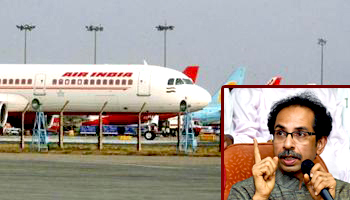
It also asked the finance minister to spell out the reasons which made the 'Maharaja' (the Air India's characteristic logo) a "beggar."

The Sena's taunt comes two days after Finance Minister Arun Jaitley said the Cabinet has given "in-principle" approval for the disinvestment of Air India.

The Civil Aviation Ministry is charting out the disinvestment of the debt-laden carrier.

"Had this decision been taken by the previous government, the BJP would have exposed the Congress in public. The BJP would have asked how can a government that cannot run an airline, run the nation," the Sena said in an editorial in party mouthpiece 'Saamana'.

"But the BJP today has indulged in the sale of the national carrier," it noted.

The Sena also sought to know from Jaitley the reasons for Air India's downfall and losses in the last few years, and those responsible for it.

The airline earlier had a local market share of about 35 per cent which has gone down to a mere 16 per cent. This happened as many routes were sold off to private companies by the Civil Aviation Ministry, the Sena claimed.

"This is corruption. If done during the Congress regime, the Modi dispensation had a chance to undo the damage. Why did they not do it?" it asked.

"Today the airline is being sold off as it has a debt of Rs 50,000 crore. Tomorrow the government will say they are unable to provide for the security cost of Kashmir valley and will thus auction it. They cannot be trusted," the Sena claimed.

Surviving on taxpayers' money, Air India has been in the red for long and various proposals, including government think tank Niti Aayog's suggestion for complete privatisation, have been made.

The airline has a debt of more than Rs 52,000 crore and is surviving on a Rs 30,000-crore bailout package extended by the previous UPA government in 2012.

Comments

Yaseen Baig
 - 
Friday, 30 Jun 2017

This government is selling one by one, now what is left!

Add new comment

  • Coastaldigest.com reserves the right to delete or block any comments.
  • Coastaldigset.com is not responsible for its readers’ comments.
  • Comments that are abusive, incendiary or irrelevant are strictly prohibited.
  • Please use a genuine email ID and provide your name to avoid reject.
News Network
January 14,2020

New Delhi, Jan 14: The curative petitions of Vinay Sharma and Mukesh, who were sentenced to death in the Nirbhaya gang rape and murder case, was on Tuesday rejected by a five-judge Supreme Court Bench led by Justice N.V. Ramana.

In a three-page order, the Bench concluded, after an in chamber consideration that began about 1.45 p.m., that there was no merit in their pleas to spare them from the gallows.

“We have gone through the curative petitions and relevant documents. In our opinion, no case is made out within the parameters indicated in the decision of this Court in Rupa Ashok Hurra versus Ashok Hurra. Hence, the curative petitions are dismissed,” the court held.

Curative is a rare remedy devised by a Constitution Bench of the Supreme Court in its judgment in the Rupa Ashok Hurra case in 2002. A party can take only two limited grounds in a curative petition - one, he was not heard by the court before the adverse judgment was passed, and two, the judge was biased. A curative plea, which follows the dismissal of review petition, is the last legal avenue open for convicts in the Supreme Court. Sharma was the first among the four convicts to file a curative.

The Bench also rejected their pleas to stay the execution of their death sentence and for oral hearing in open court.

Besides Justice Ramana, the Bench comprised Arun Mishra, Rohinton Nariman, R. Banumathi and Ashok Bhushan.

Curative petitions were filed in the Supreme Court by both convicts on January 9. The petitions had come just days after a Delhi sessions court schedulled the execution of all the four convicts in Tihar jail on January 22.

Sharma and Mukesh, in separate curative petitions, argued that there was a “sea change” in the death penalty jurisprudence since their convictions. Carrying out the death sentence on such changed circumstances would be a “gross miscarriage of justice”.

In his plea, Sharma said the Court had commuted the death penalty in several rape and murder cases since 2017, when it first confirmed the death penalty to the Nirbhaya convicts.

“fter the pronouncement of judgment in 2017, there have been as many as 17 cases involving rape and murder in which various three-judge Benches of the Supreme Court have commuted the sentence of death,” the petition contended.

The Supreme Court recently dismissed a review petition filed by Akshay Singh, another of the four four condemned men, to review its May 5, 2017 judgment confirming the death penalty. It also refused his plea to grant him three weeks' time to file a mercy petition before the President of India.

A Bench led by Justice R. Banumathi had said it was open for the Nirbhaya case convicts to avail whatever time the law prescribes for the purpose of filing a mercy plea.

Akshay (33), Mukesh (30), Pawan Gupta (23) and Sharma (24) had brutally gang-raped a 23-year-old paramedical student in a moving bus on the intervening night of December 16-17, 2012. She died of her injuries a few days later.

The case shocked the nation and led to the tightening of anti-rape laws. Rape, especially gang rape, is now a capital crime.

One of the accused in the case, Ram Singh, allegedly committed suicide in the Tihar jail. A juvenile, who was among the accused, was convicted by a juvenile justice board. He was released from a reformation home after serving a three-year term.

Comments

Add new comment

  • Coastaldigest.com reserves the right to delete or block any comments.
  • Coastaldigset.com is not responsible for its readers’ comments.
  • Comments that are abusive, incendiary or irrelevant are strictly prohibited.
  • Please use a genuine email ID and provide your name to avoid reject.
Agencies
May 14,2020

New Delhi, May 14: India may witness the death of additional 1.2-6 lakh children over the next one year from preventable causes as a consequence to the disruption in regular health services due to the COVID-19 pandemic, UNICEF has warned.

The warning comes from a new study that brackets India with nine other nations from Asia and Africa that could potentially have the largest number of additional child deaths as a consequence to the pandemic.

These potential child deaths will be in addition to the 2.5 million children who already die before their fifth birthday every six months in the 118 countries included in the study.

The estimate is based on an analysis by researchers from the Johns Hopkins Bloomberg School of Public Health published in the Lancet.  

This means the global mortality rate of children dying before their fifth birthday, one of the key progress indicators in all of the global development, could potentially increase for the first time since 1960 when the data was first collected.

There were 1.04 million under-5 deaths in India in 2017, of which nearly 50% (0.57 million) were neonatal deaths. The highest number of under-5 deaths was in Uttar Pradesh (312,800 which included 165,800 neonatal deaths) and Bihar (141,500 which included 75,300 neonatal deaths).

The researchers looked at three scenarios, factoring in parameters like reduction in workforce, supplies and access to healthcare for services like family planning, antenatal care, childbirth care, postnatal care, vaccination and preventive care for early childhood. The effects are modelled for a period of three months, six months and 12 months.  

In scenario-1 marked by 10-18% reduction of coverage of all the services, the number of additional children deaths could be in the range of 30,000 plus over three months, more than 60,000 over six months and above 120,000 over the next 12 months.

Coronavirus India update: State-wise total number of confirmed cases, deaths on May 13

The numbers sharply rose to nearly 55,000; 109,000 and 219,000 respectively for scenario-2, which was associated with an 18-28% drop in all the regular services.

But in the worst-case scenario in which 40-50% of the services are not available, the number of additional deaths ballooned to 1.5 lakhs in the three months in the short-range to nearly six lakhs over a year.

The ten countries that could potentially have the largest number of additional child deaths are Bangladesh, Brazil, Congo, Ethiopia, India, Indonesia, Nigeria, Pakistan, Uganda and Tanzania.

In countries with already weak health systems, COVID-19 is causing disruptions in medical supply chains and straining financial and human resources.

Visits to health care centres are declining due to lockdowns, curfews and transport disruptions, and due to the fear of infection among the communities. Such disruptions could result in potentially devastating increases in maternal and child deaths, the UN agency warned.

Comments

Add new comment

  • Coastaldigest.com reserves the right to delete or block any comments.
  • Coastaldigset.com is not responsible for its readers’ comments.
  • Comments that are abusive, incendiary or irrelevant are strictly prohibited.
  • Please use a genuine email ID and provide your name to avoid reject.
Agencies
May 30,2020

New Delhi, May 30: The COVID-19 pandemic has left the Indian private healthcare sector in acute financial distress, a new survey said on Friday adding that the healthcare facilities in the country have witnessed at least 80 per cent fall in average revenue.

Post the lockdown from March 24, Indian hospitals have seen a large impact, especially among small and medium-sized hospitals, which are now facing existential challenges.

The survey by healthcare industry body NATHEALTH was conducted in 251 healthcare facilities across nine states and 69 cities to assess the impact of COVID-19 on the domestic healthcare industry.

The findings showed that 90 per cent of the surveyed healthcare facilities are facing financial challenges with 21 per cent facilities facing an existential threat.

"There is a need for a stimulus package to revive the Indian healthcare industry which will be crucial to provide much-needed relief to the healthcare sector which is the frontline defence in this fight against COVID-19," said Dr Sudarshan Ballal, President NATHEALTH.

According to the survey, hospitals in tier 1 and tier 2 cities are experiencing a 78 per cent reduction in OPD footfalls, and a drop of 79 per cent in in-patient admissions.

The study found that 90 per cent of organisations require some form of financial assistance.

The findings indicated that even after the lockdown lift, the situation will remain difficult for the hospitals and nursing homes as patients will hesitate from visiting hospitals.

Comments

Add new comment

  • Coastaldigest.com reserves the right to delete or block any comments.
  • Coastaldigset.com is not responsible for its readers’ comments.
  • Comments that are abusive, incendiary or irrelevant are strictly prohibited.
  • Please use a genuine email ID and provide your name to avoid reject.