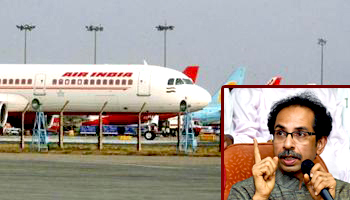
Sena hits out at BJP on Air India privatisation decision

Agencies
June 30, 2017

Mumbai, Jun 30: NDA ally Shiv Sena today came down heavily on the Centre over its decision to privatise national carrier Air India, saying had such a decision been taken by the previous Congress-led UPA government, the BJP would not have spared it.airindia

It also asked the finance minister to spell out the reasons which made the 'Maharaja' (the Air India's characteristic logo) a "beggar."

The Sena's taunt comes two days after Finance Minister Arun Jaitley said the Cabinet has given "in-principle" approval for the disinvestment of Air India.

The Civil Aviation Ministry is charting out the disinvestment of the debt-laden carrier.

"Had this decision been taken by the previous government, the BJP would have exposed the Congress in public. The BJP would have asked how can a government that cannot run an airline, run the nation," the Sena said in an editorial in party mouthpiece 'Saamana'.

"But the BJP today has indulged in the sale of the national carrier," it noted.

The Sena also sought to know from Jaitley the reasons for Air India's downfall and losses in the last few years, and those responsible for it.

The airline earlier had a local market share of about 35 per cent which has gone down to a mere 16 per cent. This happened as many routes were sold off to private companies by the Civil Aviation Ministry, the Sena claimed.

"This is corruption. If done during the Congress regime, the Modi dispensation had a chance to undo the damage. Why did they not do it?" it asked.

"Today the airline is being sold off as it has a debt of Rs 50,000 crore. Tomorrow the government will say they are unable to provide for the security cost of Kashmir valley and will thus auction it. They cannot be trusted," the Sena claimed.

Surviving on taxpayers' money, Air India has been in the red for long and various proposals, including government think tank Niti Aayog's suggestion for complete privatisation, have been made.

The airline has a debt of more than Rs 52,000 crore and is surviving on a Rs 30,000-crore bailout package extended by the previous UPA government in 2012.

Comments

Yaseen Baig
 - 
Friday, 30 Jun 2017

This government is selling one by one, now what is left!

Add new comment

  • Coastaldigest.com reserves the right to delete or block any comments.
  • Coastaldigset.com is not responsible for its readers’ comments.
  • Comments that are abusive, incendiary or irrelevant are strictly prohibited.
  • Please use a genuine email ID and provide your name to avoid reject.
News Network
May 28,2020

May 28: Abdul Kareem was forced out of school and into a life of odd jobs like repairing bicycles before he finally managed to pull his family out of abject poverty transporting goods across Delhi in a mini truck.

The job, and the slim financial security that came with it, was the first stepping stone to a better life.

All that is now gone as India reels under the economic impact of its protracted coronavirus lockdown. Mr Kareem's out of a job and stranded in his village in Uttar Pradesh with his wife and two children. Their minuscule savings from his Rs 9,000 a month job have been exhausted, and the money he saved for books and school uniforms is spent.

"I don't know what the job situation will be in Delhi once we go back," Mr Kareem said. "We can't stay hungry so I will do whatever I find."

At least 49 million people across the world are expected to plunge into "extreme poverty" -- those living on less than $1.90 per day -- as a direct result of the pandemic's economic destruction and India leads that projection, with the World Bank estimating some 12 million of its citizens will be pushed to the very margins this year.

Some 122 million Indians were forced out of jobs last month alone, according to estimates from the Center for Monitoring Indian Economy, a private sector think tank. Daily wage workers and those employed by small businesses have taken the worst hit. These include hawkers, roadside vendors, workers employed in the construction industry and many who eke out a living by pushing handcarts and rickshaws.

For Prime Minister Narendra Modi, who came to power in 2014 promising to lift the poorest citizens out of poverty, the fallout from the lockdown brings with it significant political risk. He won an even larger second term majority last year on the strength of his government's popular social programs that directly targeted the poor, such as the provision of cooking gas cylinders, power and public housing. The breadth and depth of this renewed economic pain will only increase the pressure on his government as it works to steer the country's economy back on track.

"Much of the Indian government's efforts to mitigate poverty over the years could be negated in a matter of just a few months," said Ashwajit Singh, managing director of IPE Global, a development sector consultancy that advises several multinational aid agencies. Noting that he did not expect unemployment rates to improve this year, Singh said: "More people could die from hunger than the virus."

Desperate Times

Mr Singh points to a United Nations University study estimating 104 million Indians could fall below the World Bank-determined poverty line of $3.2 a day for lower-middle-income countries. This will take the proportion of people living in poverty from 60% -- or 812 million currently, to 68% or 920 million -- a situation last seen in the country more than a decade ago, he said.

A World Bank report found the country had been making significant progress and was close to losing its status as the country with the most poor citizens. The impact of PM Modi's lockdown risks reversing those gains.

The World Bank and the CMIE estimates were published in late April and early May respectively. Since then the situation has only become grimmer, with harrowing images of people making desperate attempts to reach their villages, on crowded buses, the flatbeds of trucks and even on foot or on bicycles dominating media coverage.

The Rustandy Center for Social Sector Innovation at the University of Chicago Booth School of Business analyzed the unemployment data from the CMIE, collected through surveys covering about 5,800 homes across 27 states in April.

Researchers found rural areas were the hardest hit, and the economic misery was the result of the lockdown, rather than the spread of infections in the hinterland. More than 80% of households had experienced a drop income and many won't survive much longer without aid, they wrote in a report.

The government has promised cheap credit to farmers, direct transfer of money to the poor and eased access to food security programs -- but these help people who have some documentation, which many of the poorest don't. With millions of impoverished people now in transit across the country, the food security situation is dire -- news reports are emerging of people foraging through piles of rotting fruit or eating leaves.

Shattered Economy

The economy was already growing at its slowest pace in over a decade when the virus struck. The lockdown, which came into effect on March 25, has hammered it, stalling business activity and putting a lid on consumption, pushing the economy to what may be its first full-year contraction in more than four decades.

It's dire enough to warrant the country exiting its lockdown, as it has been doing incrementally since May 4, even as its infections are surging. India is now Asia's virus hotspot with infections crossing 151,000 according to data from Johns Hopkins University.

PM Modi, who has come under criticism for the pain inflicted on the poor, has said his government will spend $265 billion or about 10% of its GDP to help Asia's third-largest economy weather the pandemic's fallout. But experts say only a part of it is direct fiscal stimulus, and probably smaller than the total damage done to the economy during the lockdown period.

"What is especially worrying is the government's response," said Reetika Khera, an economics professor at the Indian Institute of Technology in Delhi. "The epidemic will magnify existing -- and already high -- inequalities in India."

Still, the economic measures aren't going to kick in for some time and industry will likely struggle to restart because of the flight of labour from industrial hubs.

And as the harsh summer unfolds more pain lies in store in the villages now dealing with returning migrant workers.

"There are no factories or industries here, there are just hills," said Surendra Hadia Damor, who had walked nearly 100 km from Ahmedabad, Gujarat, before a voluntary organisation drove him to his village in the neighboring state of Rajasthan. "We can survive for a month or two and then try and find a job nearby -- we will see what happens."

Comments

Add new comment

  • Coastaldigest.com reserves the right to delete or block any comments.
  • Coastaldigset.com is not responsible for its readers’ comments.
  • Comments that are abusive, incendiary or irrelevant are strictly prohibited.
  • Please use a genuine email ID and provide your name to avoid reject.
News Network
February 10,2020

New Delhi, Feb 10: Former finance minister P Chidambaram on Monday tore into the Modi government's handling of the economy, saying it was close to collapse and was been attended by "very incompetent doctors."

Initiating the debate on the Union Budget for 2020-21, he said rising unemployment and falling consumption was making India poorer.

The economy, he said, is facing demand constraints and is investment starved. The economy is facing fall in consumption and rising unemployment.

"Fear and uncertainty prevails in the country," he added.

He said the chief economic advisor to the BJP government for four years, Arvind Subramanian has stated that the economy is in the ICU. But "I would say the patient has been kept out of ICU and incompetent doctors are looking at the patient," Chidambaram said.

"It is dangerous to have a patient out of ICU and being looked upon by incompetent doctors. What is the point standing around and chanting slogan 'Sab ka saath, sab ka vishwas'," he said, adding every competent doctor the Modi government could ever identify has left the country.

His said a list of such people included former RBI governor Raghurman Rajan, former CEA Arvind Subramanian, former RBI governor Urjit Patel and former NITI Aayog vice chairman Arvind Panagariya.

"Who are your doctors, I want to know," he said, adding the government considers Congress as untouchable and doesn't think of any good about the rest of the opposition and so doesn't consult them.

Chidambaram charged that instead of putting money in the hands of people, the Modi government "put money in hands of 200 corporates" by way of corporate tax.

He said Finance Minister Nirmala Sitharaman in her 160- minute budget speech did not talk of the economy and its management.

"You are living in echo chambers. You want to hear your own voice," he said.

Listing problems with the Modi government, Chidambaram said it refuses to admits in mistakes, lives in denial and has predispositions.

The demonetisation of old 1000 and 500 rupee notes, as well as the hurried implementation of the Goods and Services Tax (GST), are "monumental blunders" that ruined the economy, he said, adding the Modi regime is predisposed to protectionism, a 'strong' rupee and is against bilateral and multilateral agreements.

"It is living in denial," he said, adding the economic growth has fallen for hereto unseen six consecutive quarters.

He wondered on the narrative Finance Minister Nirmala Sitharaman was trying to give after reading out a 160-minute budget speech with few pages left unread.

Her budget neither made any reference to the Economic Survey nor picked up a single idea from it, he said.

Chidambaram, who is credited with presenting a 'dream budget' more than two decades back, said the GDP growth has declined for six consecutive quarters, agriculture is growing by just 2 per cent, while consumer price inflation has risen from 1.9 per cent in January 2019 to 7.4 per cent in a matter of 11 months.

Also, food inflation is at 12.2 per cent. Bank credit is growing 8 per cent with non-food credit rising by 7-8 per cent and credit to industry by just 2.7 per cent. Credit to agriculture has declined from 18.3 per cent to 5.3 per cent and that for MSMEs from 6.7 per cent to 1.6 per cent.

Overall industrial index showed just 0.6 per cent growth. "Every major industry is either near zero or in negative zone," he said, adding thermal power plants are operating at just 55 per cent of the capacity as factories have either closed or are on the verge of closure.

"That gives you a good picture of the state of economy. You don't require MRI," he said. "You are in management for six years. How long can you blame previous managers."

He charged the government with burying unfavourable reports such as the labour survey that put unemployment at 45 -year high of 6.1 per cent at end of 2017-18. Also, consumer expenditure has falling to 3.7 per cent between 2011-12 and 2017-18.

Drilling holes in Budget numbers, he said the 2019-20 budget projected a nominal GDP growth of 12 per cent but ended with just 8.5 per cent. Fiscal deficit was targeted to be shrunk to 3.3 per cent of the GDP but ended by at 3.8 per cent and in the next fiscal it is being targeted at 3.5 per cent.

Revenue deficit was targeted at 2.3 per cent in fiscal ending March 31, 2020 but ended up at 2.4 per cent and in the next it will rise to 2.8 per cent, he said, adding capital expenditure in the next fiscal will shrink to 0.7 per cent from 1.4 per cent in the current.

Net tax revenue in the current fiscal was targeted at Rs 16.49 lakh crore but only Rs 9 lakh crore was collected in first nine months till December 2019 and "you want us to believe this will rise to Rs 15 lakh crore by March 2020," he said.

Similarly, expenditure in 2019-20 was pegged at Rs 27.86 lakh crore but only Rs 11.78 lakh crore spent during April- December and by March this is projected to rise to Rs 27 lakh crore.

"You have no money to spend... and these are masked by numbers," he said. "Numbers are not easily acceptable or believable."

Chidambaram said the government is facing shortfall in all forms of taxes - Rs 1.56 lakh crore on corporate tax, Rs 10,000 crore on personal income tax, Rs 30,000 crore on customs, Rs 52,000 crore on excise and Rs 51,000 crore on GST.

This despite "the extraordinary powers" and "all kinds of power" given to lower level tax officials, he said.

He read of list of heads under which allocation has fallen - food subsidy, agriculture, PM-Kisan, rural roads, mid-day meal scheme, ICDS, skill development, Ayushman Bharat, rural development and MGNEGA.


Comments

Add new comment

  • Coastaldigest.com reserves the right to delete or block any comments.
  • Coastaldigset.com is not responsible for its readers’ comments.
  • Comments that are abusive, incendiary or irrelevant are strictly prohibited.
  • Please use a genuine email ID and provide your name to avoid reject.
News Network
February 28,2020

Patna, Feb 28: Social and cultural activists from far and wide converged here on Thursday to lend their support to a massive rally that marked the conclusion of Kanhaiya Kumar's 'Jan Gan Man Yatra' across Bihar to galvanise public opinion against CAA-NPR-NRC.

Medha Patkar of the Narmada Bachao Andolan fame, Mahatma Gandhi's grandson Tushar Gandhi and former IAS officer Kannan Gopinathan, who gave up his career at a young age in protest against abrogation of Article 370, shared the stage with the former JNU students' leader.

Shabnam Hashmi -- founder of socio-cultural organisation ANHAD and sister of slain Marxist playwright and director Safdar Hashmi -- also joined them.

Congress MLA Shakil Ahmed Khan, a former president of JNU students' union himself who accompanied Kanhaiya during his tour that commenced at Champaran on January 30, Mahatma Gandhi's death anniversary, and leaders of state units of CPI and CPI(M) also addressed the rally held at Gandhi Maidan.

Kanhaiya began his speech with a one-minute silence held in the memory of those who lost their lives in Delhi violence.

Defending his frequent use of the term "azadi" (freedom) which supporters of the Sangh Parivar hold to be tantamount to supporting secession, Kanhaiya said, "We must talk about the virtues of azadi here since today happens to be the day when legendary revolutionary Chandrashekhar Azad had given up his life fighting the British."

Charging the ruling BJP with pitting Hindus against Muslims, he said, "Let us resolve to defeat their agenda by emulating the fabled friendship of Ram Prasad Bismil and Ashfaqullah Khan."

The young CPI leader, who made an unsuccessful debut from his native Begusarai Lok Sabha constituency last year, seemed unimpressed with the resolution passed by the Bihar Assembly earlier this week against NRC and inclusion of contentious clauses in NPR forms.

"Both the government and the opposition are busy congratulating themselves. I extend my congratulations as well. But to all those who are present here, I would say it is a half-victory. We must not allow our movement to fizzle out and draw inspiration from Gandhi's model of civil disobedience when the NPR exercise gets underway," he said.

"Villagers should ask their respective panchayat heads to ensure that no NPR official is allowed to come knocking in their areas of jurisdiction when NPR is scheduled to be undertaken in May," the CPI leader said.

"We have to brace for a long and tough fight. We are living under a regime which sends conscientious professionals like Dr Kafeel Ahmed behind the bars and declares anybody questioning its actions as an anti-national," said Kanhaiya, who has himself been slapped with a sedition case.

Earlier, in his address, Tushar Gandhi likened CAA, NPR and NRC to the "three bullets that killed the Mahatma" and asserted that these measures would "harm the poor, belonging to all religious communities and not just the Muslims".

"If the government does not care about the poor, we must tell those in power -- 'chale jaao' (go away) just as we had done to the British colonisers... it is going to be a long fight. Independence was achieved five years after the call for Quit India Movement," he said.

"We need to keep repeating the importance of non-violence over and over again while those with other value systems simply have to utter inciting statements," he said, in an oblique reference to the controversial poll campaign of Union minister and BJP leader Anurag Thakur during the recently-held Delhi Assembly elections, which the party lost.

Kannan Gopinathan said, "The claim that CAA is all about granting citizenship and not taking it away is bunkum. Any law which seeks to favour one section of the society on the basis of religion can be tweaked to harm another social segment... people say this government is Fascist. I am not sure of that but it is certainly stupid."

"This government brought in demonetisation and wrecked the economy but failed to achieve its promise of eradicating black money. It abrogated Article 370 and now it is clueless as to what to do with the situation in Kashmir," he said.

"Union minister Amit Shah had declared in Parliament that NRC will be implemented. Faced with public resistance, Prime Minister Narendra Modi had to say he does not know what NRC is. Keep up the stir for a little longer, he will start saying he does not know Amit Shah," said Kannan, evoking peals of laughter.

In the course of his speech, Kanhaiya also made the crowds sing after him the National Anthem but skipped a few words towards the end. Participants at the rally were viciously trolled on social media for the slip-up.

Comments

Add new comment

  • Coastaldigest.com reserves the right to delete or block any comments.
  • Coastaldigset.com is not responsible for its readers’ comments.
  • Comments that are abusive, incendiary or irrelevant are strictly prohibited.
  • Please use a genuine email ID and provide your name to avoid reject.