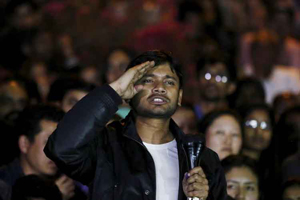
Sena hits out at BJP for 'free publicity' to Kanhaiya

March 7, 2016

Mumbai, Mar 7: In a veiled attack on the BJP for letting JNUSU President Kanhaiya Kumar get "free publicity", ally Shiv Sena today sought to know how he got bail in such a short span of time when others charged with 'sedition' are still languishing in jails.

kanhaiyyaaa"(Union Minister) Venkaiah Naidu said Kanhaiya Kumar is getting free publicity. If that is so, who is responsible for letting him get free publicity? Today, nothing comes for free," the Sena said in an edit in its mouthpiece 'Saamana'.

"A price has to be paid for even the smallest of things. Working class people, labourers who used to save money in PF, will now be taxed on their earnings. In short, the government has only shown people nothing will be given for free," it said.

It said that Hardik Patel, who led the Patel agitation demanding reservation for his community in Gujarat is still behind bars after being charged with 'sedition' and so are people like Colonel Purohit and Sadhvi Pragya.

"Then how did Kanhaiya get bail so easily? Was it that keeping him behind bars was becoming a problem for the government and that it had to answer too many questions?" the Sena asked.

"If Naidu says Kanhaiya is getting free publicity, then our system and administration is responsible for it. He has become a hero because people are announcing reward for attack on Kanhaiya," it said, referring to BJP leader Kuldeep Varshnay announcing Rs 5 lakh prize money for cutting off the tongue of Kanhaiya, who he had alleged, was speaking against BJP and PM Narendra Modi after being released on bail.

A poster announcing Rs 11 lakh prize money to anyone "shooting down" Kumar was also spotted in Delhi.

The Sena further said that the sole aim (of politicians) is to win elections and form a government.

"Promises made before elections vanish into the air and farmers, labourers, working class and students are made victims. If this continues, there would be human bombs made within the country. These youngsters will be exploited for political games," the Sena warned.

Kumar, who was arrested on February 12 on sedition charges, was released from Tihar jail on March 3 after the Delhi High Court granted him interim bail for six months.

Comments

Rikaz
 - 
Monday, 7 Mar 2016

Of course he has become a household name around the world....he simply raised his voice against PEKU....great job....

Add new comment

  • Coastaldigest.com reserves the right to delete or block any comments.
  • Coastaldigset.com is not responsible for its readers’ comments.
  • Comments that are abusive, incendiary or irrelevant are strictly prohibited.
  • Please use a genuine email ID and provide your name to avoid reject.
News Network
March 10,2020

New Delhi, Mar 10: Minutes after Jyotiraditya Scindia submitted his resignation to the party membership to Congress chief Sonia Gandhi, the Congress expelled him for anti-party activities after reports emerged that he had met PM Modi and Amit Shah.

Disgruntled Congress leader Jyotiraditya Scindia met Prime Minister Narendra Modi on Tuesday amid indications that he might join hands with the BJP to topple the Madhya Pradesh government.

Sources said Scindia first met Union Home Minister Amit Shah, and then the two leaders met Modi at the prime minister's residence.

Legislators loyal to Scindia, who has been upset with the Congress leadership with his marginalisation in the affairs of the Madhya Pradesh Congress, are likely to quit the party to reduce the Kamal Nath-led government to a minority.

It is likely to be followed by the Bharatiya Janata Party staking claim to form the government in the state.

The Congress President has approved the expulsion of Jyotiraditya Scindia from the Indian National Congress with immediate effect for "anti-party activities," said KC Venugopal, General Secretary Congress.

No person is, nor will be greater than the party: Congress youth wing chief

Indian Youth Congress (IYC) chief Srinivas B V on Tuesday slammed Jyotiraditya Scindia, who has announced his resignation from the primary membership of the Congress, and thanked party chief Sonia Gandhi for expelling the former Guna MP "who was promoting anti-party activities and factionalism".

"The history of 1857 and 1967 was once again repeated," Srinivas B V said, referring to the 1857 Revolt against East India Company and the role of the Scindia royals back then as well as Vijayaraje Scindia's switch from the Congress to the Jana Sangh in 1967.

"I would like to thank Congress president Sonia Gandhiji for taking the strong steps to expel the leader who was promoting anti-party activities and factionalism," the IYC chief said.

"No person is, nor will be greater than the party," he added.

Comments

Add new comment

  • Coastaldigest.com reserves the right to delete or block any comments.
  • Coastaldigset.com is not responsible for its readers’ comments.
  • Comments that are abusive, incendiary or irrelevant are strictly prohibited.
  • Please use a genuine email ID and provide your name to avoid reject.
News Network
January 13,2020

Jan 13: For the first time in years, the government of India’s Prime Minister Narendra Modi is playing defense. Protests have sprung up across the country against an amendment to India’s laws — which came into effect on Friday — that makes it easier for members of some religions to become citizens of India. The government claims this is simply an attempt to protect religious minorities in the Muslim-majority countries that border India; but protesters see it as the first step toward a formal repudiation of India’s constitutionally guaranteed secularism — and one that must be resisted.

Modi was re-elected prime minister last year with an enhanced majority; his hold over the country’s politics is absolute. The formal opposition is weak, discredited and disorganized. Yet, somehow, the anti-Citizenship Act protests have taken hold. No political party is behind them; they are generally arranged by student unions, neighborhood associations and the like.

Yet this aspect of their character is precisely what will worry Modi and his right-hand man, Home Minister Amit Shah. They know how to mock and delegitimize opposition parties with ruthless efficiency. Yet creating a narrative that paints large, flag-waving crowds as traitors is not quite that easy.

For that is how these protests look: large groups of young people, many carrying witty signs and the national flag. They meet and read the preamble to India’s Constitution, into which the promise of secularism was written in the 1970’s.

They carry photographs of the Constitution’s drafter, the Columbia University-trained economist and lawyer B. R. Ambedkar. These are not the mobs the government wanted. They hoped for angry Muslims rampaging through the streets of India’s cities, whom they could point to and say: “See? We must protect you from them.” But, in spite of sometimes brutal repression, the protests have largely been nonviolent.

One, in Shaheen Bagh in a Muslim-dominated sector of New Delhi, began simply as a set of local women in a square, armed with hot tea and blankets against the chill Delhi winter. It has now become the focal point of a very different sort of resistance than what the government expected. Nothing could cure the delusions of India’s Hindu middle class, trained to see India’s Muslims as dangerous threats, as effectively as a group of otherwise clearly apolitical women sipping sweet tea and sharing their fears and food with anyone who will listen.

Modi was re-elected less than a year ago; what could have changed in India since then? Not much, I suspect, in most places that voted for him and his party — particularly the vast rural hinterland of northern India. But urban India was also possibly never quite as content as electoral results suggested. India’s growth dipped below 5% in recent quarters; demand has crashed, and uncertainty about the future is widespread. Worse, the government’s response to the protests was clearly ill-judged. University campuses were attacked, in one case by the police and later by masked men almost certainly connected to the ruling party.

Protesters were harassed and detained with little cause. The courts seemed uninterested. And, slowly, anger began to grow on social media — not just on Twitter, but also on Instagram, previously the preserve of pretty bowls of salad. Instagram is the one social medium over which Modi’s party does not have a stranglehold; and it is where these protests, with their photogenic signs and flags, have found a natural home. As a result, people across urban India who would never previously have gone to a demonstration or a political rally have been slowly politicized.

India is, in fact, becoming more like a normal democracy. “Normal,” that is, for the 2020’s. Liberal democracies across the world are politically divided, often between more liberal urban centers and coasts, and angrier, “left-behind” hinterlands. Modi’s political secret was that he was that rare populist who could unite both the hopeful cities and the resentful countryside. Yet this once magic formula seems to have become ineffective. Five of India’s six largest cities are not ruled by Modi’s Bharatiya Janata Party in any case — the financial hub of Mumbai changed hands recently. The BJP has set its sights on winning state elections in Delhi in a few weeks. Which way the capital’s voters will go is uncertain. But that itself is revealing — last year, Modi swept all seven parliamentary seats in Delhi.

In the end, the Citizenship Amendment Act is now law, the BJP might manage to win Delhi, and the protests might die down as the days get unmanageably hot and state repression increases. But urban India has put Modi on notice. His days of being India’s unifier are over: From now on, like all the other populists, he will have to keep one eye on the streets of his country’s cities.


Comments

Add new comment

  • Coastaldigest.com reserves the right to delete or block any comments.
  • Coastaldigset.com is not responsible for its readers’ comments.
  • Comments that are abusive, incendiary or irrelevant are strictly prohibited.
  • Please use a genuine email ID and provide your name to avoid reject.
March 24,2020

New Delhi, Mar 24: Thirty-two states and Union Territories (UTs) have announced complete lockdown to check the spread of the coronavirus in the country, informed the Central government on Tuesday.
There is a complete lockdown in as many as 560 districts of the country affecting several hundred million people.
Earlier, the complete lockdown was imposed in 30 districts, as of now, almost the entire country is in lockdown to restrict public movement in an attempt to break the chain of transmission of coronavirus.
Three states -- Uttar Pradesh, Madhya Pradesh and Odisha -- have announced lockdown in select districts with the governments continuously monitoring the situation and ready to extend the restrictions to other districts as well.
The Union Territory of Lakshadweep has announced restrictions on certain activities.
The Indian Railways has suspended all passenger train operations till March 31 in view of coronavirus.

Comments

Add new comment

  • Coastaldigest.com reserves the right to delete or block any comments.
  • Coastaldigset.com is not responsible for its readers’ comments.
  • Comments that are abusive, incendiary or irrelevant are strictly prohibited.
  • Please use a genuine email ID and provide your name to avoid reject.